



惯性聚合 高效追踪和阅读你感兴趣的博客、新闻、科技资讯
阅读原文 在惯性聚合中打开

推荐订阅源

量子位
C
CXSECURITY Database RSS Feed - CXSecurity.com
Project Zero
Project Zero
O
OpenAI News
C
Cisco Blogs
Microsoft Azure Blog
Security Latest
Security Latest
T
Tor Project blog
S
SegmentFault 最新的问题
P
Privacy & Cybersecurity Law Blog
博客园 - 【当耐特】
V
Vulnerabilities – Threatpost
W
WeLiveSecurity
小众软件
小众软件
博客园 - 聂微东
Y
Y Combinator Blog
Spread Privacy
Spread Privacy
人人都是产品经理
人人都是产品经理
Know Your Adversary
Know Your Adversary
Scott Helme
Scott Helme
B
Blog RSS Feed
N
News | PayPal Newsroom
J
Java Code Geeks
T
The Blog of Author Tim Ferriss
TaoSecurity Blog
TaoSecurity Blog
D
Docker
阮一峰的网络日志
阮一峰的网络日志
NISL@THU
NISL@THU
CTFtime.org: upcoming CTF events
L
LINUX DO - 最新话题
MongoDB | Blog
MongoDB | Blog
Recorded Future
Recorded Future
Webroot Blog
Webroot Blog
L
Lohrmann on Cybersecurity
博客园 - 三生石上(FineUI控件)
雷峰网
雷峰网
让小产品的独立变现更简单 - ezindie.com
L
LangChain Blog
Cloudbric
Cloudbric
罗磊的独立博客
宝玉的分享
宝玉的分享
Jina AI
Jina AI
freeCodeCamp Programming Tutorials: Python, JavaScript, Git & More
OSCHINA 社区最新新闻
OSCHINA 社区最新新闻
N
News and Events Feed by Topic
GbyAI
GbyAI
大猫的无限游戏
大猫的无限游戏
A
About on SuperTechFans
L
LINUX DO - 热门话题
Cyber Security Advisories - MS-ISAC

Cisco Blogs

Deloitte Japan Advances Security Operations with Cisco Foundation AI’s Open-Source Model CCNP Security News Roundup: Free SDSI Training, New Duo Course Cisco AI Defense Policy Studio: Turning Unwritten Policy into Adaptive AI Guardrails From Intelligence to Action: Operationalizing MS-ISAC Threat Data Across SLED Environments Scale. Speed. Trust: Three Imperatives for the AI Era Reflecting on Cisco Live: OT security is the new IT. Are you ready? Security in the Post-Mythos Era Fusing Security and Networking: Your Fastest Path to Profitability How we built an AI foundation for Marketing Revenue Operations at Cisco Cisco SASE with Meraki: Get in the Fast Lane to SASE Powering the AI-ready branch with agentic operations and quantum-era security Voices from the field: How data strengthens livelihoods in coastal communities Cisco Customer Achievement Awards AMER 2026: Honoring Those Transforming IT From tenant-aware to job-aware: scaling shared AI clusters with Cisco Nexus One Protecting SaaS AI Agents with Cisco AI Defense and AppOmni AI Agents Need Built-In Security. Here Is How Cisco Does It AI infrastructure has entered its operational era Cisco Silicon One: Purpose-Built for Secure Networking in the Agentic AI Era Accelerating Growth for Developers with Cisco Compatible AI Solutions in the Cisco 360 Partner Program Share Your Experience: Where the Human Voice Thrives in the Age of AI Layered Defense for the Plant Floor: Simplifying OT Security Extending Zero Trust Across the Agentic AI Workflow White House AI Executive Order: Advancing Innovation & Security Streamlining Partner Procurement: Introducing the ‘Shop Cisco Refresh’ eCommerce Platform How Cisco Cloud Control Changes the Partner Motion Strengthening the Foundation: A Predictable, Customer focused Response to AI-Accelerated Vulnerability Discovery Powering resilient ecosystems | FY25 Purpose Report End-to-end AI networking: Cisco’s answer to the inferencing era Security at Cisco Live: Going Shields Up for the Agentic Era From an Idea to a Live App on Cisco, in Minutes Agent Builder in Cloud Control Studio: A new way to extend and customize Cisco Cloud Control Cisco AI Canvas is here: the workspace for agentic operations Cisco Cloud Control: The Secure Harness for the Agentic Era Identity Elevated: A New Unified Identity Experience in Cisco Cloud Control Security Needs a New Operating Model Cisco AI Defense Gets Personal with Agent Security DevNet Sandbox: Building the Future of Developer Experiences Oscar’s Insights: A Conversation on BBVA Argentina’s Network Transformation Cisco Secure Access and Microsoft Purview Integration for Simplified Data Protection Cisco Secure Access and Island Browser Enable Zero Trust Everywhere Finding what lives between the alerts: Announcing Cisco Talos Threat Hunting From Log Flood to Threat Signal: Cisco and Splunk Bring Context to Modern Defense The Skills Payload: What’s Landing at Cisco Live 2026 More efficient and functional workplaces start with smart building data Cisco Secure Access and Microsoft Edge for Business Integration Must-See Cisco U. Theater Sessions at Cisco Live 2026 Las Vegas Navigating the Future of Connected Roadways: Cisco at ITS Americas 2026 In the AI era, defense starts with the network. Here’s how Cisco is doing it. Unlock the power of scale-across with Cisco converged silicon, systems, and optics Trusted network data for end-to-end visibility with Nexus Data Broker Maximizing Managed Security Services Sales & Profitability: Part 2 of 2, A Strategic Guide to Creating New Services Explore Enterprise Networking Automation at Cisco Live US 2026 A new model for infrastructure security: How Cisco defends against AI threats From Research to Reality: Launching the 9th Annual Cisco Partner Innovation Challenge Unlocking Partner Profitability with Lifecycle Advantage APIs Why Financial Agility is the New Competitive Edge Proprietary Problems: No Frontier Model Is Multi-Turn Immune Securing campus and branch networks from boot to transport with full-stack PQC Why Network Segmentation Projects Fail: Four Patterns Accelerating Enterprise-Scale AI Development & Experimentation Cisco’s Risk-Based Vulnerability Disclosure in the Age of AI Powering Modern Data Workloads with Cisco UCS and Qumulo The Fundamentals of AI: What every curious person should know about how language models work The impact of AI on wide area network traffic: we need to talk Cisco Live 2026 Las Vegas: Explore AI and automation across the network One open NOS, any workload: SONiC on Cisco Enhancing Cisco Secure Email Gateway: Safer Clicks and Cleaner Files Cisco Partners With College Board to Launch AP Cybersecurity and Expand Career-Connected Learning Fueling “The Greatest Spectacle in Racing®” AI-generated reporting: Lessons learned from Cisco Talos Incident Response Cisco Named a Leader in the 2026 Gartner® Magic Quadrant™ for Enterprise Wired and Wireless LAN Infrastructure AI network performance with Cisco Intelligent Packet Flow Building a world-class employee experience | FY25 Purpose Report Real-World Skills for Real World Challenges: AI-Led Updates Across Cisco Certification Portfolio Learn with Cisco at Cisco Live 2026: Your Week for Skills, Certs, and What’s Next Cisco N9000 excels in EANTC 2026 VXLAN EVPN and timing tests Innovating at the Speed of Business: Announcing the Customer Achievement Awards AMER 2026 Finalists Future of Sports Analytics: Building Trust and Intelligence with SūmerSports and Cisco Accelerate Your Career and Impact with CCNA Certifications Skills-based volunteering for the AI era: Inside Cisco’s first Tech for Social Good Hackathon Cisco Live 2026: Bringing the Future of Customer Experience to Las Vegas Mission-First: Equipping the Digital Warfighter at AFCEA TechNet Cyber 2026 Edge opportunity for service providers: Turn infrastructure into new services MRC and SRv6: How Foundational Networking Innovations Are Enabling the Next Generation of AI Supercomputers The SMB Marketing Reset: Winning Customer Trust in a Digital-First Economy Inside the SOC: AI-powered DNS defense against ransomware Our Path Forward Securing the Federal Digital Experience with Cisco ThousandEyes for Government Cisco at ONUG Dallas 2026: Securing the AI Data Center in the Agentic Era Cisco and Red Hat are powering intelligent core to edge: Red Hat Summit insights Building the Capabilities That Win: How Cisco Partners Can Lead in the SMB & Mid-Market Era How Two Hours Felt Bigger Than My To-Do List Announcing Foundry Security Spec Ace the CCIE Collaboration Lab: Success Tips from a TAC Engineer Turned CCIE Protecting Agents with Cisco AI Defense and Google Agent Development Kit Powering an Inclusive Future: Your guide to the Purpose Pavilion at Cisco Live Las Vegas The Infrastructure Behind the Mission: SOF Week 2026 Cisco Networking App Marketplace Partners at Cisco Live 2026 Beyond the Pilot: Building the Clinical Data Fabric for the Agentic Era Benchmarking scale-out AI fabrics with Cisco N9000 + AMD Pensando™ Pollara 400 NICs
Quantum Resilience Needs a Common Language. Here’s Where to Start.
Christian Chisholm · 2026-06-02 · via Cisco Blogs

The Industry Is Moving. But Not Together.

In the last two years, post-quantum cryptography (PQC) has moved from a future concern to an immediate priority for governments and enterprises across the globe. The National Institute of Standards and Technology (NIST) finalized its first PQC standards in 2024. The U.S. National Security Agency (NSA) CNSA 2.0 advisory is shaping acquisition requirements for National Security Systems. The European Union (EU) has published a PQC transition roadmap. Hyperscalers are embedding PQC requirements into RFPs. Regulators on multiple continents are signaling that quantum readiness is becoming an expectation, not an option.

Unfortunately, quantum computing advances have outpaced regulators and compliance regimes. In the absence of certification programs and globally aligned standards, we see a proliferation of quantum-safe claims with little to no industry-wide coordination: some vendors focus on data in transit or quantum key distribution, others highlight platform integrity and authentication, and some make broad claims without reference to specific risks or requirements. The result is a fragmented landscape where organizations struggle to understand where they stand relative to the threat, their peers, or their vendors.

What’s missing isn’t urgency. It’s clarity.

Standards provide the foundation to build secure, scalable, and interoperable technology. However, these algorithms, protocols, and benchmarks do not, on their own, provide a shared language for measuring progress. The broader industry still lacks a common way to describe the level of quantum resilience a product or system provides – one that maps to those industry standards, can be applied consistently across vendors and architectures, and gives customers and regulators something concrete to evaluate against.

No single company can solve that alone. But Cisco has spent years working through exactly this question: engaging with standards bodies, mapping our own portfolio against the threat, and developing a structured way to think about what quantum resilience requires at each layer.

Cisco’s Quantum Resilience Framework

Cisco has developed a framework to articulate multiple levels of quantum resilience – each representing distinct capabilities designed to respond to new and emerging threats to confidential communication and product integrity.

We are sharing Cisco’s framework to support our customers and the broader industry as we grapple with multiple stages of maturity: some capabilities are available today, others are emerging, and others represent the direction customers should be planning toward as standards, certifications, and product implementations continue to evolve. Organizations need to understand the end goal while also committing to making progress today based on what is available. Each incremental level of resilience matters:

  • Level 1 provides partial defense against harvest-now-decrypt-later (HNDL) attacks, giving organizations a foundation to begin reducing threat exposure today.
  • Level 2 makes it materially harder for adversaries to harvest useful data or compromise product integrity for the coming years.
  • Level 3 defines the longer-term horizon for identity, authentication, and lifecycle trust.

Our framework is grounded in globally recognized cryptographic standards, including NIST’s post- quantum algorithms, CNSA 2.0 and EU standards where applicable. These standards provide some of the clearest high-assurance benchmarks available today.
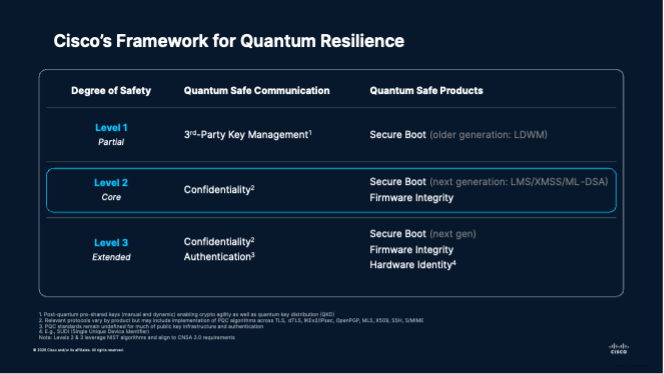
Level 1 – Partial

  • Third-party key management support, including support for Quantum Key Distribution (QKD), enables crypto agility without requiring full protocol-layer PQC.
  • Secure boot, using established hash-based signing algorithms such as LDWM.

Level 1 is a starting point and not an end state. It gives organizations a foundation as they progress toward more complete levels of quantum resilience.

Level 2 – Core

  • Confidentiality protection across relevant protocols, including TLS, DTLS, IKEv2/IPsec, MLS, SSH, and others, with support for pure PQC or hybrid approaches where applicable based on customer risk priorities and evolving standards.
  • Full PQC chain of trust, from hardware root of trust to running applications, including next-generation secure boot, using NIST-approved algorithms such as ML-DSA and LMS, plus software and firmware integrity verification aligned to CNSA 2.0.

Level 2 addresses both data-in-transit risk and the integrity of the platforms enforcing protection, while giving customers flexibility to adopt PQC in ways that reflect their security, interoperability, and compliance needs.

Level 3 – Extended

  • Confidentiality coverage across relevant protocols, plus quantum-resistant authentication and identity verification for devices, users, and systems.
  • PQC-signed Secure Unique Device Identifiers and Attestation Identity Key certificates, enabling devices to cryptographically prove their identity and demonstrate that they have not been tampered with across their lifecycle.

Level 3 extends quantum resilience into identity and attestation. This is especially critical for infrastructure with long deployment cycles, where trust established at manufacturing time must remain reliable years into the future.

Together, these levels give customers a practical way to evaluate quantum resilience. You can move beyond asking if a device is quantum safe and instead ask more precise questions about which risks it addresses, which layers it protects, and how it advances the specific level of resilience your organization requires.

From Framework to Portfolio Execution

A framework only matters if it can be operationalized. Today, we are introducing our Quantum-Safe Communications Roadmap, marking the shift from a conceptual framework to portfolio execution.

Cisco’s advantage is that we are building quantum resilience broadly across our portfolio: the network and layers of infrastructure that customers use every day. That includes Quantum-safe communications across protocols and network planes, Quantum-safe products with stronger boot integrity, software and firmware validation, and hardware-rooted trust – and the broader capabilities that help organizations understand, deploy, and manage their quantum transition.

Cisco Live 2026, Jeetu Patel announced:

  • New Quantum-safe communications advancements across Cisco’s core portfolio: With a commitment to enable quantum-safe communications capabilities across the majority of Cisco’s core portfolio by December 2026, Cisco is extending post-quantum protection to the systems where the most sensitive enterprise traffic flows. We are also publishing our roadmap for quantum-safe communications on Cisco.com.
  • Quantum-safe by default for new infrastructure. Starting today, all newly introduced campus, branch and data center routers, switches, and firewall series launch with quantum-safe secure boot.

The point is not simply that individual products are adding PQC capabilities. The bigger story is that Cisco is helping customers move toward quantum resilient infrastructure as a system, one that protects communications, strengthens product integrity, and supports the trust foundations that digital operations depend on.

The Call to Action

No company, government, or organization can solve this problem alone. We must collaborate – and that starts by defining a common set of goals and standards to align efforts and drive progress. By working together, we can realize the potential of quantum computing without sacrificing the cryptographic protections that provide the foundation for a secure and resilient future.

To learn more about Cisco’s PQC approach and track our progress, visit the Cisco Trust Center.

Note: Some products and features described are in development and offered on a when-and-if-available basis. Cisco reserves the right to change delivery timelines and will have no liability for any delays or failures to deliver. The views and standards described above are current as of the date of posting and may change over time.