


惯性聚合 高效追踪和阅读你感兴趣的博客、新闻、科技资讯
阅读原文 在惯性聚合中打开

推荐订阅源

N
News and Events Feed by Topic
WordPress大学
WordPress大学
Vercel News
Vercel News
CTFtime.org: upcoming CTF events
小众软件
小众软件
L
LangChain Blog
雷峰网
雷峰网
D
DataBreaches.Net
博客园 - 三生石上(FineUI控件)
Threat Intelligence Blog | Flashpoint
T
Tor Project blog
NISL@THU
NISL@THU
Scott Helme
Scott Helme
量子位
S
Security Affairs
T
Threat Research - Cisco Blogs
博客园_首页
云风的 BLOG
云风的 BLOG
D
Docker
AWS News Blog
AWS News Blog
腾讯CDC
博客园 - 聂微东
The GitHub Blog
The GitHub Blog
U
Unit 42
Recent Announcements
Apple Machine Learning Research
G
Google Developers Blog
T
The Exploit Database - CXSecurity.com
MongoDB | Blog
MongoDB | Blog
Stack Overflow Blog
Stack Overflow Blog
cs.AI updates on arXiv.org
L
LINUX DO - 热门话题
Cyber Security Advisories - MS-ISAC
The Last Watchdog
The Last Watchdog
C
Cybersecurity and Infrastructure Security Agency CISA
IT之家
IT之家
W
WeLiveSecurity
P
Privacy & Cybersecurity Law Blog
F
Full Disclosure
L
Lohrmann on Cybersecurity
The Hacker News
The Hacker News
Exploit-DB.com RSS Feed
Y
Y Combinator Blog
S
Security @ Cisco Blogs
C
Cyber Attacks, Cyber Crime and Cyber Security
C
Check Point Blog
C
CXSECURITY Database RSS Feed - CXSecurity.com
N
News and Events Feed by Topic
PCI Perspectives
PCI Perspectives
I
InfoQ

Cisco Blogs

Cisco Live 2026: Bringing the Future of Customer Experience to Las Vegas Edge opportunity for service providers: Turn infrastructure into new services MRC and SRv6: How Foundational Networking Innovations Are Enabling the Next Generation of AI Supercomputers The SMB Marketing Reset: Winning Customer Trust in a Digital-First Economy Inside the SOC: AI-powered DNS defense against ransomware Our Path Forward Securing the Federal Digital Experience with Cisco ThousandEyes for Government Cisco at ONUG Dallas 2026: Securing the AI Data Center in the Agentic Era Cisco and Red Hat are powering intelligent core to edge: Red Hat Summit insights Building the Capabilities That Win: How Cisco Partners Can Lead in the SMB & Mid-Market Era How Two Hours Felt Bigger Than My To-Do List Ace the CCIE Collaboration Lab: Success Tips from a TAC Engineer Turned CCIE Protecting Agents with Cisco AI Defense and Google Agent Development Kit Powering an Inclusive Future: Your guide to the Purpose Pavilion at Cisco Live Las Vegas The Infrastructure Behind the Mission: SOF Week 2026 Cisco Networking App Marketplace Partners at Cisco Live 2026 Beyond the Pilot: Building the Clinical Data Fabric for the Agentic Era Benchmarking scale-out AI fabrics with Cisco N9000 + AMD Pensando™ Pollara 400 NICs Month of Developer Productivity: Build and Forget The race to autonomous transport networks: A new study Lean IT, future-ready: How to save time and simplify wireless management with AI Reading Between the Pixels: Failure Modes in Vision Language Models Biochar’s triple win: Healthier soils, improved crops, and decarbonization Designing a Proactive Customer Journey Modernize your data center operations with Cisco Nexus Dashboard Why your automation stack needs Cisco Agentic Workflows Try Cisco AI Defense Explorer Edition in this hands-on lab From Bandwidth to Intelligence: How Cisco is Powering AI-Ready Networks Spotlight on digital transformation | FY25 Purpose Report Galaxy Mode is live: A limited-time look at what your Cisco AI Assistant and AgenticOps can already do Securing the Agentic Workforce: Cisco Announces Intent to Acquire Astrix Security Understanding CISA BOD 26-02: Mitigating Risk from End-of-Support Edge Devices Digging Deeper: The Future of Mining with Automation and Ultra-Reliable Wireless Voices from the field: Helping farmers build resilient local economies across rural America Built like a startup, scaled like Cisco: Transforming data center cooling for the AI era Defining Model Provenance: A Constitution for AI Supply Chain Safety and Security Introducing Model Provenance Kit: Know Where Your AI Models Come From Security Insights: A Threat-First View for the Platform That Enforces Access How I Turned My Curiosity into a Patent From Strategy to Architecture: How Cisco is Building a Quantum-Safe Future Maximizing Managed Security Services: A Strategic Guide to Optimizing Your Portfolio (Part 1 of 2) Simplify access control in five easy steps Trust: Why security is your next growth engine Cisco IQ is generally available. Here’s what that actually means. From Vision to Reality: Intelligence in Action with Cisco IQ How connectivity is shaping the future of surgical care The power of your network: Solving a physical security incident on Vision portal 5 signs your data center is holding your AI strategy back Stop Overthinking OT Security: The Total Cost of Ownership and Being Smart with Refreshes AI-Ready, Simpler, and More Secure WAN: Cisco SD-WAN Innovations Scaling the digital future: Why AI and skills investments matter for business and society Expanding our Product Organization Recap Scaling the Future: Reddit AMA on Network Automation at Scale Bringing Professional-Level Skills to Cisco Networking Academy Announcing Cisco Availability in Google Cloud Marketplace: A New Path to Scalable, Partner-Led Growth The Innovation Paradox: How We Reduced Incidents by 25% While Deploying Faster Funding the AI-ready data center: Why flexibility wins The switch that quantum networking has been waiting for From a Message I Couldn’t Believe to a Stage I’ll Never Forget The Hidden Bottleneck Slowing Down Manufacturing Transformation 30 Years as a CCIE: Why Certifications Matter in the AI Era Securing Enterprise AI: Cisco AI Defense Expands to Google Cloud How ThousandEyes Closed the Cloud Visibility Gap by Solving It Themselves First Energy Will Define the Scale of AI Introducing the AI Agent Security Scanner for IDEs: Verify Your Agents Stop Overthinking OT Security: People, Process and Technology Powering the Future of Research: Join Cisco at NLIT 2026 Building the Digital Foundation for a Smarter West Lincoln Memorial Hospital How Cisco built an AI-RRM that maximizes your wireless solution From Automation to Autonomy: Cisco and Rockwell Power a New Era for Manufacturing Unlocking the Future of Fan Engagement: The Power of VisionEDGE Find Yourself in the Future: AI Is the New Baseline—Here’s How to Build Your Skills One Day with Our Customers: Driving better outcomes through customer centricity What It Really Takes to Build an AI-First Workforce From Connectivity to Security: How E80 Future-proofed its AGV Operations with Cisco The Infrastructure of a Floating City: AIDA Cruises’ CX-Led Digital Transformation Scaling your network for AI without a forklift upgrade Why modern networks are moving DDoS defense to the edge Evolve IP Media to AI-Driven Media Fabrics: Future-Proof Broadcast with Cisco and NVIDIA Cisco and Generation are scaling AI-powered pathways to employment Reading Between the Pixels: Assessing Prompt Injection Attack Success in Images Lean IT, future-ready: Why Wi-Fi is your AI growth strategy Cisco Modeling Labs: Bringing the Network Digital Twin to Life AI on the Factory Floor: Why Manufacturing Requires a New Architecture with Cisco Unified Edge Designing for What’s Next: Securing AI-Scale Infrastructure Without Compromise Scaling the Future: Join Our Reddit AMA on Network Automation at Scale 5 wireless trends retail IT teams can’t ignore in 2026 Can your infrastructure management tools do that? Sustainability 101: Let’s talk about energy efficiency From Chai Breaks to Checkpoints: A Day at Cisco Bengaluru Preparing for Post-Quantum Cryptography: The Secure Firewall Roadmap Non-Obvious Patterns in Building Enterprise AI Assistants Making AI Trustworthy and Observable in Real-Time: Cisco Announces Intent to Acquire Galileo A simpler path to unified, AI-ready network operations Cisco Celebrates The Smart Industry Industrial Transformation Award Winners Mobile World Congress 2026: AI-powered Network Security Powering MWC Barcelona – Building a Unified SOC and NOC with Splunk in Record Time How New Data Streams Transformed Cisco Store’s Decision-Making AI-powered Network Security at the Mobile World Congress 2026 SNOC Inside the Mobile World Congress 2026 SOC: Detecting Shadow Traffic with Firepower 6100
Announcing Foundry Security Spec
Omar Santos · 2026-05-12 · via Cisco Blogs

An Open Specification for Agentic Security Evaluation 

In the age of AI, the real game changer is more than the latest LLM, it’s how you put it to work. That’s why we’re open-sourcing the Foundry Security Spec, a battle-tested blueprint for building an agentic security evaluation system. Because the framework is model-agnostic and stack-agnostic, organizations can build a harness that fits their unique environment. In sharing what we’ve learned, our goal is to help the community of defenders move faster and smarter. It enables organizations to shift from noisy alerts to verifiable security findings that drive impact.

The operating model of cybersecurity has fundamentally shifted. As frontier AI models create a new dual-front challenge, attackers are now identifying vulnerabilities at machine speed, leaving security teams struggling to keep pace with manual, legacy processes. At Cisco, we recognize that the old “find and patch” cycle is no longer sufficient to address this new velocity of risk. However, the true potential of these models is realized only when we combine the right harness – the agents and orchestration – with the skilled professionals who drive them. By moving beyond incremental productivity gains to rethink how we find and fix vulnerabilities at scale, we are introducing the Foundry Security Spec as a critical opportunity to empower our teams and help tip the scales in favor of the defenders. This work from Cisco is informed by lessons learned and capabilities developed through advanced security engineering efforts within our internal security team.

Foundry Security Spec is meant to be used with GitHub’s spec-kit, which is an industry-wide set of spec-driven development workflows that can be used with different AI agents.

Foundry is published as two main artifacts, and a set of supporting documents:

  • The “spec” artifact — eight core agent roles, five extension roles, the finding lifecycle, the coordination substrate, and roughly 130 functional requirements, each with an inline rationale explaining why it exists.
  • The “constitution” artifact — eleven inviolable principles. Every one of them encodes a real production failure we shipped, diagnosed, and fixed.

The Problem Foundry Solves 

Every security team with access to a frontier LLM has tried the same thing at least once: toss a repo at the model and ask it to “find the bugs.” The result is usually a wall of unbounded, unverifiable output that mixes sharp insights with hallucinated findings, with no way to know what was missed or when you’re actually done. A full agentic system like Foundry Security Spec is the antidote to that chaos: it wraps the model in orchestration, roles, and guardrails so that detection, validation, and coverage are designed up front instead of improvised in a chat window. The difference is stark—one is an interesting demo; the other is a security evaluation system you can defend in front of your CISO and your auditors.
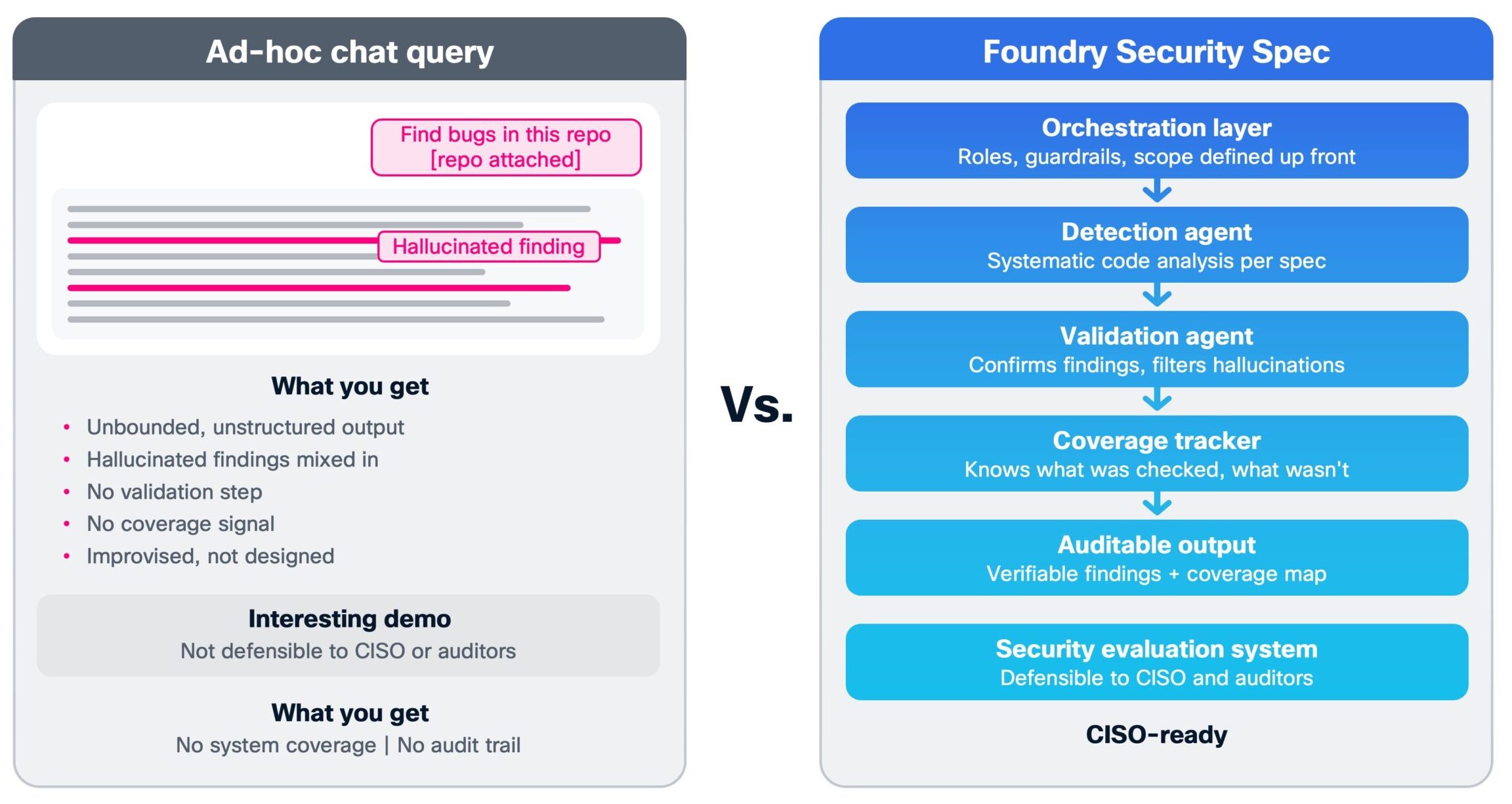
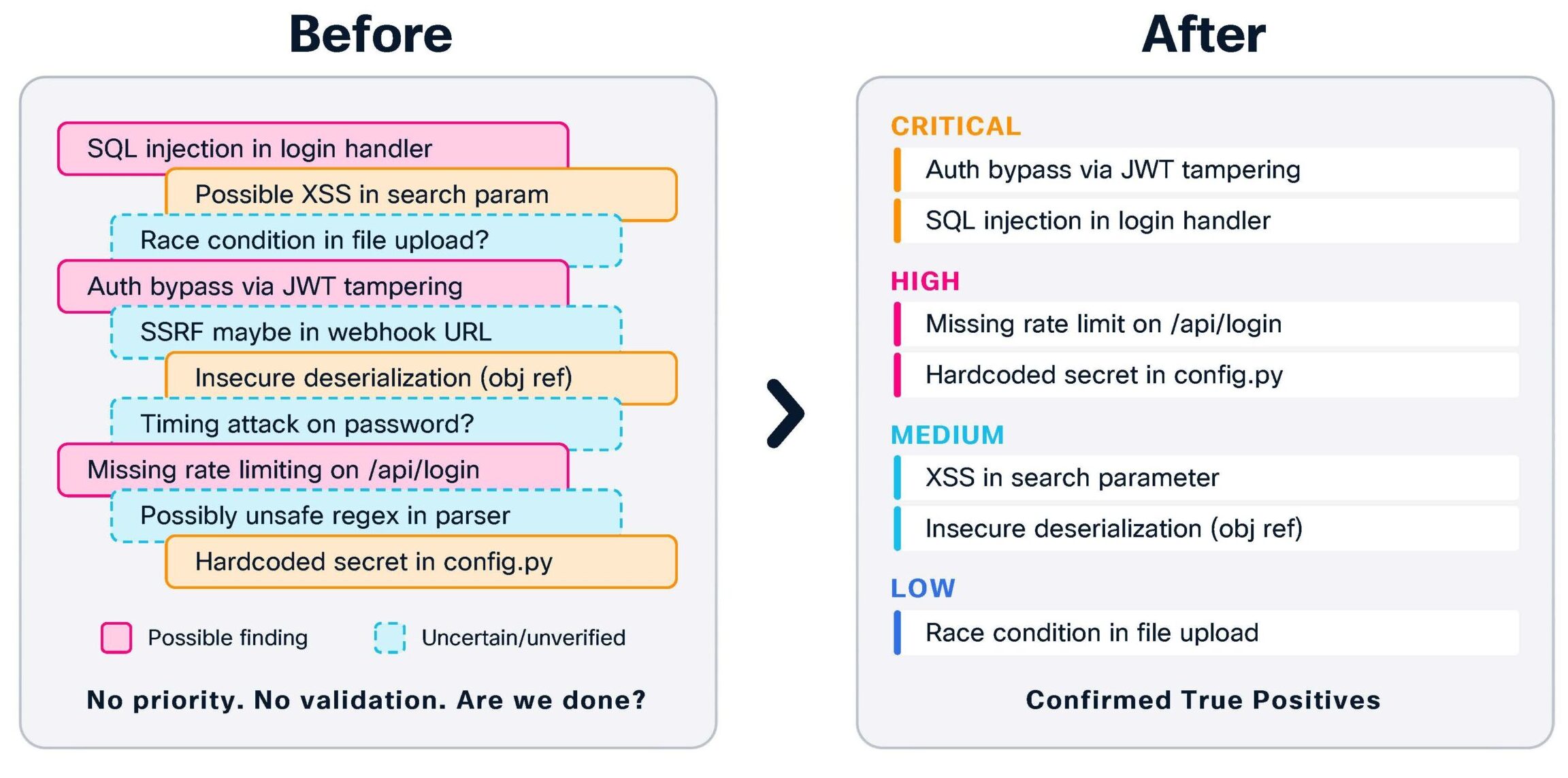
Organizations are investing on AI-assisted security and getting back hallucinated findings, false positives at scale, and no coverage signal. Foundry Security Spec is the scaffolding that turns a frontier LLM from “an interesting demo against your codebase” into a security evaluation system that produces:

  • A bounded, prioritized, verifiable set of findings.
  • A clear “done” signal and the conjunction of an operator-defined coverage floor and an economic yield threshold.
  • An auditable provenance chain from detection through triage, validation, and publication.
  • Safety guardrails that assume the model will, at some point, try to do the wrong thing; and constrain it at the substrate, not the prompt.

If you have a frontier LLM and software you are authorized to evaluate, Foundry gives you the shape of the system you need around it.

How Defenders Can Use Foundry Security Spec to Test Their Software

Foundry is designed to be picked up and adapted, not consumed as-is. It is the starting point of your agentic security evaluation journey. The flow looks like this:
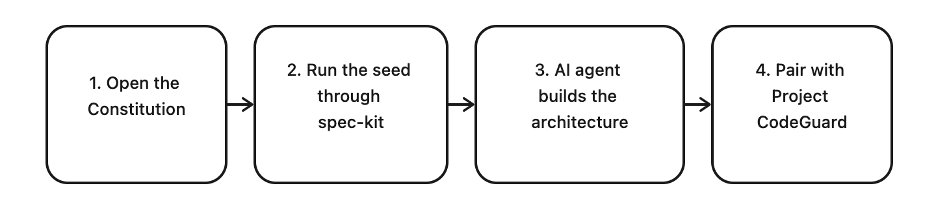
  1. The constitution.md is read by the AI agent (such as Claude Code, Codex, or others) to be used to build the infrastructure. However it is also deliberately written as prose aimed at the human builder and maintainer, with each principle’s “Why this is inviolable” paragraph explaining the specific production failure that rule prevents, so that when an engineer is tempted to weaken a principle for convenience, they encounter the cost of that decision before they make it.
  2. Run the seed through spec-kit. The specification is written to be consumed by spec-kit. The “seed” refers to the initial, minimal setup that gets your spec‑driven project into a known, ready‑to-work state so AI agents (or developers) can start doing useful work consistently.
  3. AI agent builds the architecture. The eight core roles (Orchestrator, Indexer, Cartographer, Detector, Triager, Validator, Coverage-Guide, Reporter) each have a defined purpose, defined inputs and outputs, and a list of functional requirements with rationale. You can implement them as subprocess loops, as graph-based pipelines, as serverless functions, as a bespoke harness. The shape is what transfers; the implementation is yours.
  4. Pair Foundry Security Spec with Project CodeGuard. Foundry Security Spec’s Detector role consumes a corpus of LLM-evaluated detection rules. The rules are from Project CodeGuard, which Cisco open-sourced before Foundry Security Spec existed and donated it to the Coalition for Secure AI (CoSAI). The original purpose of Project CodeGuard is to embed secure-by-default practices into AI coding agent workflows. It provides comprehensive security rules and agent skills that guide AI coding agents to generate more secure code automatically. However, it has also been very useful for code review and for autonomous security evaluations and testing.

The self-improving detection-to-prevention flywheel:

  1. CodeGuard rules sweep every function in your target: systematic, repeatable, finds what we already know to look for.
  2. Foundry Security Spec’s exploratory agents hunt alongside: creative, target-specific, finds what no rule yet describes.
  3. When exploration confirms something the rules missed, Foundry Security Spec records a rule gap.
  4. The gap is generalized into a new (or revised) CodeGuard rule and lands in the corpus.
  5. The next sweep (on this target and every future target) catches that whole class on the first pass.
  6. Because CodeGuard rules are portable, the same corpus loads into an LLM coding assistant as its secure-coding ruleset. The bug class your last evaluation taught the corpus to detect is now prevented at the keystroke, in every developer’s editor, before the next evaluation ever runs.

Every turn of the loop improves detection here and prevention everywhere.

A great starting point

We want to be very explicit about this: Foundry Security Spec is a seed and a blueprint spec. It is not a turnkey scanner or a single tool. It is an example of what a sound AI-powered security evaluation system looks like. Your environment, your threat model, and your goals will reshape parts of it. That is by design. Every place where the seed could either dictate a choice or leave it open, we left it open and explained the trade-off.

Foundry Security Spec is an open-source specification, not a managed service. As with any security tool, the responsibility for implementation, oversight, and final decision-making remains with the user. We provide the blueprint for the guardrails, but it’s up to you to ensure that the ‘human-in-the-loop’ remains the final arbiter of security decisions. We encourage users to treat this as a foundational component of their existing security governance program.

A common question is whether this spec will become obsolete as LLMs evolve. The answer is it was designed not to be. Foundry Security Spec is built on functional requirements and roles, not specific model parameters. Whether you are using today’s frontier models or the more complex reasoning agents of tomorrow, the need for an orchestrator, a detector, and a validator will remain constant. The spec is designed to be the stable harness that keeps your security evaluation consistent, regardless of the ‘engine’ under the hood.

Why a specification and not the source?

Our internal implementations are tightly bound to Cisco infrastructure: our LLM gateway, our issue tracker, our private cloud, etc. Open sourcing that code would give defenders something that runs in exactly one environment. It would not transfer.

What transfers is the design: which roles you need and why, what each must guarantee, how findings flow from detection to publication, what “done” means for an evaluation, where the quality gates go, and which shortcuts will hurt you six months in. That design is model agnostic and infrastructure-neutral.

A genuine contribution to the community

We do not say this lightly: we believe this is one of the most substantive specifications that can help defenders test their environment and software. It is what security teams trying to use a frontier LLM responsibly are currently trying to invent on their own.

It pairs with CodeGuard to form a real, running flywheel between detection (Foundry Security Spec) and prevention (CodeGuard against skills in your developer’s coding agent). Every adoption strengthens the corpus. Every corpus update raises the floor for everyone.

The security of our global digital infrastructure is a collective effort. We invite you to explore the Foundry Security Spec on GitHub, join the conversation in our community forums, and begin building your own agentic security evaluation system. Visit our repository at https://github.com/CiscoDevNet/foundry-security-spec https://github.com/CiscoDevNet/foundry to get started today.

Build on it. Adapt it. Contribute to it.