





If you’re a network engineer or automation architect, you’ve likely spent countless hours perfecting your Ansible playbooks, refining your Terraform modules, or debugging Python scripts. You’ve done the heavy lifting, and your current stack is a testament to your expertise.
When you hear about a new tool like Cisco Agentic Workflows, it’s natural to be skeptical. “I already have my automation stack,” you might think. “Do I really need another platform?”
Think of Cisco Agentic Workflows as an upgrade, not an alternative. It unifies your existing Ansible, Terraform, and Python tools into a cohesive, enterprise-grade strategy. In this blog, let’s look at some assumptions at the root of this skepticism and show how Agentic Workflows addresses them, helping your team manage and scale automation more easily.
While Ansible, Terraform, and Python each have their own unique strengths, Cisco Agentic Workflows builds on those strengths by helping you orchestrate them together more effectively.
The assumption: “If I already use Ansible, I don’t need Agentic Workflows.”
The reality: While Ansible is a premier tool for device-level configuration, managing complex, cross-domain decision logic and maintaining visibility into large-scale execution becomes more challenging as networks grow.
The Workflows advantage: Cisco Agentic Workflows provides a visual, low-/no-code designer that complements and extends your current automation capabilities. It makes complex logic easier to see, manage, and share across your team. Instead of navigating YAML files alone, you can visualize your automation flow on a canvas alongside your playbooks. With integrated run monitoring and detailed audit logging, you gain full visibility into data inputs, outputs, and status—simplifying troubleshooting far beyond standard CLI logs.
The assumption: “Orchestration just adds overhead.”
The reality: Although Terraform is a powerful tool for cloud provisioning, adapting its state-driven model to traditional CLI-based on-premises networking gear can introduce significant operational complexity and state-file management overhead.
The Workflows advantage: Agentic Workflows enhances your existing Terraform automation by using advanced adapters and a secure virtual appliance to seamlessly connect cloud and on-premises environments. This allows you to orchestrate your infrastructure without mastering complex state management. Workflows combines Terraform’s infrastructure-as-code capabilities with simplified orchestration to support a more consistent automation experience.
The assumption: “My scripts already handle everything I need.”
The reality: Custom Python scripts offer infinite flexibility, but they can also create a maintenance burden. Without standardization, you face “script sprawl,” where error handling and rollbacks are inconsistent.
The Workflows advantage: Agentic Workflows complements Python via a cloud-hosted software-as-a-service (SaaS) platform and reduces custom coding through Cisco-validated, prebuilt automations from the Exchange. With built-in versioning, role-based access control (RBAC), and automated system-level audit logging, teams can collaborate more securely and consistently without writing extra code.
Cisco Agentic Workflows acts as the intelligent orchestration layer that sits on top of your existing investments, delivering:
Consider a standard network lifecycle replacement that includes provisioning cloud infrastructure, pushing configurations, verifying connectivity, and updating IT service records. Without a unifying layer, that process often becomes a series of disconnected tasks. With Cisco Agentic Workflows, those same tasks can be coordinated in a more structured way.
| Feature | Without Agentic Workflows | With Agentic Workflows |
| Orchestration | Manual “swivel-chair” execution | Unified orchestration of tools |
| Human-in-the-loop | Disconnected email/Slack approvals | Built-in, dashboard-based approval gates |
| Audit and compliance | Fragmented logs; manual reconstruction | Centralized, automated audit trail |
| Error handling | Manual identification of errors and rollback steps | More resilient execution with auto rollback |
When you integrate Agentic Workflows into this lifecycle, the process transforms from a series of disjointed tasks into a governed, enterprise-ready operation.
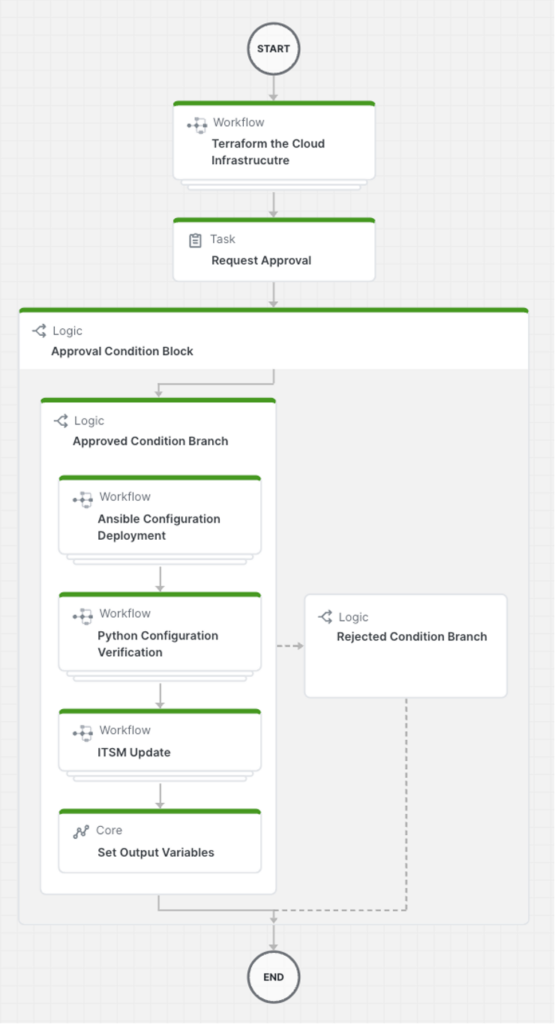
Figure 1. Workflows-generated visual representation of automation logic steps
1. Orchestrated provisioning: Workflows triggers your existing Terraform plan to provision the cloud infrastructure.
2. Governance and approval: When the workflow reaches a human-in-the-loop gate, a change manager receives an email for approval directly within the dashboard.
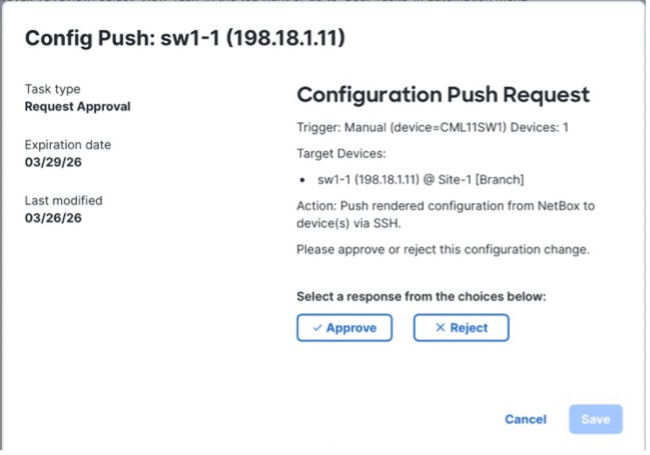
Figure 2. Email notifying change manager to approve configuration push request
3. Configuration deployment: Upon approval, Workflows kicks off Ansible playbooks to push configurations.
4. Verification and ITSM integration: Python scripts verify connectivity and automatically update your ServiceNow, Jira, and other ITSM tools.
5. Compliance-ready audit: Every action is timestamped and recorded, eliminating the need for manual log compilation.
![Run Monitoring table showing workflow statuses and properties panel for [Demo] Push Config to Devices, indicating a failed config push.](https://blogs.cisco.com/gcs/ciscoblogs/1/2026/05/blogimage3-1024x621.jpg)
Figure 3. Workflow statuses and properties are displayed in the Run Monitoring table
With Cisco Agentic Workflows, your automation strategy shifts from task-centric execution to outcome-driven orchestration. Workflows transforms network operations into a governed, enterprise-grade framework that eases onboarding and collaboration between teams, reduces change risk, and improves compliance readiness. By integrating your existing tools into a visual low-/no-code designer, you empower your team to manage complex deployments with confidence.
With AI-driven assistance, teams can spend less effort searching for answers and focus on driving outcomes.
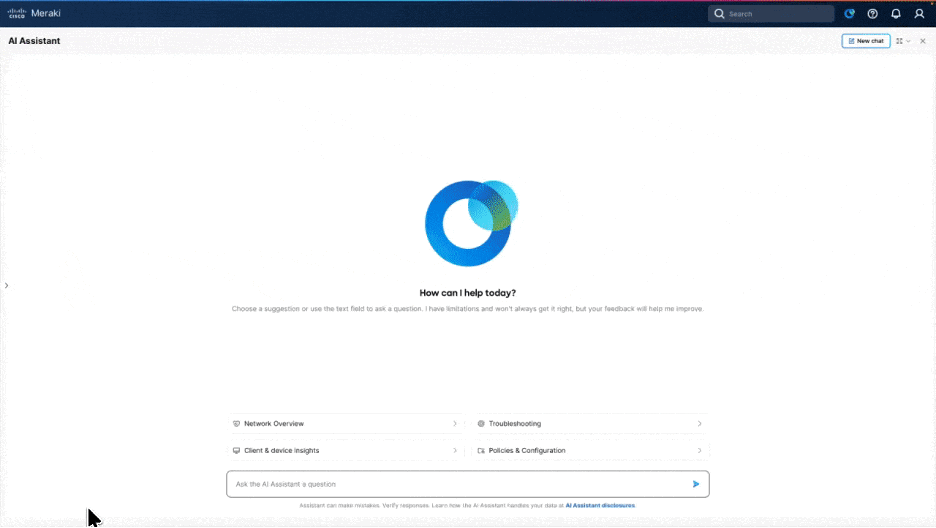
Figure 4: Workflows lets network admins coordinate tasks for a configuration push
You’ve already done the hard work of building your automation foundation. Now, empower your team with the interface and the orchestration capabilities to scale those efforts.
Cisco Agentic Workflows is included with an active license to any Cisco network management console. You don’t need to be a current Meraki customer to get started, you can create a free Meraki account and immediately explore the Workflow Exchange and editor palette today.
Ready to see how it fits into your environment? Get more information on the Cisco Agentic Workflows page. Check out the video demos on the Cisco Workflows YouTube channel or join the Workflows Community for the latest Workflows updates and to ask questions.
Create a free Meraki account to immediately explore the Workflow Exchange and editor palette.
此内容由惯性聚合(RSS阅读器)自动聚合整理,仅供阅读参考。 原文来自 — 版权归原作者所有。