
惯性聚合 高效追踪和阅读你感兴趣的博客、新闻、科技资讯
阅读原文 在惯性聚合中打开

推荐订阅源

Stack Overflow Blog
Stack Overflow Blog
博客园 - Franky
MyScale Blog
MyScale Blog
Jina AI
Jina AI
B
Blog
Microsoft Security Blog
T
Troy Hunt's Blog
博客园_首页
T
Threatpost
Threat Intelligence Blog | Flashpoint
L
Lohrmann on Cybersecurity
GbyAI
GbyAI
T
Tenable Blog
B
Blog RSS Feed
S
Securelist
T
Threat Research - Cisco Blogs
P
Privacy International News Feed
P
Proofpoint News Feed
T
The Exploit Database - CXSecurity.com
H
Hackread – Cybersecurity News, Data Breaches, AI and More
量子位
博客园 - 三生石上(FineUI控件)
大猫的无限游戏
大猫的无限游戏
雷峰网
雷峰网
C
CXSECURITY Database RSS Feed - CXSecurity.com
罗磊的独立博客
AWS News Blog
AWS News Blog
V
V2EX
宝玉的分享
宝玉的分享
J
Java Code Geeks
小众软件
小众软件
Spread Privacy
Spread Privacy
腾讯CDC
Google Online Security Blog
月光博客
月光博客
V
Visual Studio Blog
The Hacker News
The Hacker News
C
CERT Recently Published Vulnerability Notes
Project Zero
Project Zero
Know Your Adversary
Know Your Adversary
T
The Blog of Author Tim Ferriss
Last Week in AI
Last Week in AI
Apple Machine Learning Research
NISL@THU
NISL@THU
C
Check Point Blog
Webroot Blog
Webroot Blog
D
DataBreaches.Net
Cloudbric
Cloudbric
cs.AI updates on arXiv.org
IT之家
IT之家

Cisco Blogs

Cisco Live 2026: Bringing the Future of Customer Experience to Las Vegas Edge opportunity for service providers: Turn infrastructure into new services MRC and SRv6: How Foundational Networking Innovations Are Enabling the Next Generation of AI Supercomputers The SMB Marketing Reset: Winning Customer Trust in a Digital-First Economy Inside the SOC: AI-powered DNS defense against ransomware Our Path Forward Securing the Federal Digital Experience with Cisco ThousandEyes for Government Cisco at ONUG Dallas 2026: Securing the AI Data Center in the Agentic Era Cisco and Red Hat are powering intelligent core to edge: Red Hat Summit insights Building the Capabilities That Win: How Cisco Partners Can Lead in the SMB & Mid-Market Era How Two Hours Felt Bigger Than My To-Do List Announcing Foundry Security Spec Ace the CCIE Collaboration Lab: Success Tips from a TAC Engineer Turned CCIE Protecting Agents with Cisco AI Defense and Google Agent Development Kit Powering an Inclusive Future: Your guide to the Purpose Pavilion at Cisco Live Las Vegas The Infrastructure Behind the Mission: SOF Week 2026 Cisco Networking App Marketplace Partners at Cisco Live 2026 Beyond the Pilot: Building the Clinical Data Fabric for the Agentic Era Benchmarking scale-out AI fabrics with Cisco N9000 + AMD Pensando™ Pollara 400 NICs Month of Developer Productivity: Build and Forget The race to autonomous transport networks: A new study Lean IT, future-ready: How to save time and simplify wireless management with AI Reading Between the Pixels: Failure Modes in Vision Language Models Biochar’s triple win: Healthier soils, improved crops, and decarbonization Designing a Proactive Customer Journey Modernize your data center operations with Cisco Nexus Dashboard Why your automation stack needs Cisco Agentic Workflows Try Cisco AI Defense Explorer Edition in this hands-on lab From Bandwidth to Intelligence: How Cisco is Powering AI-Ready Networks Spotlight on digital transformation | FY25 Purpose Report Galaxy Mode is live: A limited-time look at what your Cisco AI Assistant and AgenticOps can already do Securing the Agentic Workforce: Cisco Announces Intent to Acquire Astrix Security Understanding CISA BOD 26-02: Mitigating Risk from End-of-Support Edge Devices Digging Deeper: The Future of Mining with Automation and Ultra-Reliable Wireless Voices from the field: Helping farmers build resilient local economies across rural America Built like a startup, scaled like Cisco: Transforming data center cooling for the AI era Introducing Model Provenance Kit: Know Where Your AI Models Come From Security Insights: A Threat-First View for the Platform That Enforces Access How I Turned My Curiosity into a Patent From Strategy to Architecture: How Cisco is Building a Quantum-Safe Future Maximizing Managed Security Services: A Strategic Guide to Optimizing Your Portfolio (Part 1 of 2) Simplify access control in five easy steps Trust: Why security is your next growth engine Cisco IQ is generally available. Here’s what that actually means. From Vision to Reality: Intelligence in Action with Cisco IQ How connectivity is shaping the future of surgical care The power of your network: Solving a physical security incident on Vision portal 5 signs your data center is holding your AI strategy back Stop Overthinking OT Security: The Total Cost of Ownership and Being Smart with Refreshes AI-Ready, Simpler, and More Secure WAN: Cisco SD-WAN Innovations Scaling the digital future: Why AI and skills investments matter for business and society Expanding our Product Organization Recap Scaling the Future: Reddit AMA on Network Automation at Scale Bringing Professional-Level Skills to Cisco Networking Academy Announcing Cisco Availability in Google Cloud Marketplace: A New Path to Scalable, Partner-Led Growth The Innovation Paradox: How We Reduced Incidents by 25% While Deploying Faster Funding the AI-ready data center: Why flexibility wins The switch that quantum networking has been waiting for From a Message I Couldn’t Believe to a Stage I’ll Never Forget The Hidden Bottleneck Slowing Down Manufacturing Transformation 30 Years as a CCIE: Why Certifications Matter in the AI Era Securing Enterprise AI: Cisco AI Defense Expands to Google Cloud How ThousandEyes Closed the Cloud Visibility Gap by Solving It Themselves First Energy Will Define the Scale of AI Introducing the AI Agent Security Scanner for IDEs: Verify Your Agents Stop Overthinking OT Security: People, Process and Technology Powering the Future of Research: Join Cisco at NLIT 2026 Building the Digital Foundation for a Smarter West Lincoln Memorial Hospital How Cisco built an AI-RRM that maximizes your wireless solution From Automation to Autonomy: Cisco and Rockwell Power a New Era for Manufacturing Unlocking the Future of Fan Engagement: The Power of VisionEDGE Find Yourself in the Future: AI Is the New Baseline—Here’s How to Build Your Skills One Day with Our Customers: Driving better outcomes through customer centricity What It Really Takes to Build an AI-First Workforce From Connectivity to Security: How E80 Future-proofed its AGV Operations with Cisco The Infrastructure of a Floating City: AIDA Cruises’ CX-Led Digital Transformation Scaling your network for AI without a forklift upgrade Why modern networks are moving DDoS defense to the edge Evolve IP Media to AI-Driven Media Fabrics: Future-Proof Broadcast with Cisco and NVIDIA Cisco and Generation are scaling AI-powered pathways to employment Reading Between the Pixels: Assessing Prompt Injection Attack Success in Images Lean IT, future-ready: Why Wi-Fi is your AI growth strategy Cisco Modeling Labs: Bringing the Network Digital Twin to Life AI on the Factory Floor: Why Manufacturing Requires a New Architecture with Cisco Unified Edge Designing for What’s Next: Securing AI-Scale Infrastructure Without Compromise Scaling the Future: Join Our Reddit AMA on Network Automation at Scale 5 wireless trends retail IT teams can’t ignore in 2026 Can your infrastructure management tools do that? Sustainability 101: Let’s talk about energy efficiency From Chai Breaks to Checkpoints: A Day at Cisco Bengaluru Preparing for Post-Quantum Cryptography: The Secure Firewall Roadmap Non-Obvious Patterns in Building Enterprise AI Assistants Making AI Trustworthy and Observable in Real-Time: Cisco Announces Intent to Acquire Galileo A simpler path to unified, AI-ready network operations Cisco Celebrates The Smart Industry Industrial Transformation Award Winners Mobile World Congress 2026: AI-powered Network Security Powering MWC Barcelona – Building a Unified SOC and NOC with Splunk in Record Time How New Data Streams Transformed Cisco Store’s Decision-Making AI-powered Network Security at the Mobile World Congress 2026 SNOC Inside the Mobile World Congress 2026 SOC: Detecting Shadow Traffic with Firepower 6100
Defining Model Provenance: A Constitution for AI Supply Chain Safety and Security
Ehsan Aghaei · 2026-04-30 · via Cisco Blogs

When it comes to AI models, one of the hardest questions to answer is deceptively simple: where did this model actually come from?

We addressed part of this problem with Model Provenance Kit, an open-source tool that fingerprints models at the weight level (the parameters that defines what a model knows and how it behaves) to verify their origins. But a fingerprinting tool needs a clear standard to measure against, that defines exactly what qualifies as a derivation relationship between two models. Here, the industry does not yet have a consistent answer.

Definitions vary across licensors, standards of bodies, research groups, and AI labs. The same pair of models can be labeled as “related” by one reviewed and “independent” by another, with both citing defensible reasoning. That inconsistency creates real problems for licensing enforcement, vulnerability triage, and regulatory compliance.

We created the Model Provenance Constitution as an attempt to fix that. Comprised of a taxonomy, definition, and boundary specifications, it is a normative reference, a constitution, that specifies what a model provenance relationship is and is not at the level of weight derivation. This post covers its structure, its reasoning, and how it connects to the frameworks that governance programs already use. You can review the Constitution within the docs folder of the Model Provenance Kit.

Why Defining Model Provenance is Important

Foundation models do not arrive in the enterprise as isolated artifacts. They get fine-tuned, distilled, quantized, merged, and repackaged, and each step produces a new checkpoint whose relationship to its parent is poorly documented. When a security team needs to know whether a deployed model inherits a known vulnerability, or when compliance needs to determine whether a third-party checkpoint triggers a licensing obligation, the question is always the same: is this model a derivative of that one?

Without a shared, rigorous answer, organization can face compounding risks:

  • Supply chain attacks are already exploiting this gap
  • Regulatory requirements assume provenance clarity that does not yet exist
  • Incident response depends on traceable lineage

Provenance is About Model Weights

The Model Provenance Constitution grounds provenance in a single concept: the verifiable derivation history of a model’s trained weights. Two models share provenance if, and only if, a causal chain of weight derivation connects them, whether directly, indirectly through distillation, or mechanically through a non-training transformation like quantization.

Shared architecture, shared training data, shared tokenizer, and shared benchmark performance do not count. The exclusion is deliberate. A broader definition that treated any architectural or behavioral similarity as derivation may make licensing enforcement apply to every model in an architecture family, would flag convergent designs as genuine vulnerability links, and would flood governance audits with false positives. Weight-level causation produces labels that are stable across reviewers, robust to metadata manipulation, and aligned with how derivation actually happens in practice.

How Model Provenance Constitution is Structured

The constitution answers three questions: when are two models related? How does that relationship occur? And what looks like a relationship, but isn’t? It organizes these answers as explicit enumerations rather than definitions-by-example, so every pair of models encountered in practice maps to a clear category.

Five conditions specify when a provenance link exists

  • Direct descent: training initialized from a trained checkpoint
  • Indirect descent: distillation from a teacher model
  • Mechanical transformation: quantization, pruning, merging, or format conversion
  • Identity: byte-equivalent copy
  • Transitivity: any composition of the above

A pair is provenance-linked if at least one condition holds.

Nine mechanisms enumerate the concrete derivation pathways observed in practice:

  • Identity and reformatting
  • Fine-tuning
  • Continued pretraining
  • Vocabulary-modified derivation
  • Knowledge distillation
  • Structural modification with weight inheritance
  • Quantization and compression
  • Adapter-based derivation (LoRA, QLoRA, prefix tuning)
  • Model merging

Eight exclusions listed below are conditions that may appear to be provenance-linked, but are provenance-independent. Each exclusion is a pattern of apparent similarity, but ultimately one that carries no weight-derivation chain:

  • Independent reproduction (e.g., Llama-2 vs. Open LLaMA which share the same architecture and tokenizer, but are trained from scratch)
  • Same-family different-size (e.g., Llama-2-7B vs. Llama-2-13B).
  • Same-family different-corpus training (e.g., T5 vs. MT5, which share a name root, but have separate from-scratch training)
  • Independent runs under a shared seed (i.e., shared seed does not constitute shared weights)
  • Architectural convergence (different teams independently arriving at similar model designs)
  • Dimensional coincidence under different mechanisms (models that happen to share the same size or shape without one being built from the other)
  • Shared vocabulary without weight transfer (a tokenizer is a tool, not a weight)
  • Shared training objective (sharing an objective does not link weights)

A rigorous provenance standard must name them explicitly, because confusing any of them with genuine derivation corrupts downstream licensing decisions, vulnerability assessments, and compliance determinations.

Establishing an Evidence Standard

A taxonomy is only as useful as the evidence standard attached to it. The Model Provenance Constitution accounts for three sources for establishing provenance (and but architectural similarity and naming conventions are explicitly insufficient):

  • Official documentation: from the releasing organization that explicitly names the parent model and derivation method
  • Checkpoint verification: through hash matching, layer-by-layer comparison, or reproducible derivation scripts
  • Authoritative third-party analysis: that has been peer-reviewed or widely cited

Under ambiguity, Model Provenance Constitution defaults to labeling a pair as provenance-independent. This conservatism is intentional. A false positive in provenance carries immediate consequences: a licensing accusation, an IP claim, a supply-chain incident notification. A false negative gets caught by defense-in-depth through manual review, licensing audit, and forensic analysis. Specificity wins when rigor is required.

Alignment with AI Threat Frameworks and Standards

Model provenance attestation can be considered a supply chain control, and the Model Provenance Constitution serves as a definitional layer that makes model dependency auditable. It specifies what it means for a deployed model to inherit from an upstream source, which is the precondition for any meaningful question about inherited vulnerabilities, license obligations, or unattributed redistribution.

weak model provenance and noting that no guarantees on the origin of the model.  The MITRE ATLAS framework documents supply chain compromise (AML.T0010) as a primary initial-access technique. The Cisco AI Security and Safety Framework classifies third-party model components under OB-009 Supply Chain Compromise, with direct applicability through AITech-9.3 (Dependency/Plugin Compromise). The Cisco AI Security and Safety Framework classifies third-party model components under OB-009 Supply Chain Compromise, with direct applicability through AITech-9.3 Dependency / Plugin Compromise: actors insert malicious code, backdoors, or vulnerabilities into third-party dependencies used by models, agents, or AI applications, creating supply-chain attacks that affect all systems using the compromised component. Foundation-model checkpoints reused as initialization for downstream models are precisely such dependencies.

The constitution also recognizes the adversarial dimension through AITech-9.2 Detection Evasion: deliberate concealment of a derivation relationship — metadata rewriting, tokenizer substitution, chained modifications intended to obscure the parent. The constitution’s commitment to weight-level evidence, rather than metadata-level evidence, is a direct response to this adversary model.

Model Provenance Constitution draws from existing frameworks that AI supply chain programs already rely on. These frameworks identify requirements or considerations that the constitution helps satisfy. A formal provenance definition is a precondition for producing that documentation consistently across an organization and across suppliers.
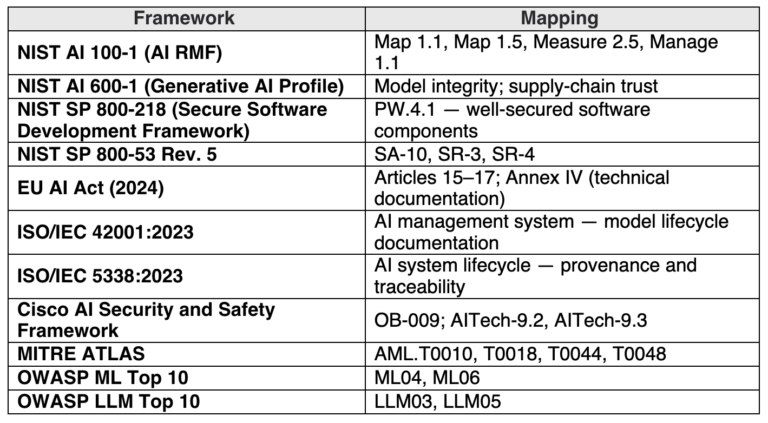
Table 1. Frameworks, regulations, and standards that Model Provenance Constitution drew upon

A Living Document

New methods of building models are emerging faster than any fixed taxonomy can accommodate. Model merging, combining specialized trained models, has become a dominant technique over the past few years. Beyond merging, the ecosystem is seeing Mixture-of-Experts architectures with independently trained components, federated training across organizations, and synthetic data pipelines that blur the line between knowledge transfer and original training. The Model Provenance Constitution considers these open frontiers and commits to revision as the landscape evolves.

Get Started

The full Model Provenance Constitution summary is available alongside this post: https://github.com/cisco-ai-defense/model-provenance-kit/tree/main/docs/constitution

For teams ready to put these definitions into practice, Model Provenance Kit provides the tooling. The entire pipeline runs on CPU, architectural matches resolve in milliseconds, and extracted features are cached for reuse. Check out Model Provenance Kit Github: https://github.com/cisco-ai-defense/model-provenance-kit

Access a starter set of base model fingerprints on Hugging Face: https://huggingface.co/datasets/cisco-ai/model-provenance-kit