

惯性聚合 高效追踪和阅读你感兴趣的博客、新闻、科技资讯
阅读原文 在惯性聚合中打开

推荐订阅源

MongoDB | Blog
MongoDB | Blog
大猫的无限游戏
大猫的无限游戏
H
Help Net Security
V
Visual Studio Blog
G
Google Developers Blog
Blog — PlanetScale
Blog — PlanetScale
Last Week in AI
Last Week in AI
C
Check Point Blog
D
Docker
M
MIT News - Artificial intelligence
P
Proofpoint News Feed
博客园 - 叶小钗
博客园 - 聂微东
The Cloudflare Blog
云风的 BLOG
云风的 BLOG
Martin Fowler
Martin Fowler
OSCHINA 社区最新新闻
OSCHINA 社区最新新闻
酷 壳 – CoolShell
酷 壳 – CoolShell
MyScale Blog
MyScale Blog
WordPress大学
WordPress大学
Engineering at Meta
Engineering at Meta
腾讯CDC
S
SegmentFault 最新的问题
博客园 - 【当耐特】

Cisco Blogs

Cisco Live 2026: Bringing the Future of Customer Experience to Las Vegas Edge opportunity for service providers: Turn infrastructure into new services MRC and SRv6: How Foundational Networking Innovations Are Enabling the Next Generation of AI Supercomputers The SMB Marketing Reset: Winning Customer Trust in a Digital-First Economy Inside the SOC: AI-powered DNS defense against ransomware Our Path Forward Securing the Federal Digital Experience with Cisco ThousandEyes for Government Cisco at ONUG Dallas 2026: Securing the AI Data Center in the Agentic Era Cisco and Red Hat are powering intelligent core to edge: Red Hat Summit insights Building the Capabilities That Win: How Cisco Partners Can Lead in the SMB & Mid-Market Era How Two Hours Felt Bigger Than My To-Do List Announcing Foundry Security Spec Ace the CCIE Collaboration Lab: Success Tips from a TAC Engineer Turned CCIE Protecting Agents with Cisco AI Defense and Google Agent Development Kit Powering an Inclusive Future: Your guide to the Purpose Pavilion at Cisco Live Las Vegas The Infrastructure Behind the Mission: SOF Week 2026 Cisco Networking App Marketplace Partners at Cisco Live 2026 Beyond the Pilot: Building the Clinical Data Fabric for the Agentic Era Benchmarking scale-out AI fabrics with Cisco N9000 + AMD Pensando™ Pollara 400 NICs Month of Developer Productivity: Build and Forget The race to autonomous transport networks: A new study Lean IT, future-ready: How to save time and simplify wireless management with AI Reading Between the Pixels: Failure Modes in Vision Language Models Biochar’s triple win: Healthier soils, improved crops, and decarbonization Designing a Proactive Customer Journey Modernize your data center operations with Cisco Nexus Dashboard Why your automation stack needs Cisco Agentic Workflows Try Cisco AI Defense Explorer Edition in this hands-on lab From Bandwidth to Intelligence: How Cisco is Powering AI-Ready Networks Spotlight on digital transformation | FY25 Purpose Report
Cisco IQ is generally available. Here’s what that actuall...
Liz Centoni · 2026-04-29 · via Cisco Blogs

We’ve fused 40 years of Cisco expertise with agentic intelligence to help IT leaders move from reactive firefighting to proactive resilience. 

The AI era did not arrive with a warning. It arrived mid-cycle, mid-budget, and mid-transformation, landing squarely on infrastructure that was never designed for it.

I know this because I lived it. Running a services organization at scale, I watched brilliant engineers spend most of their time on work that should not have existed. Pulling data from dozens of systems before a single customer conversation. Re-explaining environment context to engineers who should have already known it. Responding to outages that had visible signals which nobody caught in time.

That is what Cisco IQ was built to change.

The Problem 

Over 40 percent of outages start as misconfigurations nobody caught in time.

Sophisticated actors do not need a novel exploit. They are going after aged infrastructure organizations knew about and did not prioritize. Our Talos team confirmed it: 40 percent of top-targeted vulnerabilities last year impacted end-of-life devices. 32 percent are over a decade old.

The signal was there. Nobody was looking in the right place at the right time.

Your best engineers should be changing your business. Not re-explaining your environment for the fourth time this quarter. Not spending their week interpreting data instead of acting on it. And, not starting support interactions from zero.

That is the model we are replacing.

It is the delivery vehicle for everything Cisco Support and Professional Services knows about your environment, made continuously available before you ask for it. Forty years of institutional knowledge, every design pattern, every configuration risk we have seen turn into an outage, encoded and active inside your environment from day one.

Every agentic action is deterministic, validated, and governed before it touches your infrastructure. AI surfaces. Humans decide. Accountability stays with Cisco.

It delivers across four pillars:

  1. Complete landscape clarity.
    You cannot protect what you cannot see. Cisco IQ provides a real-time, benchmarked view of every Cisco asset, configuration, and risk. Starting in July, you will see how your posture compares against peers in your industry, your size, your sector. When you are asked whether you are ahead or behind, this is the answer that is specific, defensible, and current.
  2. Proactive resilience.
    Cisco IQ surfaces and prioritizes critical risks before they impact your business, powering a proactive infrastructure resilience model instead of a reactive one. Not 400 alerts. A ranked action list your team can actually execute, with the evidence and reasoning already built in.
  3. Rapid resolution.
    Troubleshooting is a bottleneck of time and resources. The moment a case opens, your full environment context is already there.Your engineer does not brief our TAC. TAC briefs itself.
    Cisco IQ can collapse resolution timelines from hours to minutes by understanding your specific environment.
  4. Contextualized professional services.
    Cisco IQ eliminates the learning curve with the collective experience of our global experts embedded directly into your workflow across the entire lifecycle. Projects land faster. Rework drops. And the confidence you bring when you commit to a timeline is backed by something real.

What the Results Look Like 

Close to 90 customers globally. Not projections.

A global financial services organization eliminated hundreds of hours of manual data reconciliation. A European manufacturer gained visibility into risk exposures that had been invisible for years.

At Nestlé, the most powerful outcome was not operational. It was organizational. IT leaders finally had the defensible data to have an honest conversation with business stakeholders about aging infrastructure. That conversation used to be a negotiation without evidence. Cisco IQ made it a conversation with proof.
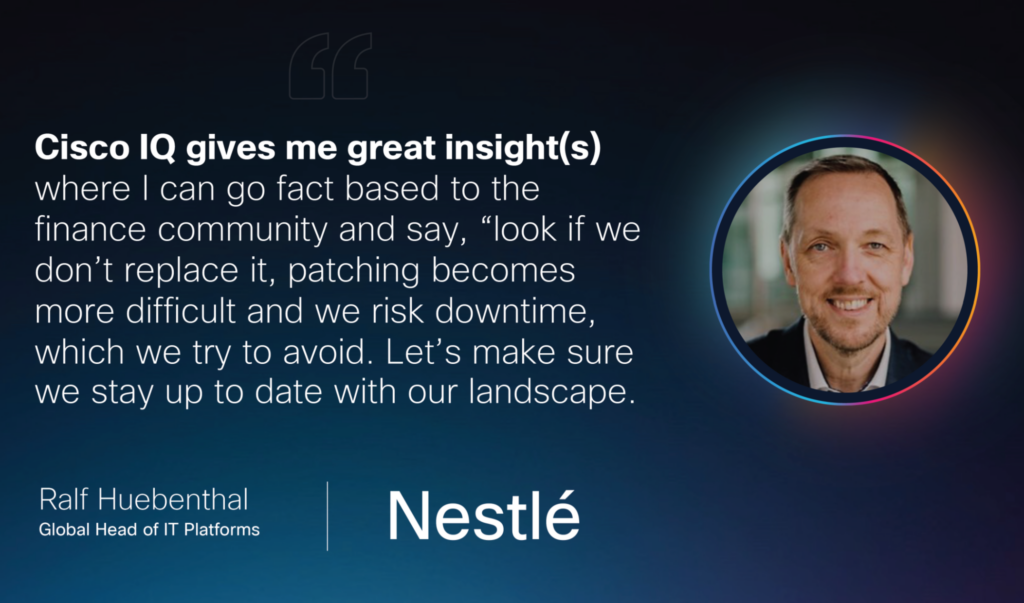
A testimonial graphic featuring a professional headshot of Ralf Huebenthal, Global Head of IT Platforms at Nestlé. The text reads: "Cisco IQ gives me great insight(s) where I can go fact based to the finance community and say, 'look if we don’t replace it, patching becomes more difficult and we risk downtime, which we try to avoid. Let’s make sure we stay up to date with our landscape.'"

That is the outcome that matters most to me. Not faster resolution times. Not reduced alert volume. The moment when the person running IT walks into a meeting with data that changes the decision.

What Changes 

Cisco IQ is generally available today in the SaaS deployment mode.

If you are an existing Cisco Support and Professional Services customer, this is not something you need to budget for. It is already part of what you have. The question is whether you are using it.

If you are evaluating your options, the right question is not what Cisco IQ costs. It is what the current model is costing you every month in engineering hours spent on work that should not exist, in outages with signals nobody caught, and in conversations you are not yet equipped to have.

The organizations that will lead the AI era are not the ones with the biggest budgets. They are the ones whose infrastructure works for them, not the other way around.

That is what Cisco IQ is built to do.


Learn more: