
惯性聚合 高效追踪和阅读你感兴趣的博客、新闻、科技资讯
阅读原文 在惯性聚合中打开

推荐订阅源

P
Palo Alto Networks Blog
Recent Commits to openclaw:main
C
CERT Recently Published Vulnerability Notes
C
Cybersecurity and Infrastructure Security Agency CISA
S
Schneier on Security
S
Securelist
酷 壳 – CoolShell
酷 壳 – CoolShell
C
CXSECURITY Database RSS Feed - CXSecurity.com
Cyberwarzone
Cyberwarzone
Apple Machine Learning Research
S
SegmentFault 最新的问题
cs.CL updates on arXiv.org
GbyAI
GbyAI
Security Latest
Security Latest
Last Week in AI
Last Week in AI
Microsoft Security Blog
云风的 BLOG
云风的 BLOG
Recorded Future
Recorded Future
Webroot Blog
Webroot Blog
cs.AI updates on arXiv.org
TaoSecurity Blog
TaoSecurity Blog
C
Cisco Blogs
博客园 - 【当耐特】
Blog — PlanetScale
Blog — PlanetScale
Hugging Face - Blog
Hugging Face - Blog
B
Blog
Hacker News - Newest:
Hacker News - Newest: "LLM"
cs.CV updates on arXiv.org
Attack and Defense Labs
The Last Watchdog
The Last Watchdog
U
Unit 42
阮一峰的网络日志
阮一峰的网络日志
Project Zero
Project Zero
WordPress大学
WordPress大学
L
LINUX DO - 最新话题
F
Fortinet All Blogs
L
LINUX DO - 热门话题
PCI Perspectives
PCI Perspectives
Simon Willison's Weblog
Threat Intelligence Blog | Flashpoint
MongoDB | Blog
MongoDB | Blog
Latest news
Latest news
P
Proofpoint News Feed
T
Threat Research - Cisco Blogs
The Hacker News
The Hacker News
爱范儿
爱范儿
O
OpenAI News
J
Java Code Geeks
T
The Exploit Database - CXSecurity.com
H
Hackread – Cybersecurity News, Data Breaches, AI and More

The Stack

How Lloyds has transformed its trusted critical data for AI Micron's revenue surges with no end to the memory shortage in sight Ubiquiti UniFi OS vulnerabilities exploited in the wild Mistral's new OCR 4 model shows size matters EU approves €76m in state aid for chip testing firm Even FedEx is a winner of the data centre boom Why AWS thinks AI coding assistants need a new place to run Why China is forging closer ties with open-source foundations China's CPU-only supercomputer tops power list Runtime: Why 'Bring-your-own-Cloud' is taking off; the TRAIT&R framework for agents, and... AWS adds yet another security tool to speed up patching Scattered Spider: UK teen pleads guilty to TfL attack OSS security finally gets a Magic Quadrant Places for People forking out £60m for new ERP system Google offers ATT&CK for bad AI, with surging cost forecast STACKUP: The Stack's weekly tech startups and funding wrap Bring Your Own Cloud: why more enterprises are buying in AWS takes NVIDIA "G7" Blackwell instances GA Runtime: Vercel sets up a new framework for agents, Databricks finds a new Genie, and… Borussia Dortmund's IT head has to sometimes think "outside of the box" Accenture stumbles after Middle East, AI, merger questions Cabinet Office offering £100k+ for AI "ambassador" Critical Splunk Enterprise vulnerability being exploited Accenture buys majority stake in OT security company Dragos npm's security rethink, Satya’s warning, a COBOL win, and... US spending billions to counter China's tech influence NatGeo Society CTO on migrating 15 years of video data to the cloud Alibaba opens French data centres in Europe cloud push SpaceX to take over Cursor in $60bn play for AI coding market Hosting firm Hetzner hikes prices sharply amid supply chain pain HSBC's CIO: AI is easy. True impact is hard. Databricks' Ali Ghodsi: 'Your processes have to change' Rackspace’s "30MW" AMD deal: The devil's in the details The Stack acquires Runtime What is npm doing to protect the JavaScript ecosystem Ron van Kemanade, Group COO, Lloyds, on agents, COBOL, IAM. Langflow instances are getting exploited – again Red Hat's $5 billion answer to Mythos: fix all the code OpenAI acquires German startup to spin up cloud dev environments for better agent control STACKUP: The Stack's weekly tech startups and funding wrap Microsoft CEO warns over concentrated AI model dependency Internet pillar cURL takes a summer holiday from security Anthropic knee-capped by abrupt export controls Months after losing its CEO, now Adobe's CFO gets poached Oracle zero-day exploited for nearly two weeks by Shiny Hunters HM Treasury needs a new CTO, the salary is below average AMD joins UK's Sovereign AI train with Cambridge "AI lab" Oracle PeopleSoft vulnerability exploited: 100s reported hit Oracle reports a $638 billion backlog The UK wants to record court hearings - but not an actual plan Bank of England restarts stalled £24m data collection refresh Anthropic warns LLMs can crank out N-day exploits cheap and fast The CISO needs to get focused on business resilience LibreOffice denounces Euro-Office as Microsoft Trojan Horse Apple's revamped Siri AI leans on Google models and cloud AI could be driving IT hiring in Europe, new report finds UK calls for “device-based” nude controls Cult browser project Ladybird cuts off code community UK gets $1.5bn AI Hardware Plan, and a big-coalition sovereign model plan too STACKUP: The Stack's weekly tech startups and funding wrap Fake IT support staff are walking in to US law firms to steal data Apple found a way to sharply cut token use Apache Livy graduates to Top-level project for Spark support Supabase raises $500m, looks to horizontal Postgres scaling GitLab Field CTO on unlikely customers pulling ahead with AI Killing the card? The UK’s banks eye a payments revolution MPs call on UK government to drop £330m Palantir-NHS deal The Tokenomics Foundation is coming for AI Finops Microsoft's new models give it a better moat The EU dropped its latest tech sovereignty package – what to know HMRC digital transformation: new customer service platform Tokenmaxxing is dead. Finops for AI is emerging slowly. This database company wants to take on Palantir ChatGPT 5.5 and Codex now on Bedrock for easy AWS access Multicloud gets sweeter with a 500 Mbps free private link Alphabet raising $80bn to keep up with ballooning AI CapEx How to get visibility and isolation for AI in Kubernetes Red Hat packages injected with worm in supply chain attack STACKUP: The Stack's weekly tech startups and funding wrap Dell COO says “pain” of price hikes will continue NVIDIA, MS tease tighter agent-native security primitives in Windows Sumedh Thakar: CISOs need to think Shock, WoW, and "AWE" Microsoft turns down temperature amid Nightmare Eclypse row IBM to put $5bn and 20,000 engineers into OSS security fight MongoDB eyes more federal work, snaps up partner Clarity Chinese cyber victims overlapping with industrial strategy - ESET Microsoft stirs a hornets nest over “criminal” zero day disclosure threats Snowflake's AI coding tool is "flywheel" for data platform “Headless” Salesforce hits 1 trillion API calls MySQL gets a foundation with no Oracle, but Alibaba presense GCHQ teases “blueprint” for national AI cyber defense BNP Paribas moves to “zero copy” data model Snowflake joins US federal discount scheme Can Dropbox's new CEO save it from stagnation? Zscaler CEO drools over Mythos tailwind, but Jason's and Joe's departures spook markets Google chases a Kubernetes moment for AI agents UKHSA sticks with Oracle after outsourcing payroll Lenovo eyes “personal AI super agents” in $100 billion drive US eyes physics-based safeguards for water cyber threats Accenture beats IBM in Post Office's latest bid to ditch Horizon
Defender under Attack: June's Patch Tuesday in the spotlight
Edward Targett · 2026-06-10 · via The Stack

Microsoft pushed patches for a record 200+ vulnerabilities in its June Patch Tuesday. The figure comes after Verizon’s annual data breach report showed that software exploitation was the primary cause of data breaches for the first time – outstripping the use of credentials, or phishing, for the first time.

Among them, an authentication bypass CVSS 10 bug in Azure’s managed Postgres service HorizonDB. That’s been fixed upstream and Microsoft is standing firm on its Secure Futures Initiative (SFI) to allocate CVEs for cloud bugs even if they are, as they ultimately must be, invisibly patched.

Redmond’s monthly patch cycle is a useful proxy to track a steady growth in disclosed vulnerabilities. And, as the Zero Day Initiative’s Dustin Childs notes, it’s already pushed fixes for more bugs this year than it did in all of 2018. 

Childs fretted over the patch volume: “It is extraordinary that Microsoft can produce so many patches in a single month, but it does raise concerns. 

He wondered aloud: “How many of these cases were found using AI tools? How many patches were generated using AI to assist in coding or testing?”

“What quality issues may exist in these patches? 
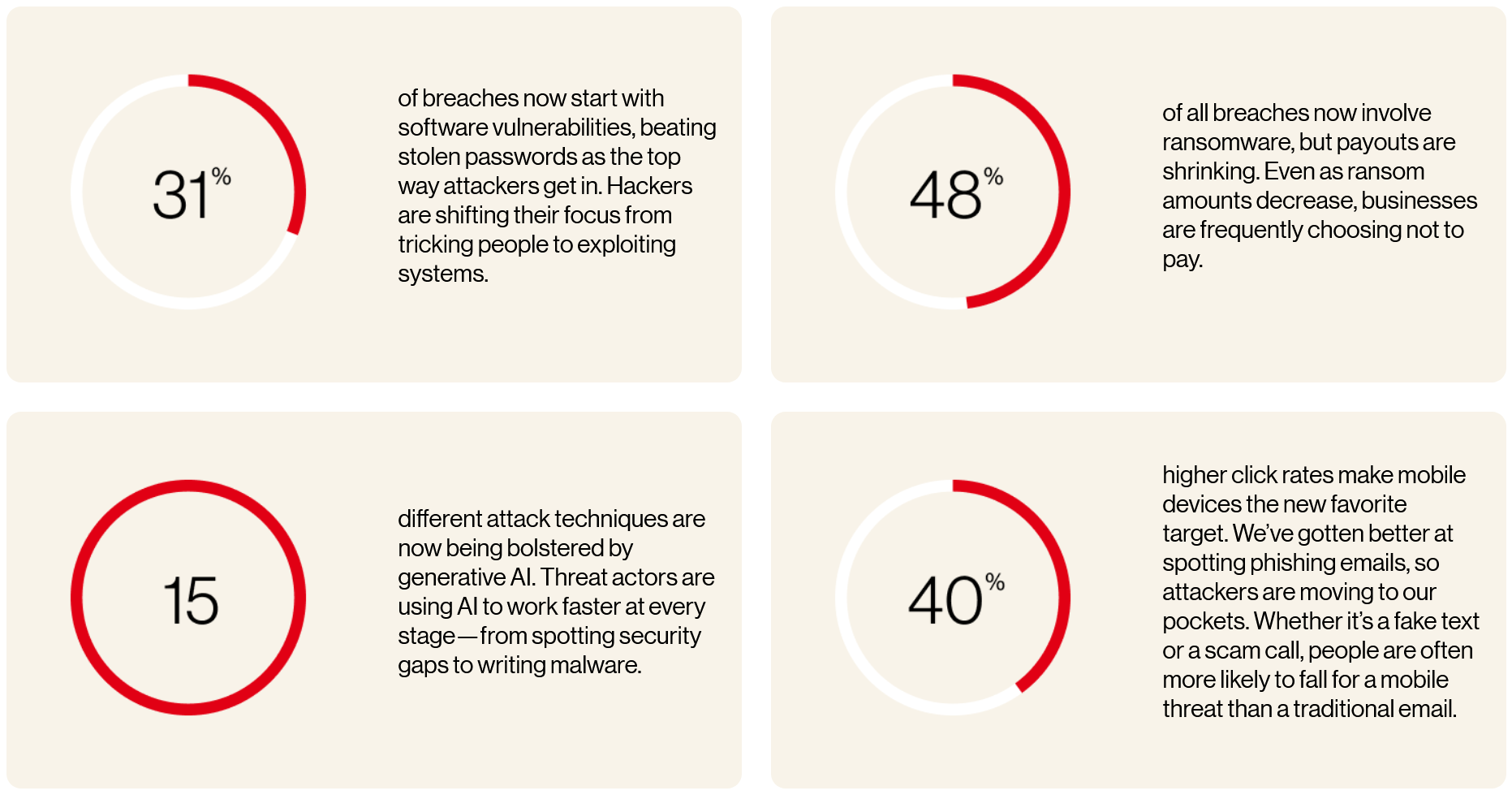
Credit, Verizon.

Under attack? Defender.

One of the bugs patched by Microsoft this month is listed as under active exploitation: Microsoft Defender elevation of privilege (EOP) bug CVE-2026-41091; one of the six disclosed outside of formal channels by an security researcher posting as “Chaotic Eclipse” who is widely understood to be a former Redmond employee – and who has been named widely.

Hours after Patch Tuesday’s fixes landed, they posted a fresh vulnerability dubbed “RoguePlanet”; a race condition EoP bug in Defender affecting Windows 11, 10, and Server installations. The POC works for Windows, but not currently for Server, they said, claiming to have run out of steam on it.

(The security researcher’s GitHub repositories with various POCs was removed from the internet by Redmond. The researcher, who is locked in a deep dispute with Microsoft, has now published them anew to a fresh repository. The Stack is sharing them to help keep defenders informed.)

See also: Microsoft looks to turn down temperature amid ongoing "Nightmare Eclipse" spat

Another highlight is a CVSS 9.8, pre-auth RCE Windows Kernel (gulp) bug tracked as CVE-2026-45657. The vulnerability lets a remote attacker execute code as SYSTEM without user interaction. Redmond says exploitation involves triggering “a flaw in how the Windows kernel processes certain TCP/IP data.” It found it internally and says exploitation is “less likely.”

(A recent Red Team report by Anthropic suggested that its Mythos Preview model developed exploits for 18 of 21 Microsoft bugs it tested – 14 of them had been marked “Exploitation Less Likely" or "Exploitation Unlikely.")

Rapid7’s Adam Barnett also flagged the following: CVE-2026-49975 aka “HTTP2/bomb” and CVE-2026-42902, an EoP bug in “PowerToys.”

He said: “Microsoft has not yet directly addressed another HTTP/2 vulnerability which allows trivial denial-of-service against the default HTTP/2 configuration of multiple web server platforms, including Microsoft IIS.

“CVE-2026-49975, also known as HTTP/2 Bomb, became public knowledge a week ago. This denial of service works by exhausting memory on the target server, and unlike a distributed denial of service attack, there is no requirement that an attacker control a large amount of bandwidth. Patches are available for NGINX and Apache, with IIS presumably to follow at some point. If practically possible, disabling HTTP/2 is a valid mitigation…”

Barnett added that the Microsoft PowerToys utility provides a wide variety of control and configuration options for Windows power users… [and] an undocumented extra: local elevation of privilege to SYSTEM via CVE-2026-42902: “It is worth noting that the fix was included in PowerToys v0.99.1 on April 29, 2026, without any apparent mention in the release notes. Attackers with patch-diffing toolkits may well take note of this discrepancy."