
惯性聚合 高效追踪和阅读你感兴趣的博客、新闻、科技资讯
阅读原文 在惯性聚合中打开

推荐订阅源

月光博客
月光博客
Scott Helme
Scott Helme
D
DataBreaches.Net
人人都是产品经理
人人都是产品经理
N
Netflix TechBlog - Medium
美团技术团队
T
Tailwind CSS Blog
博客园 - 叶小钗
小众软件
小众软件
云风的 BLOG
云风的 BLOG
S
SegmentFault 最新的问题
爱范儿
爱范儿
博客园 - Franky
量子位
I
InfoQ
博客园 - 司徒正美
Hugging Face - Blog
Hugging Face - Blog
钛媒体:引领未来商业与生活新知
钛媒体:引领未来商业与生活新知
奇客Solidot–传递最新科技情报
奇客Solidot–传递最新科技情报
Microsoft Azure Blog
博客园 - 【当耐特】
博客园_首页
Recorded Future
Recorded Future
The Register - Security
让小产品的独立变现更简单 - ezindie.com
Recent Announcements
Martin Fowler
Martin Fowler
C
CERT Recently Published Vulnerability Notes
Know Your Adversary
Know Your Adversary
P
Proofpoint News Feed
A
About on SuperTechFans
阮一峰的网络日志
阮一峰的网络日志
Cisco Talos Blog
Cisco Talos Blog
腾讯CDC
WordPress大学
WordPress大学
NISL@THU
NISL@THU
freeCodeCamp Programming Tutorials: Python, JavaScript, Git & More
C
Cisco Blogs
D
Darknet – Hacking Tools, Hacker News & Cyber Security
酷 壳 – CoolShell
酷 壳 – CoolShell
Cyberwarzone
Cyberwarzone
The GitHub Blog
The GitHub Blog
T
The Blog of Author Tim Ferriss
The Hacker News
The Hacker News
N
News and Events Feed by Topic
Y
Y Combinator Blog
T
Troy Hunt's Blog
A
Arctic Wolf
V
V2EX
S
Secure Thoughts

Human Risk Management Blog

Attackers Exploit AI Hallucinations to Send Users to Phishing Sites Warning: ARToken Phishing Kit Automates BEC Attacks The New Face of AI Risk Trust Nothing: Tips to Secure AI Tools and Agents CyberheistNews Vol 16 #29 ClickFix Social Engineering is Now the Leading Malware Delivery Method Beyond the Checkbox: How a Proactive Partnership Led to Turnkey Hazing Compliance Trust, Verify, Protect: Modernizing Email Security for the Cloud Report: Social Engineering Remains a Central Part of AI-assisted Attacks ClickFix Social Engineering is Now the Leading Malware Delivery Method CyberheistNews Vol 16 #28 Your 2026 Phishing by Industry Benchmarks: The Findings on Human Risk Scammers Can Use AI Tools to Pinpoint Your Location Based on a Photo Report: Attackers Are Using AI to Automate Social Engineering Your KnowBe4 Fresh Compliance Plus Content Updates from June 2026 From Awareness to Digital Workforce Security Your KnowBe4 Fresh Content Updates from June 2026 Threat Actor Uses Phishing to Breach Orgs for Ransomware Gangs Invoice Phishing Attacks Are Abusing the Shop App Phishing Campaign Impersonates Interpol to Deliver Ransomware Prompt Injection and the Rise of Agentic Risk Hyper-Targeted Social Engineering Needs Real-Time Video Response Your Email is Protected. Is Your Teams Chat? CyberheistNews Vol 16 #27 [HOW TO] Your Cybersecurity Starts at Home on World Social Media Day 2026 Phishing by Industry Benchmarking Report: Findings on Human Risk Static DLP Is Leaving You in the Dark: Why It’s Time for Intelligent, Self-Serve Outbound DLP and Misdirected Content Analysis INC Ransomware Gang Targets the Legal Sector 5 Essential Cybersecurity Defenses for Cloud Email Security Why Bite-Sized Security Awareness Training Matters in an Age of TikTok and Digital Distraction Happy 3rd Birthday to Our KnowBe4 Community! Phishing Exposes Employee Data at 86% of Fortune 100 Companies Shadow AI Is Not Shadow IT With a Better Marketing Budget CyberheistNews Vol 16 #26 A New Extortion Scam Uses IT Impersonation to Breach Organizations Cybersecurity Starts At Home This World Social Media Day FTC Report: Americans Lost $3.5 Billion to Imposter Scams Last Year Report: Device Code Phishing is Surging Report: Online Shoppers Increasingly Ignore Scam Warning Signs Security Training Needs Google Maps, Not Christopher Columbus Turn Account Takeover Into Real-Time Security Coaching Extortion Gang Sends In-Person Attackers to Exfiltrate Data Attackers aren’t loyal to any collaboration channel CyberheistNews Vol 16 #25 [The AI Tell] How To Expose Machine-Written Phishing Fast Social Engineering Attacks Abuse Workplace Collaboration Tools New Extortion Brand Uses IT Impersonation to Breach Organizations APWG Report: Social Media Phishing is Surging Cybersecurity Awareness Training for AI: Key Focus Areas Americans Lost $900 Million to AI-Powered Scams Last Year What AI Can’t Hide When It Writes a Phishing Email Your AI Agents Are Eager to Please And Easy to Exploit From 1% to 26%: How AIDA Orchestration Fixes the Remedial Training Gap Best AI Agent Security Tools for SMB and Enterprise in 2026 4 Hot Summer Travel Tips To Avoid Scams CyberheistNews Vol 16 #24 [FBI Alert] Lock Down Your Microsoft 365 Device Code Flows Now The Role of Agentic AI in Phishing Security Training A Credit Score for Cyber Behavior Agentic AI Security in 2026: What to Know How to Secure AI Agents: 4 Best Practices An Overview of Email Compliance Regulations and Reporting Report: AI-Assisted Fraud is Surging Attackers Use Spoofed ChatGPT Site to Deliver Malware I Love Device-Bound Session Credentials, But They Are Still Phishable and Hackable Nearly Two-Thirds of CEOs Cite Cyberattacks as Their Top Concern A Look at Spam vs. Phishing: 4 Key Differences KnowBe4 Wins Multiple 2026 TrustRadius Top Rated Awards Cyber Insurance for Mid‑Market Organizations in Southeast Asia KnowBe4 Earns Multiple 2026 Buyer's Choice Awards from TrustRadius The New Frontier: Securing Japan’s Hybrid Digital Workforce (2026 & Beyond) CyberheistNews Vol 16 #23 Now Phishing Attacks Use Real Hotel Reservations to Target Travelers Report: AI-Enabled Social Engineering Attacks Are on the Rise Your KnowBe4 Fresh Compliance Plus Content Updates from May 2026 FBI: Kali365 Phishing Kit is Targeting Microsoft 365 Accounts KB4-CON - AI Is Everything How to Secure AI Adoption In Your Organization Your KnowBe4 Fresh Content Updates from May 2026 The Silent Invitation: A Deep Dive into Calendar Invite Phishing Cyber Insurance for Mid‑Market Organizations in Southeast Asia Chinese-Language Phishing Kits Are Growing More Advanced Phishing Attacks Are Using Real Hotel Reservation Info to Target Travelers Warning: Scammers are Exploiting Geopolitical Unrest Athletes Are Increasingly Targeted by Social Engineering Attacks AI Agent Governance Part 3 - Runtime Governance: The Hidden Performance Cost of Agentic AI AI Agent Governance Part 2 - What Good Looks Like: Governing AI Agents in Practice 8 Ways to Reduce False Positives in Email Security Ransomware Attacks Drive a Surge in Cyber Insurance Claims My Favorite 5 KnowBe4 Agents Perry Carpenter KB4-CON 2026 Q&A: Deepfakes & Deception Free Gift Fallacy: How Attackers Harvest Credit Cards via Fake Surveys When Global Conflict Becomes a Cyber Weapon: How Iran Tensions and Other Stressful Events Fuel Social Engineering Attacks CyberheistNews Vol 16 #21 [Heads Up] GitHub Breach Shows Developer Tools Are Social Engineering Targets Alert: Extortion Groups Are Using Phishing Kits to Automate Their Attacks Beyond the Chatbot: Why Your AI Agents are Your Newest (and Most Vulnerable) Colleagues Report: Adversarial Use of AI is Evolving
Cybercriminals Are Targeting the FIFA World Cup 2026
KnowBe4 Threat Lab · 2026-07-02 · via Human Risk Management Blog

Lead Analysts: Jeewan Singh Jalal and Louis Tiley

KnowBe4 ThreatLabs tracked phishing campaign activity from the first week of April through June 22, 2026 — covering the pre-tournament build-up, tournament kickoff and the first twelve days of live match play. Our latest intelligence adds crucial mid-tournament telemetry (June 15-22), a newly identified reply-back campaign track and additional infrastructure intelligence.

The Scale of the Problem

Every major global event generates a parallel wave of opportunistic fraud. The FIFA World Cup 2026 is no exception. KnowBe4 ThreatLabs began tracking World Cup-themed phishing activity from the first week of April 2026. What we found was a sustained, accelerating campaign that reached peak intensity in the final days before kickoff and has continued to escalate throughout the tournament itself.
Pre-Tournament Headline Figures (April 5 - June 11, 2026)

  • "World Cup"-branded phishing attacks increased 13-fold in the six weeks leading up to the June 11 opening fixture, with the sharpest acceleration in the final seven days.
  • Average daily attack volume jumped 850% in the week immediately before the tournament started.
  • On June 4, one in every 185 phishing emails carried "World Cup" branding — the highest single-day rate recorded in the pre-tournament window.
  • On June 8, one in every 513 phishing emails spoofed the FIFA brand in the sender display name. At baseline in early May, that figure was 1 in every 3,000+.
  • A stark drop-off over the June 6–7 weekend followed by a sharp Monday rebound confirms that campaigns are explicitly targeting business inboxes during working hours.

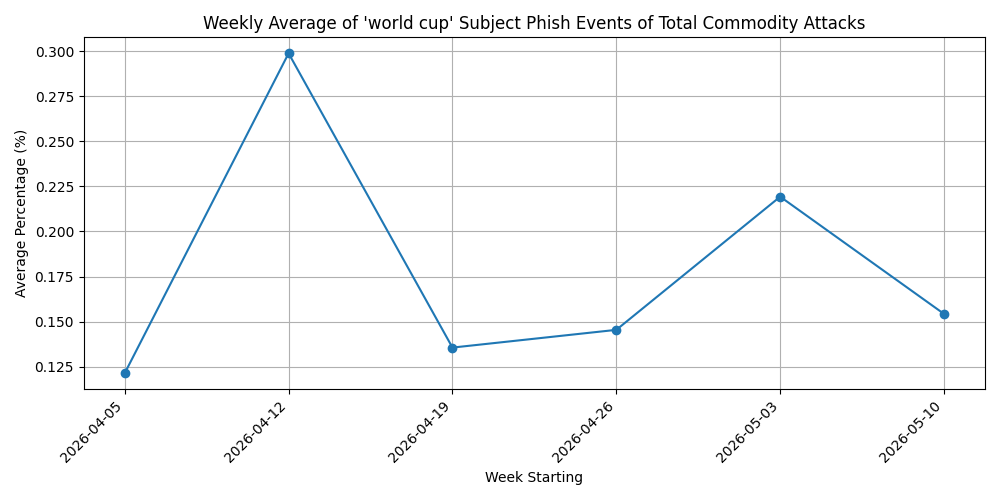
Fig. 1 — Weekly average 'World Cup' subject phish as % of total commodity attacks (Apr 5 - May 10, 2026)
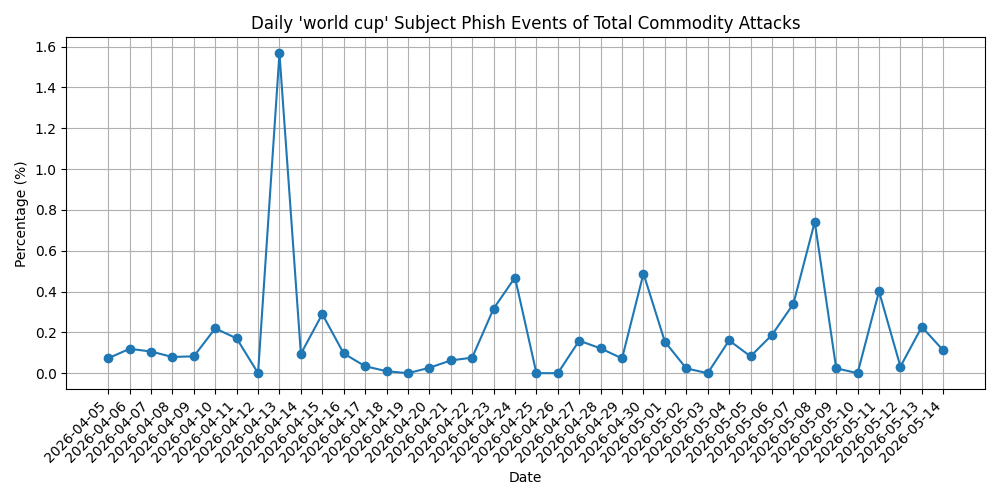
Fig. 2 — Daily "World Cup" subject commodity phish events (Apr 5 - May 14, 2026). April 13 spike at 1.57%

Mid-Tournament Update (June 15-22, 2026)

Twelve days into live tournament play, the data confirms a critical trend: rather than peaking on opening day and tapering off, the campaign's activity has steadily escalated.
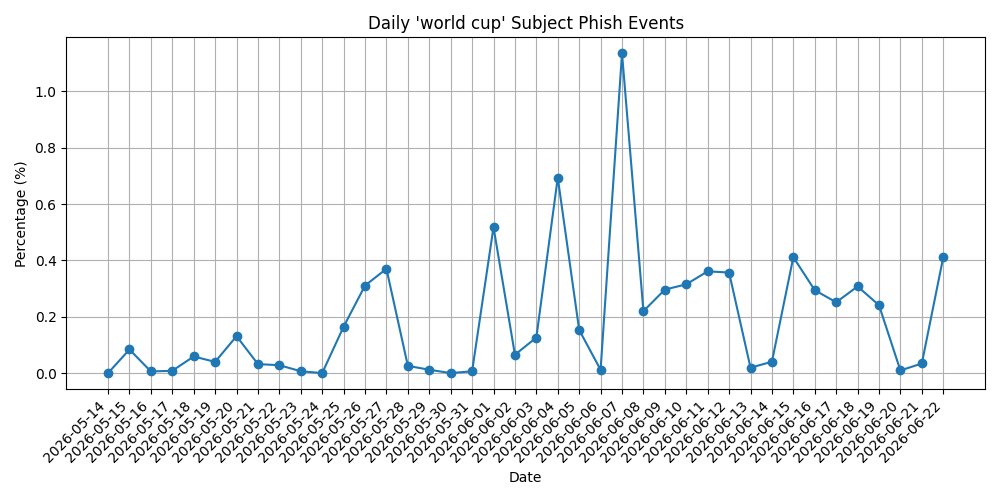
  • Mid-tournament World Cup-themed phishing has surged to a 22-fold baseline escalation, representing an average of 0.246% of all tracked phishing traffic across June 15-22 versus the 0.011% rate recorded when tracking commenced in late April.
  • Volume dropped to near-zero on June 20 (0.009%) before recovering to 0.41% by June 22. This volatility confirms match-day synchronization: threat actors are timing campaign bursts to coincide with specific fixtures.
  • On June 22, one in every 161 phishing threats leveraged tournament-themed sender names FIFA at 0.43% and generic World Cup at 0.19%.
  • The "FIFA" brand name is currently running two times more frequently than generic World Cup lures (0.24% vs 0.11%, June 15-22). Attackers have shifted to the governing body as the stronger trust signal.

Fig. 3 — Daily “World Cup” subject phish events (May 14 - Jun 22, 2026). June 7 peak at 1.13%
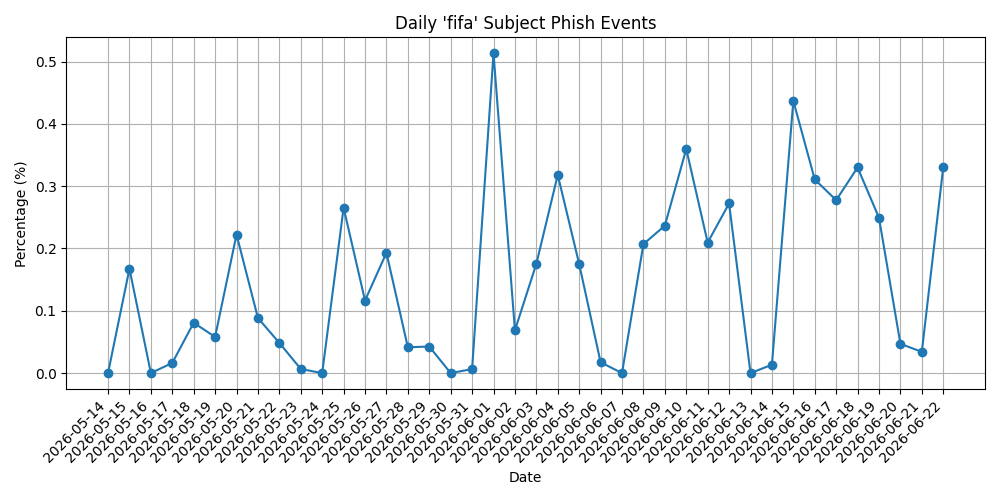
Fig. 4 — Daily “FIFA” subject phish events (May 14 - Jun 22, 2026). June 1 peak 0.51%, June 10 at 0.44%

Display Name Spoofing Dominates

Across the full observation window, attackers are heavily favoring display name impersonation over lookalike domain registration — running two-three-times higher than domain-based spoofing. Standard domain reputation filtering provides no protection against this vector.
  • FIFA Domain Impersonation, week of June 2-7: 0.09% weighted average (June 3 at 0.12%, June 4 at 0.14%).
  • FIFA Display Name weekly average, week of June 4: climbed to a record 0.109%.
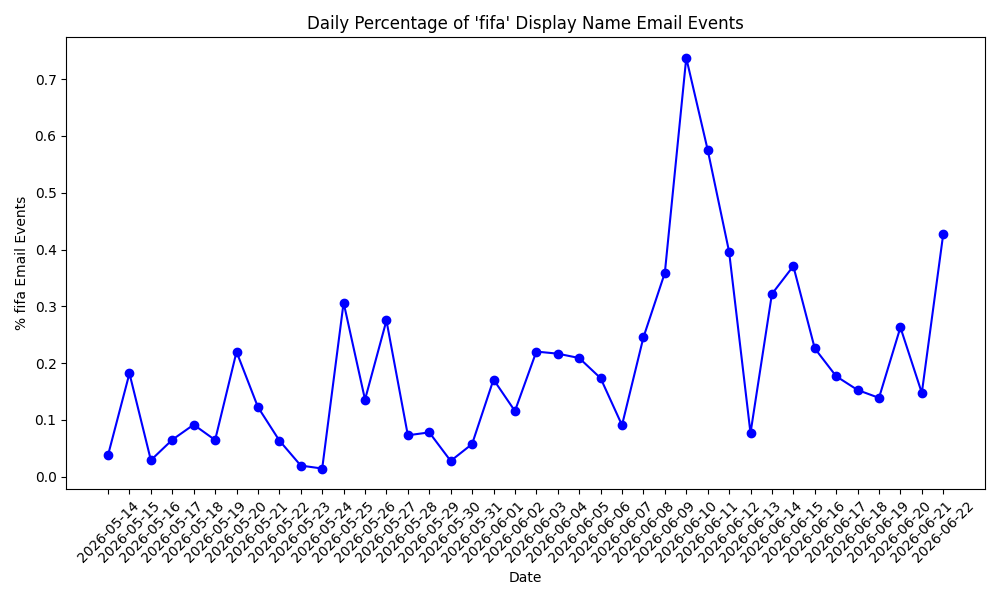
  • FIFA Display Name single-day peak, June 8: 0.195%.
  • FIFA sender name impersonation nearly tripled in 72 hours mid-tournament: 0.14% on June 19 → 0.43% by June 22.
  • Display name manipulation is currently at 6× its original campaign baseline - 0.24% average June 15–22 versus 0.04% at tracking commencement.
  • The week starting June 11 averaged 0.31%, surpassing the 0.29% pre-tournament peak - FIFA sender spoofing intensified after kickoff, not before it.

Fig. 5 — Daily “FIFA” display name phish events (May 14 – Jun 22). Peak: June 10 at 0.74%, June 22 at 0.43%
Dual-Track Brand Strategy: “World Cup” vs. “FIFA”

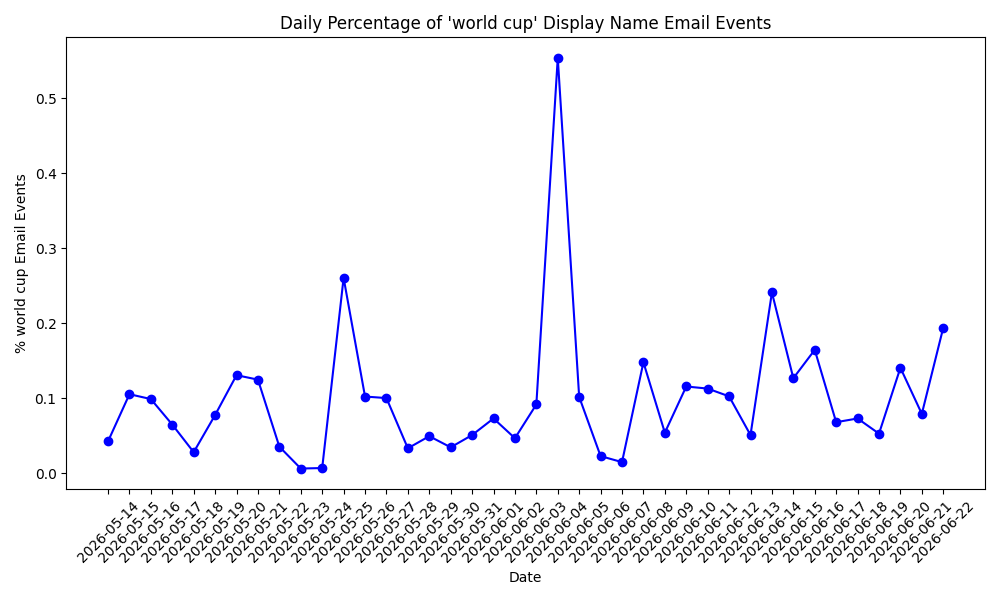
  • "World Cup" lures peaked pre-tournament - hitting 0.55% on June 4 - then declined as the tournament began.
  • "FIFA" authority branding reached its zenith mid-tournament - peaking at 0.74% on June 10, the highest value in the FIFA display name dataset.
  • Generic "World Cup" display name spoofing surged 3.8-fold over 72 hours mid-tournament: 0.05% on June 19 → 0.19% by June 22.

Fig. 6 — Daily "World Cup" display name phish events (May 14 – Jun 22). Pre-tournament peak June 4 at 0.55%

Key Intelligence: The shift from “World Cup” to “FIFA” as the dominant brand once matches went live is a deliberate tactical switch. FIFA communications are expected by targets during the tournament; the governing body name is the higher-trust signal in a live-match context.

PHISH ALERT: Impostor League — Fraudulent FIFA Recruiting Campaigns

The most technically sophisticated campaign we tracked targets job seekers, not ticket buyers. We are tracking a polished recruiting and survey scam impersonating official FIFA HR and Talent Acquisition teams, weaponizing calendar-booking and fake survey workflows to harvest credentials and steal payment card data.

The attack surface is not incidental. FIFA is actively hiring thousands of staff and volunteers for a 48-team, 16-city tournament. Candidates in application mode expect to share resume data, authenticate and book interviews making them significantly more vulnerable than a generic target.

The Attack Chain

Step 1 - The Outreach

Targets receive highly customized emails spoofing legitimate FIFA recruitment communications. Senders abuse AWS application services and third-party help-desk platforms to slip past SPF/DKIM filters. Specifically observed infrastructure:

  • worldcup2026fifa[.]awsapps[.]com - AWS WorkMail/SES abuse for initial outreach.
  • fifa-jobs[.]us2[.]desk365[.]com - Desk365 helpdesk platform abuse.

Because these are technically legitimate sending services with valid SPF records, emails arrive at the inbox with a clean authentication pass.
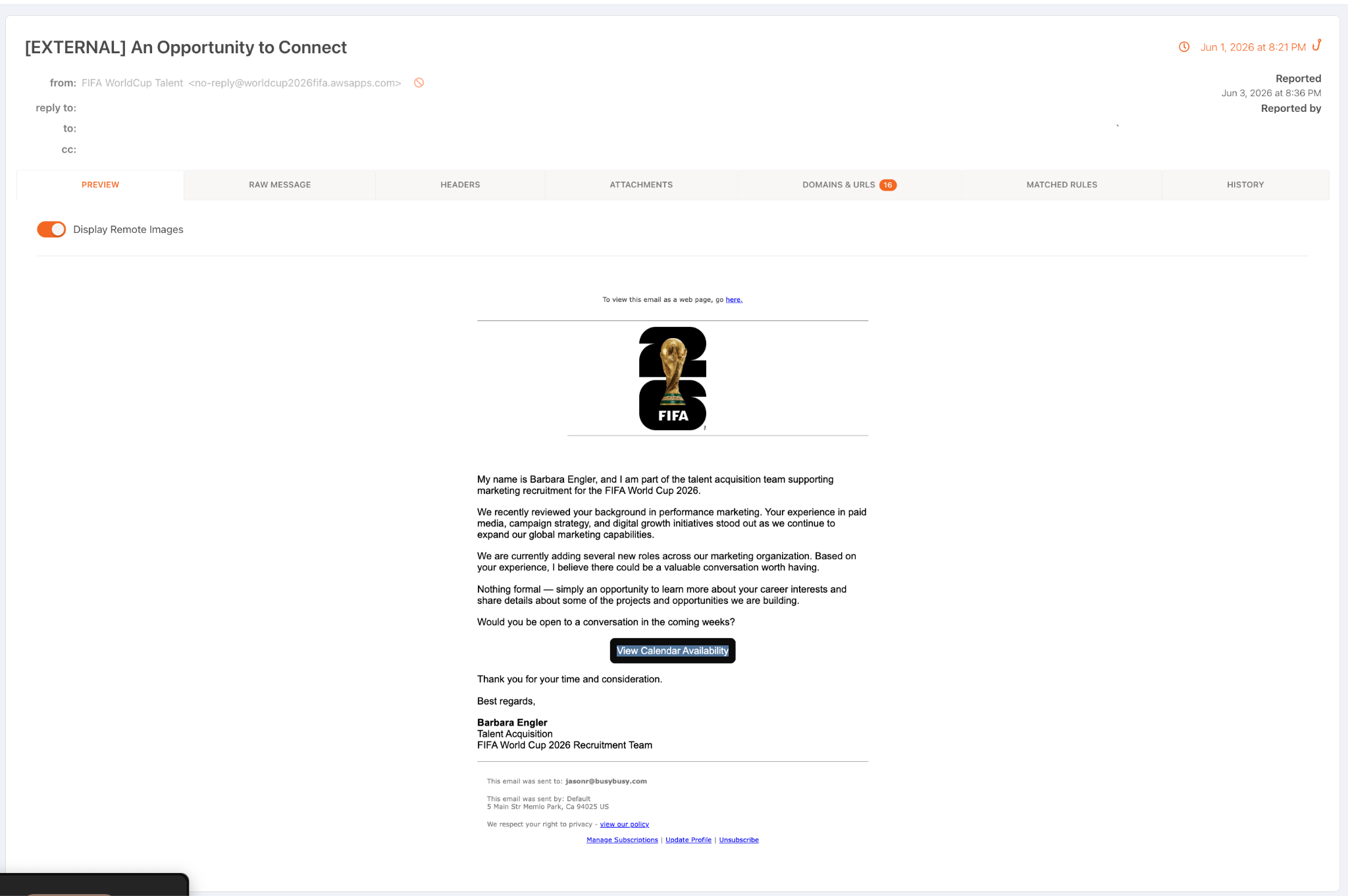
Fig. 7 — “An Opportunity to Connect:” recruiting lure from worldcup2026fifa[.]awsapps[.]com. Note 'View Calendar Availability' CTA - no attachment, sending domain passes SPF.

Step 2 - The Booking Bait

The email bypasses standard attachment payloads entirely. Instead, it presents a low-friction call to action — “View Calendar Availability” or “Select a time here” — to book a preliminary interview. There is no attachment for scanners to detonate.
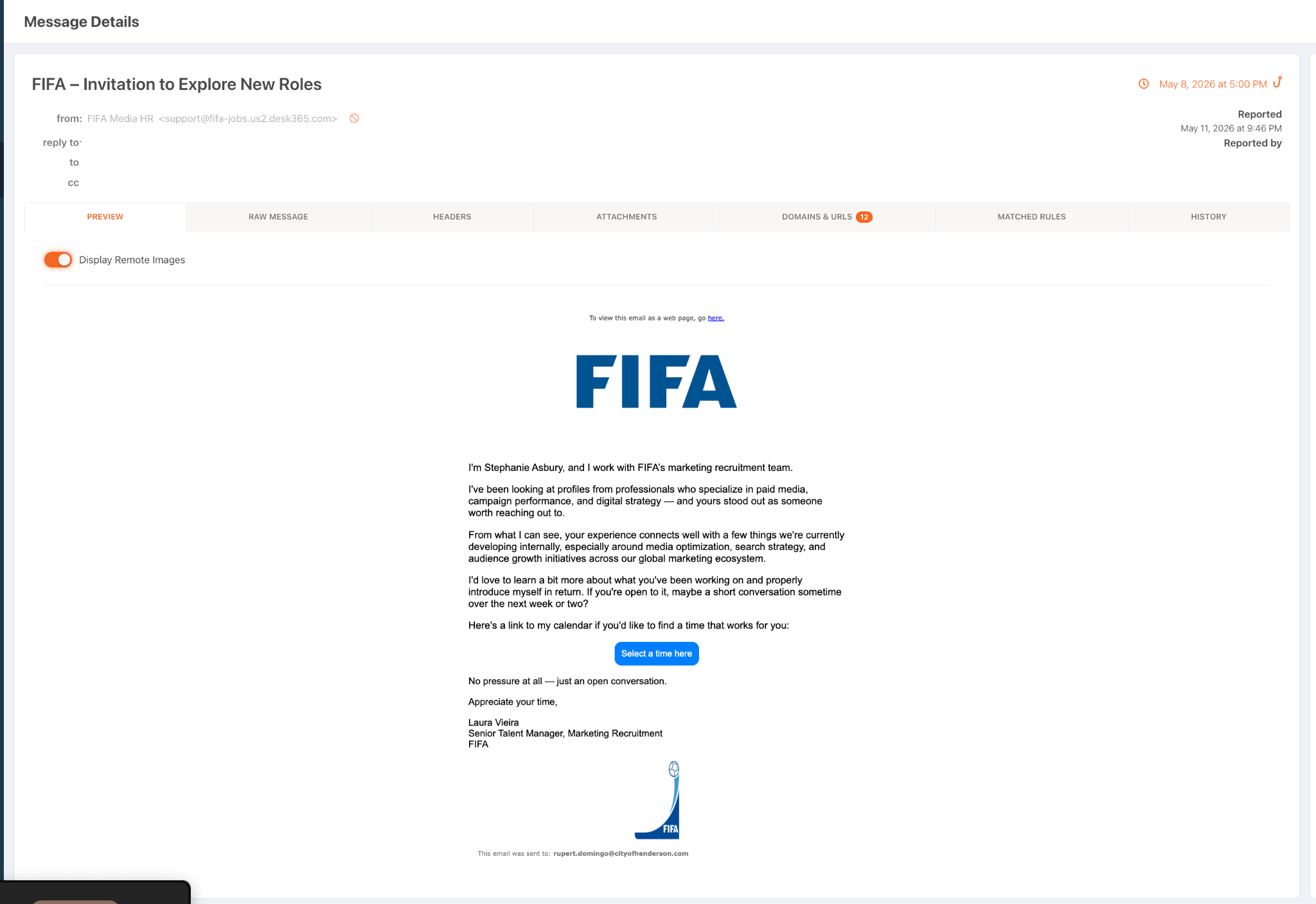
Fig. 8 — “FIFA – Invitation to Explore New Roles:” second recruiting variant with calendar CTA. Sent from an unrelated domain with FIFA display name spoofing.

Step 3 - Redirection and Fingerprinting

Clicking the calendar link redirects the victim through transactional tracking links (cl[.]s13[.]exct[.]net) onto branded landing pages. Two directly observed:

  • fifahiring[.]com
  • fifa-careerhub[.]com

The redirect chain obscures the final destination from URL scanners that inspect links at delivery time.

Step 4 - The SSO Phish

To finalize the interview slot, the victim is prompted to authenticate via Google or Microsoft SSO (“Continue with Google”). The moment they attempt to sign in, corporate or personal credentials are harvested in real time.

Step 5 - Survey Track: Card Harvesting

A parallel track presents a fake survey with Facebook-style dynamic testimonials to build trust. On completion, the kit redirects victims to otakusignalflow[.]com to cover a nominal shipping fee of €2.35 — capturing raw card numbers, CVVs, and expiry dates in real time.
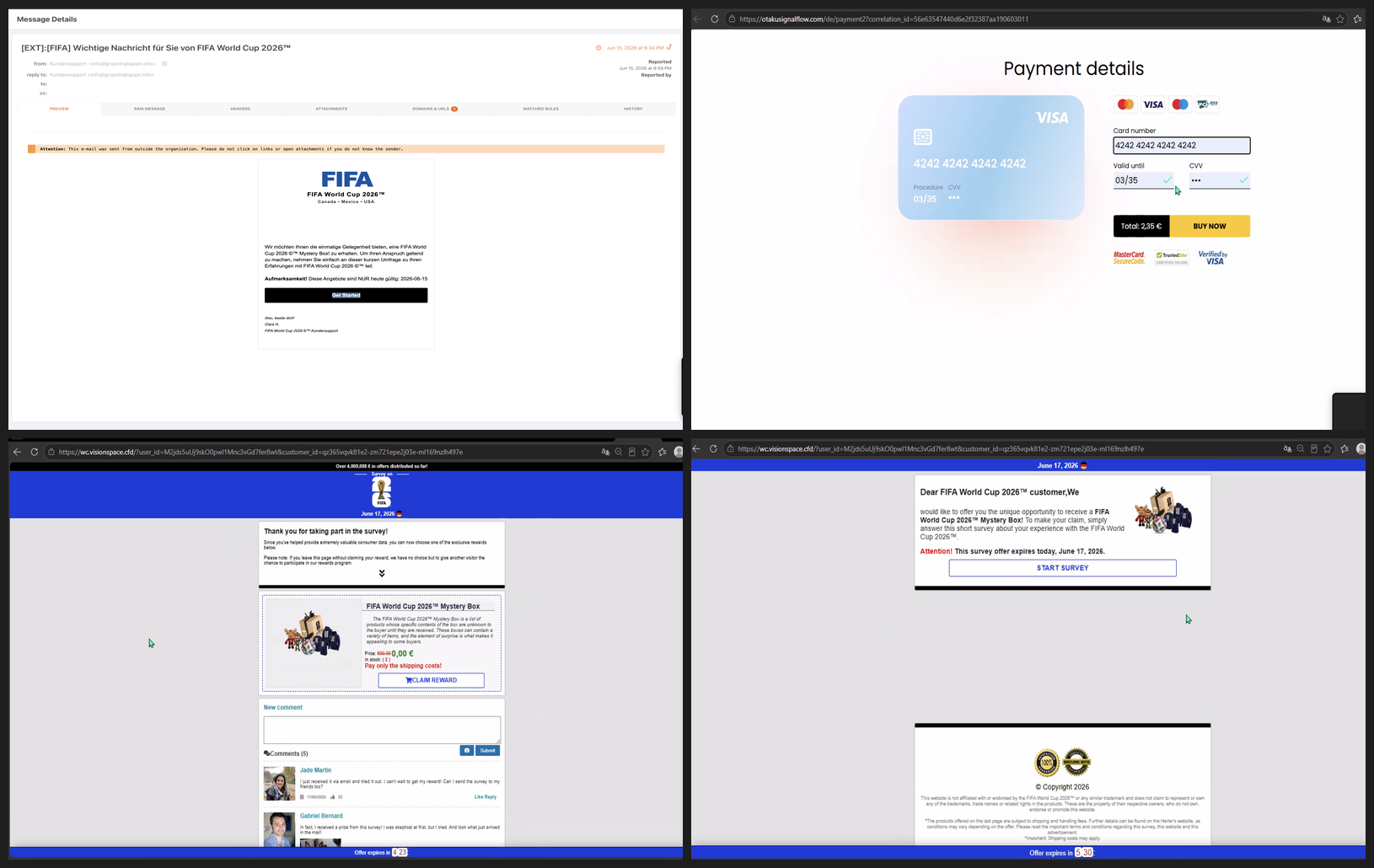
Fig. 9 — Full card-harvest chain: (top-left) FIFA Mystery Box lure; (top-right) otakusignalflow[.]com payment capture page; (bottom) survey pages with fake testimonials.

Fake FIFA Jobs Portal: fifaworldcup-jobs[.]com

The recruiting campaign is further supported by a convincing fake FIFA careers portal at fifaworldcup-jobs[.]com, presenting plausible job categories including FIFA World Cup Sponsorship Packages, Free Remote Posting and FIFA World Cup Event Jobs. The domain triggers browser TLS warnings for users with certificate inspection active.
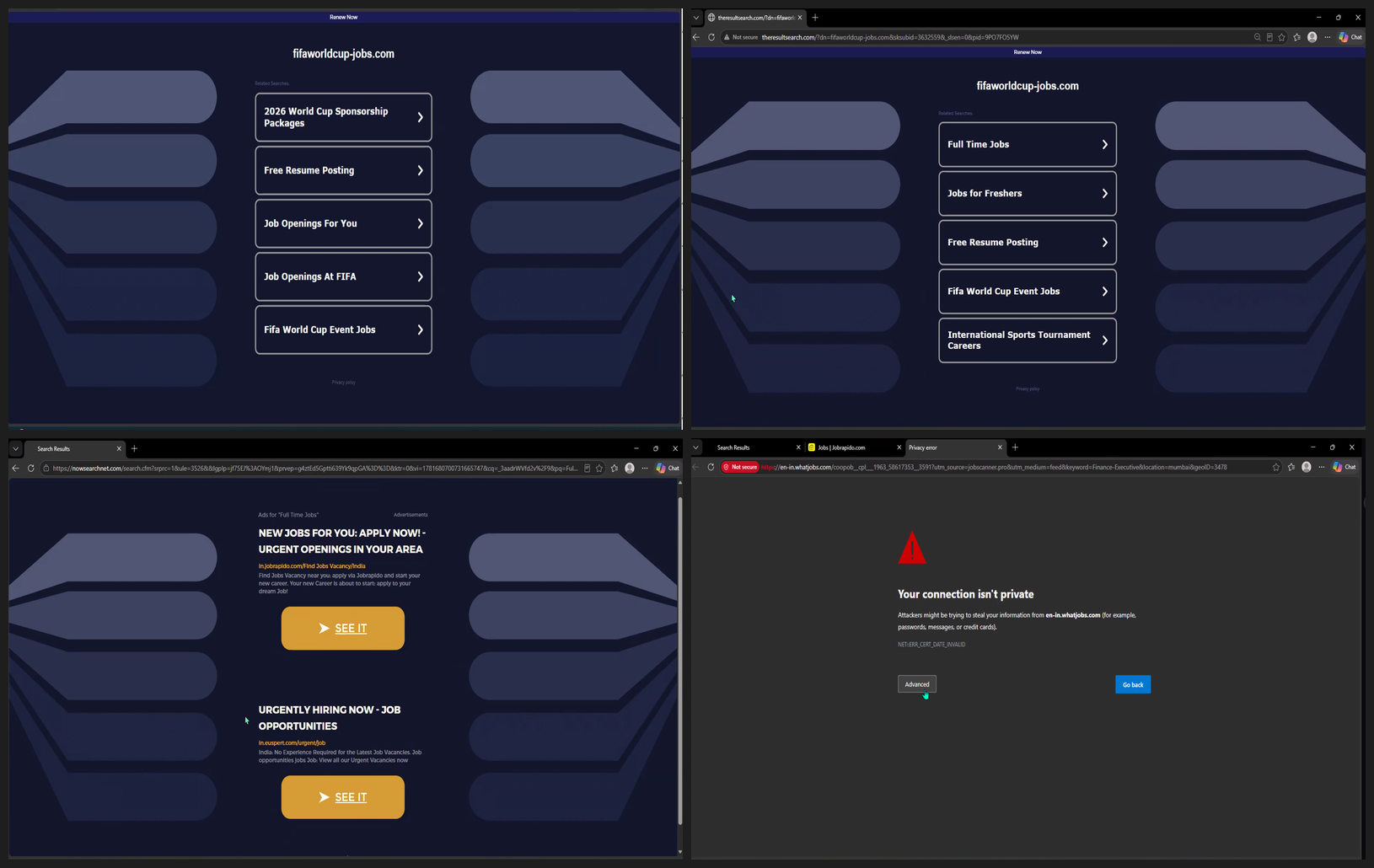
Fig. 10 — fifaworldcup-jobs[.]com fake FIFA careers portal. Left: job listing categories. Right: “Your connection isn't private” browser warning indicating non-standard TLS configuration.

Commodity Phishing: Ticket Scams, Watch Parties and Travel Fraud

Below the targeted recruiting campaign sits a much higher-volume commodity layer: mass-generated, automated phishing designed to hit as many inboxes as possible, exploiting the genuine scarcity of World Cup tickets and the cultural pull of the tournament.

Characteristics

  • High volume, automated, and opportunistic — designed to target en masse rather than specific individuals or organisations.
  • Typically mimic spam by impersonating trusted brands and organizations.
  • Utilise polymorphic tactics to randomise links, email metadata, display names and sender addresses per send to bypass detection products.
  • Primarily use credential-harvesting links, often hidden within email bodies or attachments.

Primary Lure Themes Observed

Most attacks focus on buying, selling and transferring tickets through presale draws or sponsored ticket offers. This method is effective because tickets to high-demand matches are genuinely scarce and carry significant price premiums.

A regional variation has also been noted: U.S.-region traffic is dominated by ticket-transfer fraud. UK-region traffic shows higher volumes of marketing and engagement lures — sponsored watch parties, events and merchandise discounts.

A niche but growing angle surrounds travel, parking and transport at U.S. stadiums, where car-dependent infrastructure creates demand for ride-hailing and parking services. Currently low volume, but expected to scale as the knockout stages attract larger audiences.

Additional lure categories we anticipate but have not yet seen at a significant volume: betting tips and sweepstakes; malicious links to pirate live streaming sites.
Polymorphic Evasion - Documented Examples

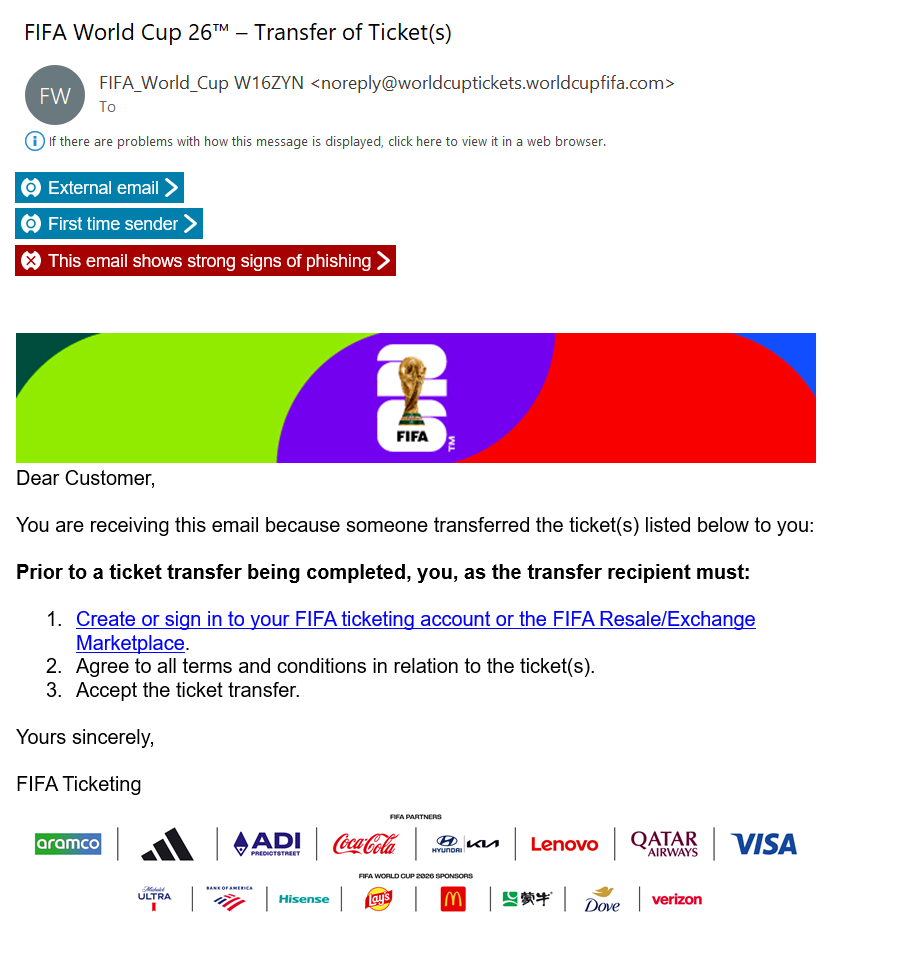
Example 1 - FIFA World Cup 26™ Ticket Transfer Lure

  • FIFA ticketing impersonation.
  • Polymorphic elements: random six-character suffix appended to the display name.
  • Rotating subject lines: "FIFA World Cup 26™ - Transfer of Ticket(s)" and "Win tickets FIFA World Cup 2026 Final."
  • Hyperlink payload leads to a credential harvesting page.
  • Observed sender domain: noreply@worldcuptickets.worldcupfifa[.]com

Fig. 11 — FIFA ticket transfer phishing email from worldcuptickets.worldcupfifa[.]com. Real FIFA partner logos (Aramco, Adidas, Visa, Coca-Cola, Hyundai) included to increase perceived legitimacy.
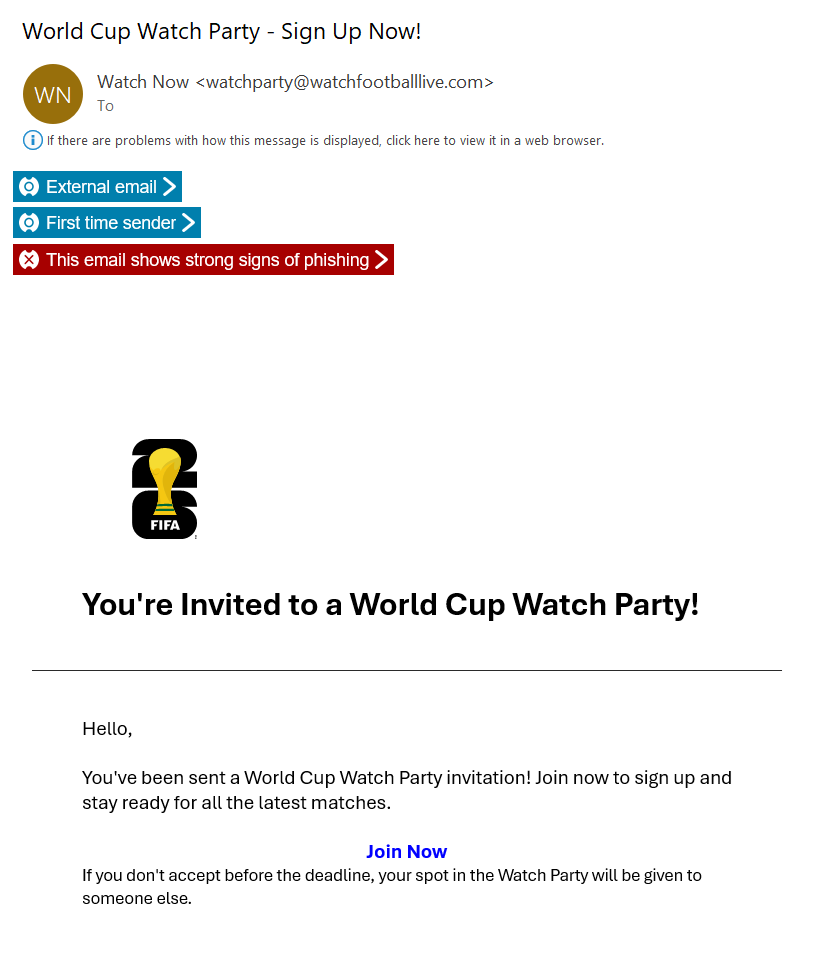
Example 2 - Office Watch Party Lure

  • Social engineering via artificial urgency and generic greetings.
  • Mass-generated phishing focused on bulk volume, not personalization.
  • Link payload leads to a credential harvesting page.
  • Observed sender: watchparty@watchfootballlive[.]com

Fig. 12 — Watch Party phishing email. Email client flags 'External email', 'First time sender', and 'This email shows strong signs of phishing'.

Example 3 - Multi-Language International Lure

A German-language variant of the FIFA Mystery Box survey scam was observed, sent from info@grupotrabajopn[.]info and reported June 15, 2026. This confirms the campaign is operating across multiple language markets beyond English-speaking targets.
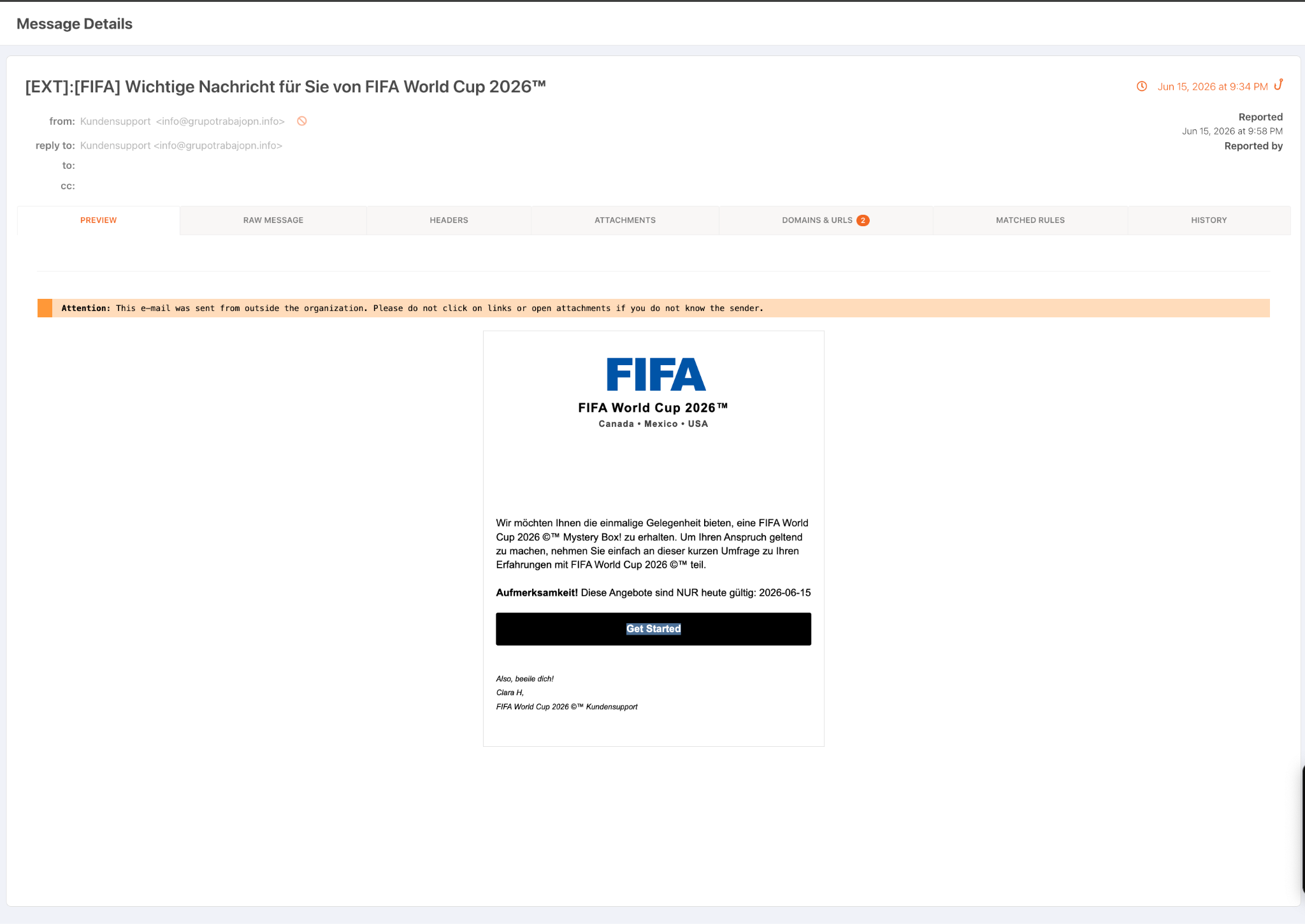
Fig. 13 — German-language FIFA Mystery Box phishing email (Jun 15, 2026) from grupotrabajopn[.]info. Subject: “[EXT]:[FIFA] Wichtige Nachricht für Sie von FIFA World Cup 2026™.” Confirms multi-language targeting.

NEW: Reply-Back and Advance-Fee Fraud Campaigns

A third distinct campaign track was identified in the updated telemetry. Unlike the recruiting and commodity campaigns, these emails contain no malicious links or attachments — making them largely invisible to automated email security tools that scan for technical payload indicators.

How the Campaign Operates

1. The Bait

Users are enticed with high-value rewards tied to the tournament — ranging from modest incentives (e.g., $50 cash vouchers or free match access) to extravagant VIP luxury ticket packages valued at $8,000+. These lures are designed to trigger excitement, create urgency and lower psychological defenses.

2. The Call to Action - The “Reply-Back”

These emails contain no malicious links or attachments. The call to action instructs the victim to reply directly to the sender or manually email a secondary attacker-controlled address to “claim” their prize. There is no technical payload for scanners to inspect.

3. Why It Bypasses Security Filters

  • Modern email security scrutinises URLs and file attachments. By forcing a purely text-based reply, the initial delivery is “clean” — passing automated scanning without triggering any technical indicator.
  • The moment a user replies, they confirm to the attacker that the account is active, monitored and that the user is susceptible to this specific social engineering lure.

4. The Hook - How the Trap Closes

Once the victim engages, follow-up emails deploy one of two payloads:
  • Credential Harvesting: Demanding corporate login credentials to "confirm registration status."
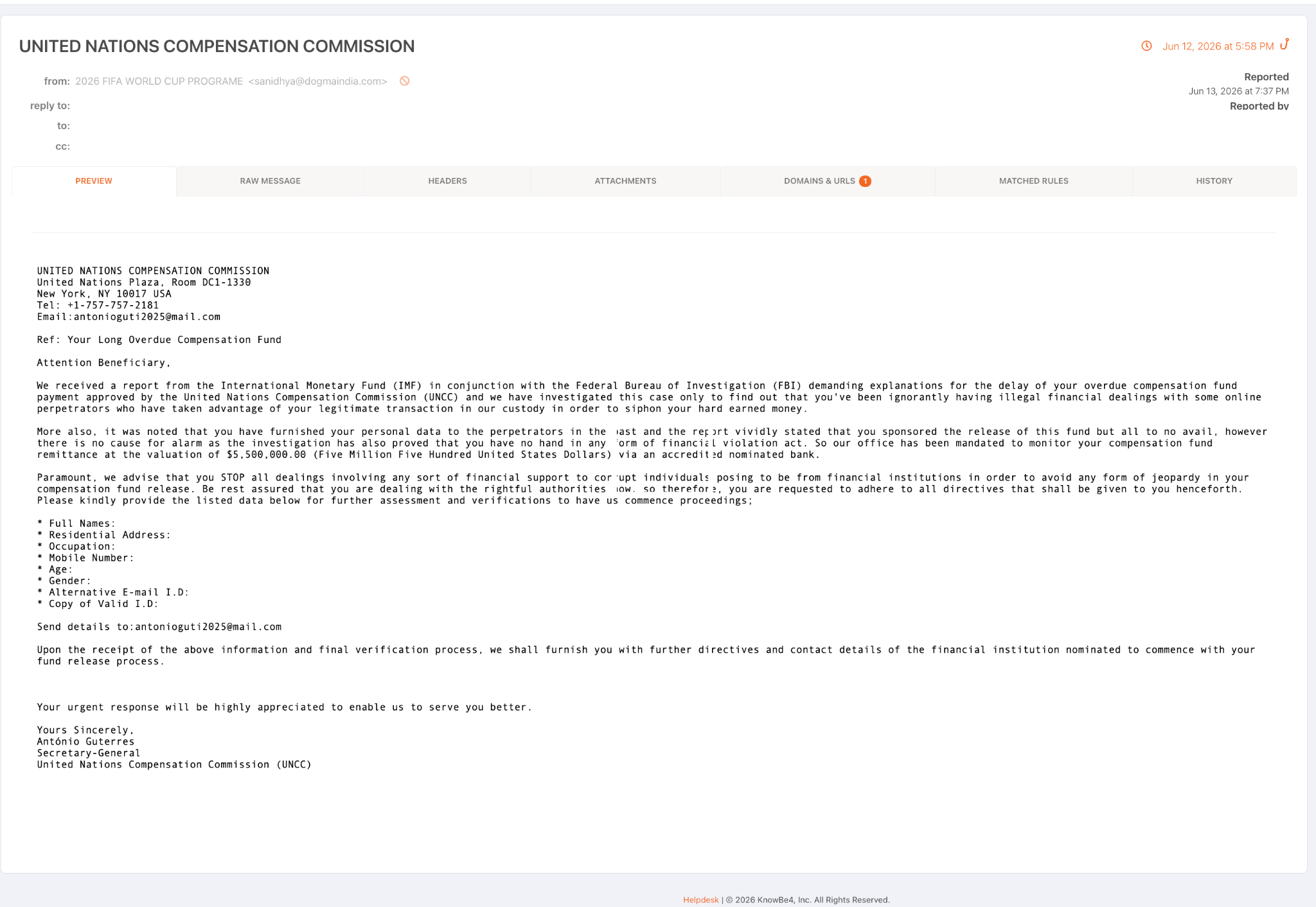
  • Advance-Fee Fraud: PII collection for "identity verification" followed by a wire transfer demand for fictitious "taxes, registration, or processing fees."

Fig. 14 — Advance-fee fraud email posing as “United Nations Compensation Commission,” leveraging FIFA World Cup 2026 context. Sent via canadiansoccerleague[.]org infrastructure. Requests full PII and bank account details.

Defender note: Reply-back campaigns have no payload for scanners to inspect. Detection requires body-level behavioral analysis — specifically, unsolicited prize or reward offers with a reply-only CTA. User awareness training is the primary control against this vector.

Indicators of Compromise

All indicators are defanged. Do not resolve or interact with them from production environments. Query using passive DNS, historical WHOIS, Shodan, or sandboxed scanners only. Do not submit raw victim PII to public scanning engines.

Top 5 Fake FIFA Domains Observed

  • worldcuptickets[.]worldcupfifa[.]com
  • fifa[.]click
  • www-fifa[.]net
  • worldcup-tickets[.]live
  • jobs-fifa[.]com

Recruiting Campaign Infrastructure

  • [Domain] worldcup2026fifa[.]awsapps[.]com — Recruiting scam — AWS application services abuse, initial outreach
  • [Domain] fifa-jobs[.]us2[.]desk365[.]com — Recruiting scam — Desk365 helpdesk platform abuse
  • [Domain] fifahiring[.]com — Recruiting scam — branded SSO phishing landing page
  • [Domain] fifa-careerhub[.]com — Recruiting scam — fake scheduling portal / credential harvest
  • [Domain] fifaworldcup-jobs[.]com — Recruiting scam — fake FIFA careers portal
  • [Domain] otakusignalflow[.]com — Live card-harvesting payment gateway (€2.35 shipping fee lure)

Redirect and Tracking Infrastructure

  • [Tracker] cl[.]s13[.]exct[.]net — Transactional tracking redirect — obscures final destination from URL scanners
  • [URL] hxxp://theresultsearch[.]com/ — Redirect / landing page infrastructure
  • [Domain] nowsearchnet[.]com — Redirect infrastructure
  • Campaign Infrastructure Pivots

  • [Domain] canadiansoccerleague[.]org — Impersonation / lure infrastructure — used in advance-fee campaign delivery
  • [Domain] installtec[.]eng[.]br — Phishing email delivery
  • [Domain] manidharipharma[.]online — Campaign infrastructure pivot
  • [Domain] visionspace[.]cfd — Campaign infrastructure pivot
  • [Domain] grupotrabajopn[.]info — Pivot domain — sender in German-language Mystery Box lure (Jun 15)

Infrastructure reuse note: The pivot domains (manidharipharma[.]online, visionspace[.]cfd, grupotrabajopn[.]info, installtec[.]eng[.]br) are structurally unrelated to FIFA but appear in the same campaign infrastructure. Pivoting through passive DNS may surface additional related infrastructure.

What Defenders Should Do

Block and Filter

  • Add all IOCs to gateway blocklists immediately. Prioritise: fifahiring[.]com, fifa-careerhub[.]com, fifaworldcup-jobs[.]com and otakusignalflow[.]com.
  • Create display-name detection rules for "FIFA" and "World Cup" spoofing. Flag any external email where these strings appear in the display name and the sending domain is not a verified FIFA or tournament-official domain. FIFA display name spoofing is now running at six times baseline.
  • Enable time-of-click link analysis. Pre-delivery URL scanning is defeated by the cl[.]s13[.]exct[.]net redirect chain. Time-of-click inspection of the final destination is required.
  • Flag text-only unsolicited prize or reward emails. The reply-back campaign carries no technical payload. Detection requires body-level behavioral analysis.
  • Run a World Cup-themed phishing simulation. Ticket-offer, fake job opportunity and prize/voucher reply-back lures are all active and supported by observed telemetry.
  • Educate your co-workers about FIFA- and World Cup-themed social engineering attacks. Ensure your coworkers understand that any current day exciting headlines are often used by scammers to socially engineer people.

What to Watch for as the Tournament Progresses

  • Pirate streaming sites offering free live match coverage — expected to scale in the knockout stages.
  • Betting tips and sweepstakes lures — expected to spike from the round of 16 onward.
  • Ride-share, parking and stadium transport fraud — specific to U.S.-hosted venues given car-dependent infrastructure.
  • Merchandise and replica kit fraud — fan spending on branded goods increases sharply during the knockout stages.

For real-time updates and ongoing threat intelligence, follow the KnowBe4 ThreatLabs on X:@Kb4Threatlabs