








In the latest episode of Frontline Conversations, physician-scientist and scientific consultant Dr Karishma S. Kaushik speaks about the realities of building a career in science—beyond awards, breakthroughs, and public recognition. Drawing from her book The Real Deal, Kaushik reflects on the often-unseen side of scientific life: failed experiments, long periods of uncertainty, and the emotional resilience required to stay the course.

Dr Karishma S. Kaushik | Photo Credit: By Special Arrangement
She explains the idea of the “leaky pipeline” in STEM, explaining why many women enter science with promise but exit midway through their careers. The conversation explores structural barriers in India’s scientific ecosystem, from limited job opportunities and a lack of transparency in hiring to the burden of invisible labour that disproportionately falls on women scientists.
Edited excerpts:
Most books about science focus on discoveries and breakthroughs. The Real Deal spends a lot of time on everything else—the waiting, the failed experiments, the doubts, the small victories that never make it into the textbooks. Why did you feel this part needed to be written about?
The Real Deal has been a little over a year in the making, and it occurred to me to write it when I was transitioning out of what I had then thought was my dream job. You grow up with notions about a career in science—it’s about discoveries, working at the edge of knowledge, accomplishments, awards, recognition, dream jobs. I did experience a lot of that. But what I also realised was that a large part of my life in science was being lived in between the awards and accomplishments.
But we don’t talk enough about what led to that award, how many doors closed, how many times you had to keep knocking. That really hit me hard when I was leaving my dream job. I was mid-career, midlife, and a lot of my reflections during that period led me to the conclusion that the real deal about living a career in science needs to be out there, told by women who are currently making a career in science happen, not in the form of biographies written towards the twilight of one’s career as an afterthought. It has to be a living, breathing storytelling experience. The Real Deal is written with humour, honesty, and hindsight.
Your book is candid about the fact that many women enter science with great promise but leave somewhere along the way. From your experience, what is one feature of lab culture that needs to change if we want more women to stay?
That’s often called the leaky pipeline—the phenomenon where women enter STEM in large numbers with a lot of passion and commitment, and then somewhere along the way, the pipeline takes its effect. In India, it actually sets in when women complete their basic STEM education and are looking for jobs. That’s the plug that needs to be fixed first: why are so few women able to access prestigious STEM jobs? Not just academia—but also positions in industry, think tanks, policy groups, and government organisations.
Fair enough, academia doesn’t have remote work as an option, but you can still ensure that hiring is gender-balanced. You can open sufficient positions for the number of STEM graduates seeking jobs. You have hundreds of thousands of STEM graduates and only a trickle of actual long-term lucrative positions—that’s the root of the problem. Transparency in recruitment, feedback when you decide not to recruit someone, timelines and accountability—so it’s not just a black hole when women apply to these positions.
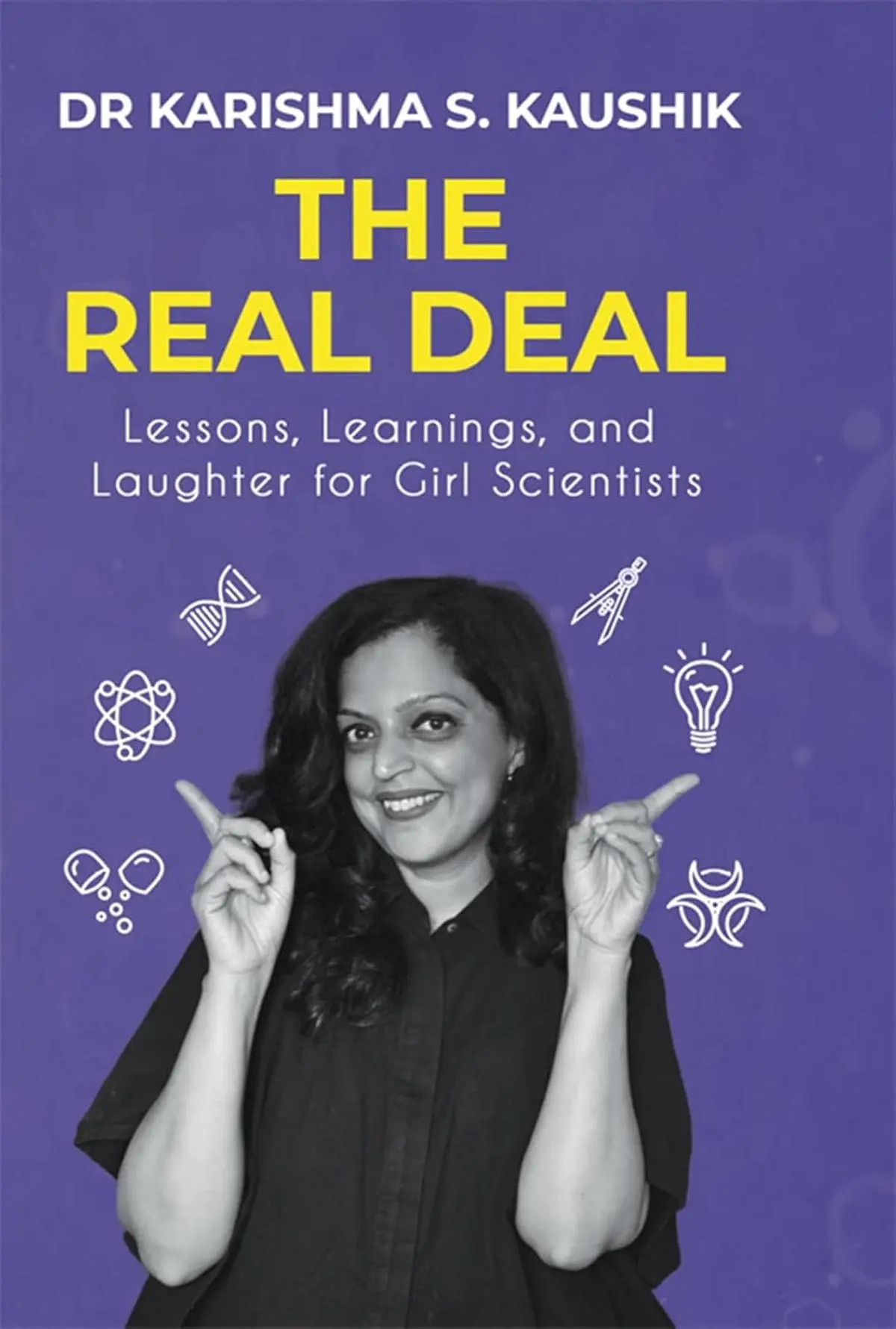
Cover of The Real Deal. | Photo Credit: By Special Arrangement
You moved from India to the United States for your PhD, then chose to return to build your career. What surprised you most about doing science in India after training abroad?
It’s not that everything there was perfect, and everything in India is hard. I’ve written in the book about how, at the US university where I did my PhD, they did not have a maternity leave policy for PhD students. They had never thought of putting on paper what they would do if a female PhD student said, I’m becoming a mother during the course of my PhD. A PhD is typically five to seven years—it’s not a short degree. So I was basically left to craft my own maternity leave. India actually does this very well. All PhD researchers in institutes in the country have a six-month maternity leave built into their fellowships and grants.
That said, the real shocker in India—and I try to talk about this humorously in the book because it takes the pain away a little—is the amount of paperwork and bureaucracy that governs the way we do science. It still runs at a pace that was set fifty, sixty, or seventy years ago. Science in Europe or the United States doesn’t work on paper purchase requisitions and arduous procurement processes. It really stalls science and takes away the joy of doing research in India, because you spend so much time thinking about how to get things done rather than actually getting them done.
You write candidly about experiments that didn’t work—something we rarely hear about. Tell us about waiting months for a result that turned out differently from what you’d hoped, and how you moved forward.
The start of my PhD was like that—and the start of most STEM PhDs would be. You’re given this vague problem, your supervisor has thought about it a little: this is a gap in the field, just go do something with it. A PhD is about discovering something no one has explored before; it’s not a ready-made course where you complete credits and get a degree. In the first few years, I kept doing experiments only to find that the results weren’t syncing up. I was doing the same experiment over and over, and the results were all over the place. That was about two years of work, until I went to a scientific conference, presented the work, and realised: I don’t think this project is going anywhere. I need to abandon it.
That’s also a decision scientists have to make—when do you abandon a project? I returned to the lab, was handed a new project, and things moved more quickly. Even then, there were days I went in very sceptical of what I was going to see, but I stumbled on a big discovery—something very unique that happened in the experimental system. But there were also days when I was sure a drug combination would give good results, and it didn’t, and we just had to publish that the results weren’t that great. My PhD taught me that science is not about wins. It’s about the process and being open to whatever the result is. Even a negative result—even showing that two drugs don’t work together as effectively as you’d hypothesise—is a result.
You write that science needs laughter and scientists need a sense of humour. That’s not how most people imagine laboratories. Why does humour matter, and what’s the funniest moment you’ve experienced in the lab?
Scientists are inherently serious, committed, passionate people, and science is a tough career—opportunities are few, journeys are long, you’re working against systemic constraints. A sense of humour, often in hindsight, just makes the journey easier on oneself and on the people around you. One moment that stood out: I was at a university in Pune, newly returned to India, leading my research group, and I had no idea how science in India functioned. I went to a senior professor and said, “There’s a bird’s nest in the women’s bathroom—maybe that needs to be taken care of, maybe we can relocate the chicks carefully”.
And she said, all right, write up a purchase requisition and send it to me. I remember thinking this is strange—in most corporate offices or newsrooms, housekeeping staff would handle that; it wouldn’t be the job of a faculty member. But I thought, maybe it doesn’t work like that here. So I wrote up the requisition. Under “what do you want to buy?” I wrote: a bird’s nest. I was called from my office to the professor’s room, where there were lots of people sitting, and she said, “ You want to buy a bird’s nest? I said, no, no—the nest that needed to be removed. And she said, then you must write ‘bird’s nest removal’. I left the room thinking, I need to learn so much about how science in India works — but also thinking, why should scientists be worried about bird’s nest removal? This is not where our time should be spent.
You also describe the moment a dream job turned out to be harder and more complicated than expected. What did that feel like, and how did it reshape the way you think about success?
It was a difficult phase. We hear about dream jobs, we hear about wanting to get one, but no one tells you what it feels like to leave a dream job. It was a prolonged period of mental acrobatics to get to that place. But if anything, it taught me that we can’t live life or build our careers around labels—it dispelled that notion for me that there’s even such a thing.
Now I think of there being many dream opportunities, but I’ll enter all of them more discerningly and wisely—because I’ll also think of what comes after, and what I should ensure an opportunity comes with: what kind of support can I expect, finances, personnel and so on. It’s been close to a year and a half now, and I look back with a lot more learning and less emotion. The Real Deal is always much more than those terminologies and the ‘perfect’ castles that are built and sold about education and careers.
Young female scientist looking through a microscope. (Image for representative purposes). Drawing on her experience in India and the United States, Dr Kaushik speaks about research culture, maternity leave policies, and the administrative challenges that shape laboratory work. | Photo Credit: Sanjeri/Getty Images
You also discuss the extra labour that often falls on women scientists—mentoring, outreach, committees, and institutional service. Why does this work tend to land on women, and how should institutions think about distributing it more fairly?
When the press talks about women scientists, save and except for a few examples, a lot of coverage is about a woman scientist setting up a childcare facility, or fighting for breastfeeding rights. This invisible extra work that women carry is encased in advocacy. But it’s not that men scientists don’t need daycares, or shouldn’t be responsible for diversity on campus. These issues in the scientific ecosystem are considered women’s issues—diversity, equity, and inclusion are seen as women’s problems because women have to be better represented. But DEI is an institutional problem. It’s an ecosystem problem.
This extra work falls on women partly because we, as women, often have a deep-seated concern about being seen as not willing to take up opportunities. We’re eager to show ourselves as contributing, as a team player—there’s a deep-seated imposter syndrome that shows up when you finally land a great opportunity. You want to show you’re valuable not just for science but for everything. And then you get talked about more for all of this other work than for the science you’ve been doing, and in turn, more of all this additional work is given to you.
This also comes from very deep-seated patriarchal notions that transfer directly into the scientific workforce. In conferences and meetings, you’ll find women scientists inviting guests, getting them seated, making sure they’re well fed, and their transportation sorted. How women scientists are acknowledged and appreciated stems from social constructs that are carried into the workforce.
Before we wrap up—if a young girl is reading The Real Deal and trying to decide whether science is the path for her, what is the most important question you hope she asks herself?
The book is very intentionally placed in a space where it is inspirational and informative. It’s important for young girls embarking on careers in science to be inspired, but also informed of the challenges, the obstacles, the roadblocks—so you can better plan for them. Proactively plan your career with yourself in the driver’s seat, and not becoming a victim of a system that is archaic and slow to change. The recognition that policies are not going to change as fast as we want to advance in our careers—it’s going to take a while—and the best thing we can do is plan and prepare accordingly. So, I would hope she asks herself: Do I know enough about what the challenges and opportunities in science are? How can I find out more? What do I need to do to better prepare myself for a career in science?
This transcript has been edited for length and clarity