







The new Labour Codes on industrial relations, wages, occupational health and safety, and social security actively invisibilise workers in the unorganised sector even as they claim to “universalise” social security and minimum wages. These workers constitute an estimated 93 per cent of the workforce and produce about 65 per cent of the country’s GDP.
And, as is characteristic of the current regime, tall claims are being made to make the Central government seem benevolent, when, in fact, the new codes accord huge benefits to big business at the expense of the most marginalised working classes in the country.
The attempt to “codify” 29 labour laws into four Labour Codes has devastated the diversity of this large set of workers and the specific laws that ensured their protections and welfare. The move to “codify” labour laws is an attempt to centralise control over labour. It has necessitated the violation of several constitutional principles, democratic procedures, and leading principles and standards for labour set by the International Labour Organization (ILO).
No discussion, no consultation
At this juncture we must recall how three of the four new codes were passed: without any debate in the Lok Sabha in September 2020, when the opposition boycotted Parliament in protest against three controversial farm laws.
Also, the codes were passed without a tripartite consultation among workers, employers, and government representatives at the Indian Labour Conference (ILC). The ILC was held once a year at the national level consistently for decades but that stopped after 2014, when the BJP-led National Democratic Alliance (NDA) came to power.
The new codes themselves succeed in popularising and legitimising oppressive working conditions such as a 12-hour workday, as opposed to the global standard of the 8-hour workday, which was achieved after intense struggle against exploitation and long working hours.
Also Read | July 9 strike unites 25 crore workers against labour codes and low wages
In India, Babasaheb Ambedkar pushed for an 8-hour workday at the ILC in 1942 to ensure humane working conditions for the working class. While actual conditions at the workplace frequently violate this principle, to legally allow 12-hour workdays through legislation is a dangerous prospect that exposes all workers to exploitative working conditions. It serves to justify current working conditions rather than seeking to improve them.
Also, the new codes constrain the right to strike. This is an attack on the basic powers of collective bargaining of workers. Besides, contract or fixed-term employment has been legitimised, even in perennial jobs such as manufacturing.
Against worker rights
These are but a few of the transgressive measures the government has taken in the name of ensuring “ease of doing business” that trade unions and workers’ organisations across the country have been pushing back against for the past five years.
While the new codes impact all workers, the structurally marginalised unorganised sector faces particularly heightened dangers that are perhaps not being discussed adequately in the media right now.
In what has been characterised as a way to ensure minimum wages, the new Wage Code empowers the Central government to fix a floor wage while accounting for the minimum living standards of a worker across different parts of the country. Any minimum wages set will not be lower than the floor wage set by the Central government.
This is the first time that a “floor wage” has acquired legal backing in the history of Indian labour law. What Article 43 of the Constitution stipulates is that the state secure for all workers “a living wage, conditions of work ensuring a decent standard of life and full enjoyment of leisure and social and cultural opportunities”.
Floor wage and living wage
The difference between a floor wage and a living wage is that the floor wage aims to set the lowest possible baseline wage a worker can receive, while a living wage accounts for the various basic needs for workers, including a degree of social security.
The last attempt to set a floor level minimum wage was in 2017, to bridge wage gaps between workers in different enterprises across different parts of the country. This was set at a mere Rs.178 a day and has remained unrevised since, without accounting for inflation and mounting costs of living. This is much lower than the minimum wages set for various sectors of workers across many parts of the country.
It remains unclear when and how the Central government will fix a floor wage for the whole country, or how it plans to determine “minimum living standards”.
The idea of a floor wage poses the serious danger of driving down the minimum wage towards this floor, including in States that offer higher minimum wages, rather than aiming to provide a living wage to meet worker needs.
The Wage Code can irrevocably change our collective imagination about what a worker deserves, creating a race to the bottom rather than an aspiration of better wages and living standards for all workers.
Of the many laws repealed and subsumed under the Wage Code, the Equal Remuneration Act, 1976, dealt with equal pay for equal work for men and women. In reality, wide gender pay gaps continue to exist across sectors, and the fact that the Wage Code makes no mention of how it will ensure gender equality in pay is a matter of concern.
Blow to worker safety
The impetus of the codes to “codify” and “consolidate” existing laws, and thus flatten the realities of diverse workers, is most pronounced in the new Occupational Safety, Health and Working Conditions (OSHWC) Code.
In India, sector-specific labour laws emerged in recognition of the particular working conditions and hazards associated with each job. For instance, the Building and Other Construction Workers (Regulation of Employment and Conditions of Service) Act, 1996, known as the BOCW Act, was the hard-won outcome of struggles mounted by construction workers and trade unions since the 1970s. It took cognisance of the safety of 3.5 crore registered construction workers across the country through a set of 180 rules.

At a building site in Prayagraj on December 16. Given the hazardous nature of construction work, it must not be bundled under a single law. | Photo Credit: PTI
These are now entirely missing in the Central rules issued for the OSHWC Code. This is a dangerous sign given the hazardous nature of labour and the high number of fatal accidents in the construction sector. The replacement of an inspection mechanism with web-based facilitation cannot be an effective means of ensuring the safety of the workplace or minimum wage implementation.
Another casualty of the OSHWC Code is the Inter-State Migrant Workmen (Regulation of Employment and Conditions of Service) Act, 1979, known as the ISMW Act, which stipulates displacement allowance and journey allowance, alongside fair regular wages, residential accommodation, and suitable conditions of work. In the new code, the procedure for registration of workers and the jurisdictions and role of the State governments are unclear.
Impact on migrant workers
Given that guest workers have no unions for collective bargaining, labour organisations across the country have been calling for increased protection of these workers, which is yet to be established. These include compulsory registration in home villages and workplaces for benefits, registration in welfare boards, inclusion in the public distribution system, mobile medical vans with occupational health units, childcare, schools, and shelter facilities.
The disappearance of thousands of migrant workers from electoral rolls in Bihar is a sign of their erasure and disenfranchisement, which the new codes only heighten.
The OSHWC Code also seems to apply only to “establishments” where 10 or more workers are employed. This means that agricultural and fish workers, domestic and home-based workers, and large groups of informal workers have been left out of occupational health and safety considerations. When provisions for workplace safety do not extend to these feminised workforces, legitimising night work for women opens up the possibilities of dangerous working conditions, especially in the absence of rigorous inspection processes.
In addition to safety concerns, unorganised workers contract diseases from prolonged manual work and exposure across several sectors. For instance, silicosis is highly prevalent in the construction sector, while agricultural workers are experiencing a high incidence of cancer owing to the use of pesticides, and salt workers face chronic eye, skin, and kidney problems. The OSHWC Code does not address these realities of informal workers and their working conditions.
Occupational health
This negligence stands in violation of ILO Convention 161, which calls for a national policy on occupational health services for all workers and mandates identification, treatment, and rehabilitation in the event of an occupational disease.
The procedures for identification, treatment, rehabilitation, and compensation of workers in the event that they contract an occupational disease are conspicuously absent.
Given that the Employees’ State Insurance is not available to them, informal workers will be left entirely to fend for themselves with no state recognition or measures to address their occupational health and safety concerns.
The history of the welfare state in India indicates that differential welfare entitlements have been accorded to workers on the basis of their employment status. The new Social Security (SS) Code continues in that vein, with organised workers given some social security benefits, while informal workers are to receive vaguely defined “welfare schemes”.
The abolition of various cesses as part of GST reforms has huge implications for the informal sector: now, there are no guaranteed funds, raised either from employers or offered by the Central government, for the social security of workers in sectors such as beedi manufacturing and mining.
The repeal of sector-specific laws has already had a devastating impact: dedicated hospitals for beedi workers have been shut down and so have medical camps and the provision of educational assistance for the children of such workers. Since the cancellation of the salt cess, funding for the provision of drinking water, toilets, childcare facilities, medical camps, and housing is no longer available for the sector.
The only sectors of informal workers that the code seems to recognise are construction and gig workers, who are each to be served by two separate welfare boards, while all other workers will be served by one welfare board. This is in sharp contrast to sector-specific welfare boards and laws that exist in multiple States, including Tamil Nadu, Kerala, and Maharashtra.
Welfare protection
For instance, the Tamil Nadu Manual Workers (Regulation of Employment and Conditions of Work) Act, 1982, protects unorganised workers across several sectors. Currently, there are 20 functional welfare boards enabled by the legislation under the State’s Labour Department that offer registered workers several benefits and protection, including old age pension, educational assistance for children, and marriage and maternity assistance.
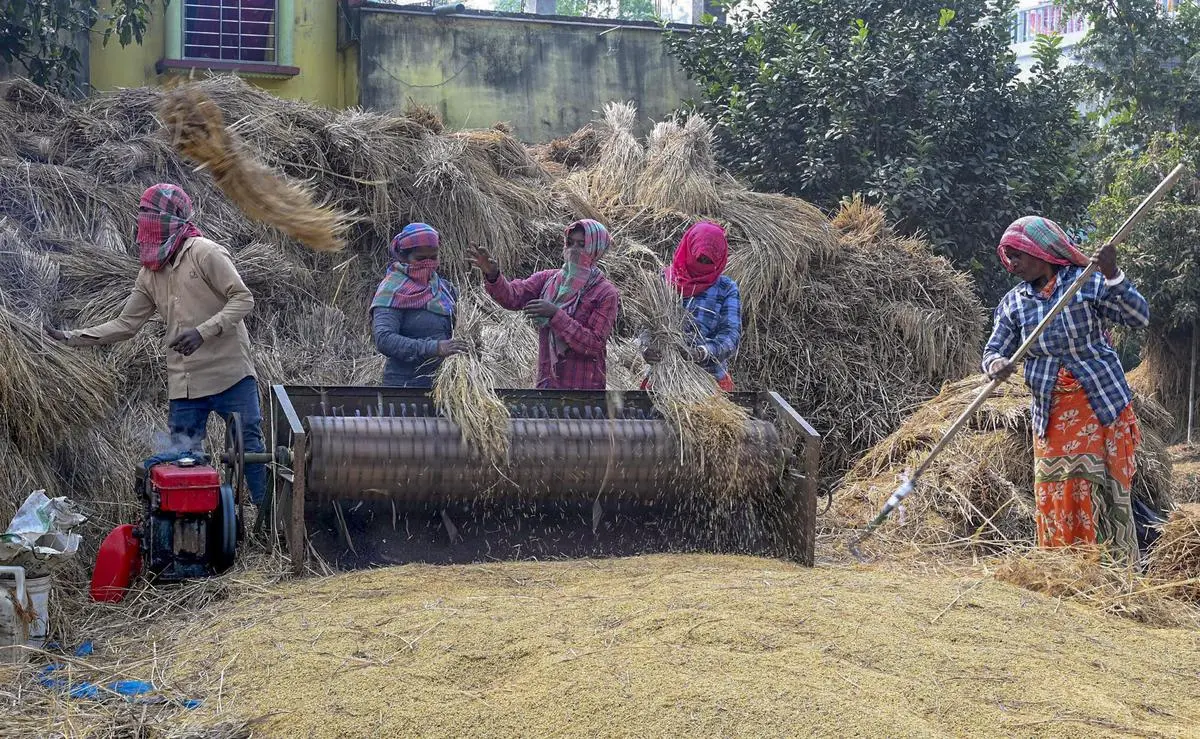
At a paddy field during the harvest in West Bengal’s Malda on December 9. Given that migrant workers have no unions, labour organisations have asked for their increased protection, but to no avail. | Photo Credit: PTI
Other than these, there are 18 other welfare boards administered by various departments for workers in the fisheries and agricultural sectors, transgender people, and others. Some two crore workers are registered across these various welfare boards. The biggest risk of the SS Code is that there is no saving clause to ensure that State laws and welfare boards will be protected, unlike earlier Central laws like the BOCW Act or the Unorganised Workers’ Social Security Act, 2008.
Even in the construction sector, the implementation of the now-centralised e-Shram registration system creates a possibility for the Centre to take over accrued funds—estimated to be of the order of Rs.1 lakh crore—raised for workers’ welfare. This is clearly an attempt to centralise social security measures and control their funding. Further, the SS Code stipulates the collection of levies only from constructions costing over Rs.50 lakh, reducing the total amount of money collected for worker welfare.
Also Read | Long hours, no overtime pay: Are India’s archaic labour laws enabling worker exploitation?
After decades of labour movement struggles to enforce increased protections for the unorganised sector through specific laws, the latest Labour Codes mark a new inflection point.
Isolating workers
The recently released Shram Shakti Niti 2025, the government’s labour and employment policy, invokes the Manusmriti to describe labour as a “sacred and moral duty”, even as the new codes destroy hard-won protections for workers. They have been formulated in a way that does not allow unions and worker organisations to play any meaningful role, as is clear in their exclusion from online registration procedures for workers and in the undercutting of all powers of collective bargaining.
Not only do these measures isolate workers, they also hinge unrealistically on misunderstood levels of digital and institutional literacy and bode ill for the future of labour welfare. But there is hope, especially in the federal spirit displayed by State governments such as Kerala, which have refused to implement the codes and surrender their own painstakingly built labour welfare architecture.
Other governments must follow suit and demand that existing State-level laws be upheld and welfare boards saved. As workers across the country are demanding, the ILC must be convened to meaningfully discuss the new Labour Codes.
Against the centralising tendencies of the new codes, the national Joint Action Committee for Unorganised Workers emphasises that besides a dedicated national law for unorganised workers, specific laws must regulate the labour and working conditions of agricultural workers, workers in commons, domestic workers, and home-based workers.
This is the only way to preserve their collective bargaining powers, meet their sector-specific ends, and create mechanisms to ensure their protections and rights.
R. Geetha is adviser to the Unorganised Workers Federation.
Priti Narayan is an assistant professor in the Department of Geography at the University of British Columbia.