


The BJP’s victory in the Gujarat local body elections was widely predicted but it became a foregone conclusion when it was elected unopposed to 717 seats. The BJP won 43 municipality seats, 370 nagarpalika seats, 52 zilla parishad seats, and 252 taluka panchayat seats without a single vote being cast when opposition party candidates simply withdrew from the contest at the last minute. The BJP was the only party to win uncontested seats.
During the Lok Sabha election of 2024, the BJP had won the Surat seat in Gujarat and the Indore seat in Madhya Pradesh seats in a similar way, with the last-minute withdrawal of competing candidates.
A similar pattern was seen recently in the Maharashtra local body elections, where 68 seats were won unopposed by the BJP and its alliance partner Shiv Sena (Eknath Shinde) after opposition aspirants retired.
Experts commented that the increasing number of such withdrawals raised questions about the use of threats or inducements by the ruling party, casting doubts on the election process and worries about the veiled erasure of democracy. The Election Commission of India’s silence and the Special Intensive Revision exercise being conducted in parallel across States, experts say, point to the BJP’s increasing dominance of the electoral process after the 2024 general election.
The BJP’s strike rate in the Gujarat local body elections was almost 90 per cent. The results were announced on April 28. The BJP got more than 50 per cent of the votes in all four categories of local bodies. The battle then was for the No. 2 spot. Here, it was the Congress that came through with the Aam Adami Party coming third. These local body elections have been called the mini-Assembly polls ahead of the December 2027 State election, and the results show an uphill task ahead for both the Congress and the AAP.
Municipality
Of the 1,044 seats in 15 municipalities, the BJP won 937, the Congress 95, and the AAP 6. All 15 municipalities were, however, won by the BJP. These include Ahmedabad, Surat, Vadodara and the newly formed Porbandar Chhaya, all cities that have been bastions of the BJP but now proving the party’s continued grip on their political imagination. The AAP was expected to perform better in Surat as it had won 27 seats in the city the last time, but the BJP swept Surat, reducing the AAP to four seats.
In this sweep, the only interesting result came from Khadia ward of Ahmedabad. Although the BJP won Ahmedabad with a huge margin, the Congress won this ward and surprised many. Khadia is the birthplace of the RSS and the BJP in Gujarat. A Hindu majority ward, it has been the bastion of the Jan Sangh and then the BJP over the years. That the Congress wrested it back after 53 years is noteworthy and echoes the BJP’s loss of Faizabad (home of the Ram Mandir) in the 2024 Lok Sabha election.
Across the municipalities, the BJP got 59 per cent of the votes, the Congress got 27 per cent, and the AAP 10 per cent.
Nagarpalika
Of the 2,624 seats in 84 nagarpalikas, the BJP won 1,976 seats, the Congress won 484 and the AAP won 25. The BJP’s vote share was 52 per cent, the Congress 34 per cent and AAP 12 per cent. Historically, these semi-urban classifications have always shown the first signs of anti-incumbency. Until the last decade, they were the strongholds of the Congress, but now it is clear that the BJP has read their pulse well, winning 77 of 84 nagarpalika seats and leaving the Congress with only 8.
Zilla Panchayat
The BJP won 33 of 34 Zilla Panchayats, creating history in Gujarat. The AAP could win only one Zilla Panchayat, in Narmada district. Of the 1,090 Zilla Panchayat seats, the BJP won 893, the Congress won 141, and the AAP won 55. The BJP got 52 per cent of votes, the Congress 34 per cent, and AAP 12 per cent. AAP’s victory in Narmada district is the result of the hard work of its MLA Chhaitar Vasava, a prominent tribal leader of Gujarat.
Taluka panchayat
The BJP won 3,829 seats out of 5,234, once again a historic sweep. The Congress won only 964 seats while the AAP could get 360. The BJP’s vote share in the taluka panchayat elections was 51 per cent, the Congress got 33 per cent and the AAP 12 per cent. In actual terms, of the 260 Taluka bodies, the BJP won 253 while the Congress won five, and the AAP won two.
Prime Minister Narendra Modi has termed his party’s victory in his home State as “proof of the people’s love for the BJP model of governance”. Gujarat Chief Minister Bhupendra Patel gave credit for the victory to Modi’s charisma and the hard work of party workers.
The national leadership of the Congress has been silent on the results, but the State leadership said the party was still No. 2 and the only credible option to the BJP in Gujarat. “The elections have proved that the Congress vote share is constant in the State. It is true that we have fared badly in the rural parts but in the upcoming Assembly election, the party’s performance will be better,” said Amit Chavda, State president of the Congress.
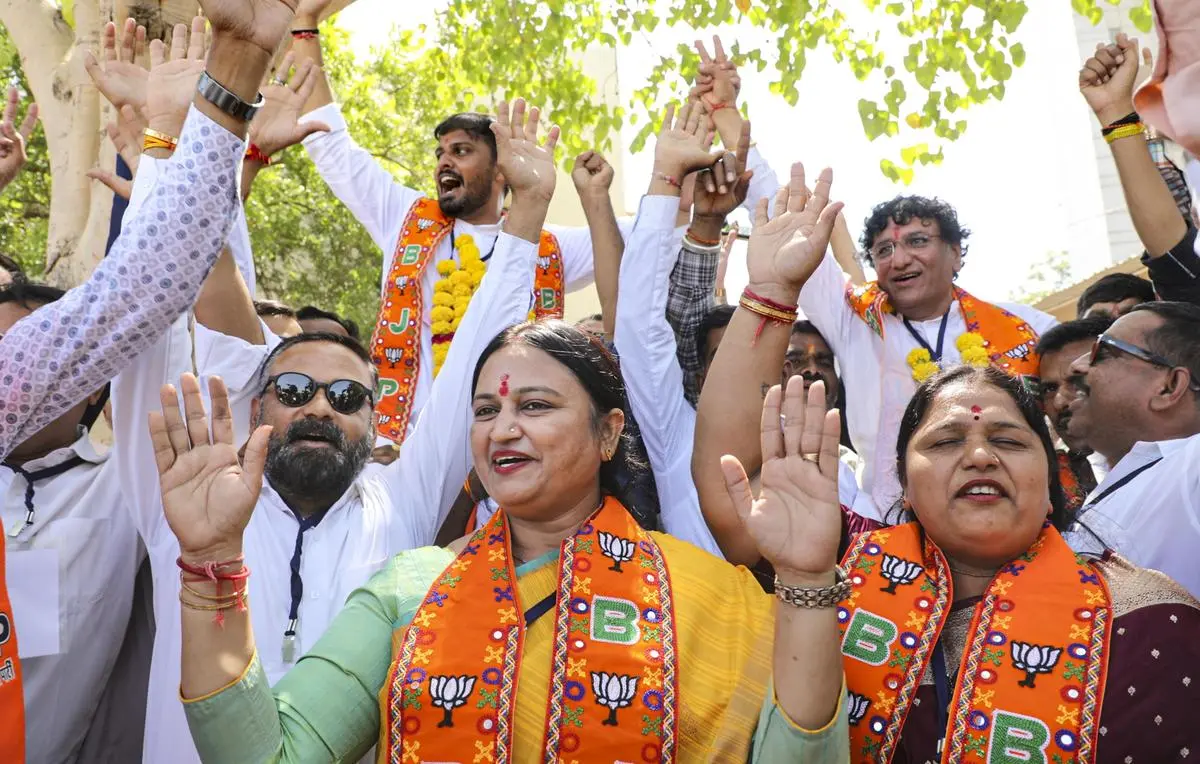
Supporters of the BJP celebrating their victory in the local body elections, in Rajkot, on April 28. | Photo Credit: PTI
The AAP has celebrated, with its national convenor Arvind Kejriwal thanking the people of Gujarat for supporting his party. In 2021, the debut election for the AAP in Gujarat, the party had won around 60 seats which has now increased to 590. The party won the Narmada district panchayat as well as all 11 zilla parishad seats in the Dedhiyapada Assembly constituency.
The BJP has been in power in Gujarat since 1997, and 2027 will mark its 30th year. By winning the local body elections with such huge margins, the BJP has sounded the bugle for the 2027 Assembly polls. In these years in power, the BJP and its mother organisation the RSS have spread their roots deeply into all the verticals of power. This has helped the party strengthen its hold on a State where the Modi factor and Hindutva’s polarised and constantly triggered vision continues to influence society.
It is equally true that the anti-BJP votes in Gujarat have not reduced substantially. The BJP faced its toughest Assembly election in 2017 when the party got 99 seats and Congress got 77. The Patidar protest was one of the reasons for that tough battle. At that time, the Congress won 41.44 per cent of the vote share while the BJP received 49.05 per cent.
The vote shares in the last four municipality elections tell the same story. See Table 1.
Table 1:
Vote share percentage in municipality elections
| Party | 2010 | 2015 | 2021 | 2026 |
| BJP | 53.82 | 50.28 | 52.90 | 59 |
| Congress | 32.62 | 41.58 | 26.75 | 27 |
| AAP | — | — | 13.91 | 10 |
In 2021, the anti-BJP vote was divided between the Congress and AAP. But together, they polled 40.66 per cent, not far from the 2015 Congress tally of 41.58 per cent. This year too, their combined vote share was 37 per cent.
Also, the total vote share across all four local body divisions this year (municipality, nagarpalika, zilla parishad, and taluka panchayat) was 54.28 per cent for the BJP, with the Congress at 30.76 per cent and the AAP at 10.98 per cent. The combined Congress and AAP vote share comes to 41.74 per cent, close to the Congress vote share in the closely contested Assembly election of 2017.
This shows that anti-BJP voters are still rooted in their stance, but their votes are getting divided. As of now, there is no sign of the Congress and the AAP coming together. Both parties have taken a strong stand against each other in various issues. Both parties are also fighting each other in Punjab where Assembly election is due in February 2027. It is unlikely there will be any alliance between the two for the Gujarat election either. In such a scenario, the local body results show that in 2027, the BJP’s fight in Gujarat will only be against itself to sustain its numbers.
Also Read | Intercaste marriages and the unfinished law
Also Read | Saundala’s ‘My Caste is Humanity’ now a Maharashtra mission