
惯性聚合 高效追踪和阅读你感兴趣的博客、新闻、科技资讯
阅读原文 在惯性聚合中打开

推荐订阅源

Vercel News
Vercel News
The GitHub Blog
The GitHub Blog
博客园 - 【当耐特】
Cyber Security Advisories - MS-ISAC
Recent Announcements
D
Docker
GbyAI
GbyAI
酷 壳 – CoolShell
酷 壳 – CoolShell
WordPress大学
WordPress大学
The Cloudflare Blog
雷峰网
雷峰网
A
About on SuperTechFans
小众软件
小众软件
博客园 - Franky
博客园 - 聂微东
F
Full Disclosure
大猫的无限游戏
大猫的无限游戏
C
Check Point Blog
MongoDB | Blog
MongoDB | Blog
G
Google Developers Blog
Microsoft Azure Blog
U
Unit 42
freeCodeCamp Programming Tutorials: Python, JavaScript, Git & More
V
V2EX
Engineering at Meta
Engineering at Meta
宝玉的分享
宝玉的分享
aimingoo的专栏
aimingoo的专栏
量子位
P
Proofpoint News Feed
Hugging Face - Blog
Hugging Face - Blog
博客园_首页
罗磊的独立博客
Martin Fowler
Martin Fowler
D
DataBreaches.Net
cs.CL updates on arXiv.org
S
Secure Thoughts
Project Zero
Project Zero
L
LangChain Blog
阮一峰的网络日志
阮一峰的网络日志
C
Cybersecurity and Infrastructure Security Agency CISA
T
Tailwind CSS Blog
S
Schneier on Security
Blog — PlanetScale
Blog — PlanetScale
The Hacker News
The Hacker News
Spread Privacy
Spread Privacy
Security Latest
Security Latest
NISL@THU
NISL@THU
奇客Solidot–传递最新科技情报
奇客Solidot–传递最新科技情报
C
CXSECURITY Database RSS Feed - CXSecurity.com
J
Java Code Geeks

India’s National Fortnightly Magazine

SIR West Bengal Voter Exclusion Case 2026 TN Assembly Polls 2026: Senthil Balaji and SP Velumani Clash for Western Belt Supremacy Women’s Reservation Act Amendments Raise Delimitation Fears Healthcare’s Breaking Point India’s Elderly Boom: Care Gaps and Policy Failures AI chatbots fill mental health gaps in India, but risks grow Substandard Drugs in India: The Hidden Public Health Threat India Healthcare Costs Crisis: Who Pays the Price? ASHAs hold India’s fragile health system together but are woefully underpaid Partha Chatterjee’s For a Just Republic and the Limits of the People-Nation India’s Missing Middle: Trapped Between Health Insurance and Care Hungary Election 2026: Orbán Defeated, Magyar Wins Big Shailaja Paik on Dalit Women, Caste, and the Politics of Erasure in India Free Speech Crackdown in India: Is Dissent Under Threat? Ambedkar Jayanti and the New Publicness of Protest Politics Implementing Women’s Reservation: Why a Hybrid 651-Seat Lok Sabha Model Outperforms Mass Expansion Ambedkar and Free Speech: Who Controls Dissent in 2026? How a Maharashtra Village Turned Tea with Dalits into a Statewide Equality Mission Women’s Reservation, Delimitation Bills Spark Secrecy Row Reforming Tamil Nadu's Local Governance: Why MLAs Aren't Fixers in 2026 Sewage, Neglect, and Governance Failure Mark India's Water Crisis West Bengal voter list controversy explained | Why names are being deleted Pattukkottai Kalyanasundaram: Tamil Cinema and Left Politics Delhi’s PM-UDAY Reset: Regularising Unauthorised Colonies on an “as is” Basis Will Vijay’s TVK disrupt DMK and AIADMK? | Tamil Nadu election 2026 Constitutional Morality vs Social Morality in India 2026 Amit Shah’s Anti-Conversion Promise Opens a New Faultline in Punjab Politics Why Indian Shias Protest for Iran: History of Solidarity (2026) West Bengal Voter List Row 2026: “Votercide” Debate The Hidden Ecosystem Inside our Homes Asha Bhosle’s Death Marks the End of an Era in Indian Playback Music Women’s Health in India: Inequality by Design How Algorithms Turn Feminism into a Marketable Aesthetic An Unanswered People: Adivasi Poetry’s Fight for Language and Land Rereading Kari in the Age of Identity Debates Absolute Jafar: Nostalgia and restlessness in frames Anita Nair’s Why I Killed My Husband Review: Powerful Themes, Uneven Storytelling Why the FCRA Amendment Bill 2026 Has Triggered a Political Storm Iran’s Staying Power Redraws the US-Israel War Calculus Snake Metaphors in Indian Politics 2026: Venomous Rhetoric From Grief to Politics: Porkodi Armstrong and the Battle for Dalit Power in North Chennai West Bengal election 2026: Will Babri Masjid split the Muslim vote? West Bengal Communal Politics and the 2026 Election Battle Raghav Chadha-AAP Rift Explained: Rise to Fallout (2026) Why India Is Not Energy-Secure Amid Global Oil Shocks Mulla Shah Mosque: Jahanara Begum's forgotten legacy Strait of Hormuz Ceasefire: Pause, Not Peace Dharavi’s Kumbharwada Potters fear Adani-led Redevelopment will Destroy their Livelihoods How India’s Poor Lose Years Waiting in Queues (2026) India IT Rules 2026: Threat to Free Speech? Iran War Ceasefire Signals a Shift Toward Multipolar Deterrence US Foreign Policy: Empire, Coups, and Control (2026) CBFC Ban on Gaza Film Raises New Alarm Over Censorship Queer Dalit identity and the limits of visibility 2026 Assembly Polls: Congress vs BJP Power Test Israel's Relentless Bombing Creates Displacement Crisis in Lebanon Iran War Ceasefire Marks End of US Dominance Era Imported Inflation in India: Navigating Gulf Crisis Kerala Assembly Election 2026: LDF Anti-Incumbency vs UDF Momentum Petronet LNG: A Public Company Built to Escape Public Accountability Gujarat Local Polls: AAP Rise Deepens Congress Crisis Who Defines You? | The Frontline Newsletter SIR controversy deepens fear of Muslim disenfranchisement in Bengal Kerala Election 2026: LDF, UDF, and the BJP “B Team” Charge Delhi’s LPG Crisis Exposes How Migrants Are Locked Out At 100, Krishnammal Jagannathan’s Life Marks a Legacy of Dalit Land Rights and Resistance Who will win Kerala Assembly Election 2026? LDF or UDF? Assam Polls: Cash Transfers Mask Stagnant Incomes and Job Distress Jaishankar and India's Diplomacy Crisis West Bengal SIR 2026: Voters Treated as Suspects Sathankulam Verdict: How a Rare Death Penalty Challenges India’s Custodial Torture Crisis How three 2026 bills redefine identity, marriage, and freedom in India After Nitish Kumar, Bihar BJP faces its biggest test: caste coalition without a ‘Mr Clean’ Nuclear Deterrence in South Asia: Fragile Stability Actor Vijay and Politics: An Emerging Landscape Dharavi’s Idli-Vada Economy Faces Disruption Under Redevelopment Child Marriage Annulment in India: Khushbu’s Fight (2026) India’s Role in Palestine: Why West Asia Peace Needs Action 2026 Rethinking Iran beyond Western narratives N Rangasamy’s 2026 Puducherry Poll Strategy and Power Play Khalid Jawed on Urdu’s Future and Cultural Loss (2026) Kashmir Encounter Killing Sparks AFSPA Debate 2026 Birds and grief in Hamnet and H is for Hawk GST Federalism Crisis 2026: How States Lost Fiscal Power US-Iran War 2026: Petrodollar Stakes Behind Hormuz Clash White Savior Complex in Arab Regimes Drives Ukraine Deals Not Self Reliance UPA Corruption Narrative vs Court Verdicts 2026 Mathur Sathya Case Exposes Patriarchy in Progressive Politics Personality Cult in Indian Politics 2026: Why Leaders Remain Untouchable India Needs a New Economic Model Beyond Neoliberalism Why J&K MLAs Are Fighting the Lieutenant Governor Over Security Pawar Family Rivalries Stall NCP Factions Merger in Maharashtra DMK manifesto 2026: Key promises, alliances, & welfare politics State Assembly Elections 2026: How Voter Dynamics Are Shaping India Iran-Israel War: Hegel’s Recognition Theory Explains the Escalation Coal, Capital, and Compliance: Fairmine Under NGT Lens Hindu Rashtra Debate: 2026 State Elections Test Secular India Tamil Nadu Election 2026: How Gender and Gen Z Voters are Reshaping the Dravidian Power Struggle Gujarat's proposed marriage registration amendment 2026 polices choice Will NEET Break More Students Than It Makes Doctors?
Modi UAE Visit 2026 and India’s Foreign Policy Crisis
Aditya SinhaAditya Sinha is a writer living on the outskirts of · 2026-05-14 · via India’s National Fortnightly Magazine
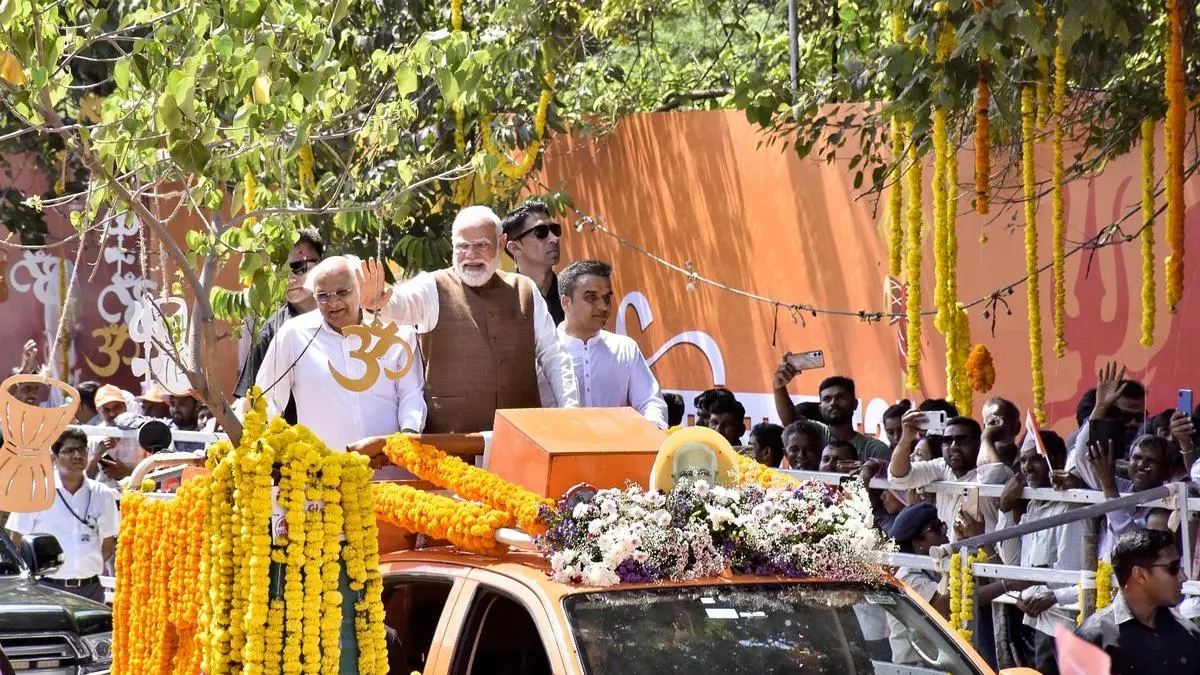
Prime Minister Narendra Modi waves to the crowd during a roadshow on the occasion of the Somnath Amrut Mahotsav, celebrating the 75th anniversary of the inauguration of the restored Somnath Temple, in Gir Somnath on May 11, 2026.

Prime Minister Narendra Modi waves to the crowd during a roadshow on the occasion of the Somnath Amrut Mahotsav, celebrating the 75th anniversary of the inauguration of the restored Somnath Temple, in Gir Somnath on May 11, 2026. | Photo Credit: @InfoGujarat-X/ANI

Vassal King Narendra Modi, defeater of democracy, vanquisher of electoral fair play, and slave to American Burger King Donald Trump, has urged us not to buy gold, and to conserve energy by working from home. It means the Indian economy is in dire straits, thanks to the US-Iranian struggle over the Strait of Hormuz. Gold imports jumped to $72 billion in 2025-26, up from $58 billion the year before, eating up valuable foreign exchange reserves, currently at around $690 billion. We have a terrible trade imbalance and will be paying through our collective nose for a much higher oil import bill in the months to come. (India has 60 days of oil reserves and 45 days of LPG.) A steep drop in reserves will further plunge the value of the Indian rupee, the worst-performing Asian currency for the second year running. To conserve the reserves, Modi says no gold for a year.

On May 15, Vassal King Modi will fly to the UAE, our strategic partner, and a member of the US-Israel alliance. The four of us are cheering for the India-Middle East-Europe Economic Corridor (IMEC), a feeble reply to China’s Belt and Road Initiative. That India has chosen sides was clear when the vassal king went to Tel Aviv to tell Prime Minister Benjamin “Bibi” Netanyahu he had India’s full support, two days before the war on Iran. Bibi was last week interviewed on America’s famous news show, “60 Minutes”, and bragged about the support he had from 1.4 billion Indians, as if we were King Modi’s hordes.

During the Russia-Ukraine war, India declared it “was wedded to strategic autonomy”, a modern version of the Nehruvian non-alignment. Vassals have no autonomy, however. One word from the Burger King and we dumped cheap Iranian oil in 2019, and cheap Russian crude a few months back. Last week, we turned away a Russian LNG tanker that was under US sanctions. India also pulled out the Chabahar port project in Iran. So as far as strategic autonomy goes, the emperor has no clothes. (In Modi’s case, the emperor has too many clothes.)

King Modi, as usual, has not told us why he’s going to the UAE. Is it because he wants to reduce the gold imported from the UAE, which surged after the India-UAE deal in February 2022 deal, which gave the UAE concessions on gold imports? Is it because of the IMEC? Is it because the UAE plans another attack on Iran? It is less likely due to energy security, because now Iran controls the region’s oil.

The UAE is important as 4.36 million Indians live and work there, more than a third of the UAE population. But it is an unreliable nation, trying to punch above its weight: it pulled out of OPEC, and the US media revealed the UAE’s fresh attacks on Iran. Its big brother, Israel, also tries to punch above its weight, dreaming of a Greater Israel that dominates the Gulf. Perhaps India too tries to punch above its current weight, which is in free-fall thanks to the vassal king.

Twenty years ago, we believed ourselves to compete with China. No longer. If India was a non-combatant loser of the Iran war—globally isolated, with arch-enemy Pakistan feted all around—then China is the non-combatant winner. Even Burger King is paying court to Beijing, hoping to talk about trade and not geopolitics. The Chinese see Trump for the crude and vulgar liar he is; so, he will return empty-handed even if he declares that Taiwan belongs to China. With its unnecessary war on Iran, the US ceded global supremacy, and since we’re on the US’ side, not China’s, it counts as a double loss for India.

King Modi achieves substantively little on his foreign visits, and this visit to the UAE and Europe will be no different. It is, at a time of austerity, a luxurious holiday in Nordic climes. It is like His Highness telling everyone to save petrol while going in 100-vehicle convoys to Gujarat and Hyderabad. For what are 100 vehicles needed? Even King Charles does not have such a royal procession. It is only for Modi’s regal majesty.

A ‘visionary’ announcement

The peasants remain impressed, unfortunately. Oil Minister Hardeep Puri, named in the Epstein Files, referred to Vassal King Modi’s austerity announcement as “visionary”. It is beyond absurd. There is nothing visionary about flapping one’s wings in the face of crisis, and in 12 years the King has shown no understanding, much less vision, of the complex matters of governance. His philosophy of reign is to leave everything to God (Bhagwan Bharose).

His competence is limited to being anti-Muslim. Unfortunately, that is all that matters to the Indian public at large. India is dumber than the US. Perhaps he is preferred by some over the Leader of Opposition, who took eons to decide on a Chief Minister for Keralam despite the days slipping by.

Vassal King Modi should know that not all kings are remembered fondly, if at all. Take the incompetent and useless Mughal emperor, Mohd Shah “Rangeela”, who ruled from 1719 till his death in 1748. It was a most ruinous time for India, particularly after the 1739 invasion by Nader Shah, a Persian who sacked Delhi and took the Peacock Throne and the Kohinoor. This invasion marked the decline of the Mughal dynasty, mainly because of Rangeela’s lack of attention to agrarian crises and the growing assertiveness of provincial governors. Rangeela was incompetent and lacked administrative skill, much like later kings who are famously averse to reading files.

Instead, Rangeela drowned himself in poetry and lost the Kohinoor. Incidentally, New York Mayor Zohran Mamdani tried to pry the Kohinoor out of King Charles’ sausage fingers. It was more than what the vassal king could dare do.

Vassal King Modi is strategically isolated and without global influence. He should focus on domestic problems instead of hanging with the Sheikhs. He is no Jawaharlal Nehru, however; he’s our modern day Rangeela.

Aditya Sinha is a writer living on the outskirts of Delhi.

Also Read | Fascism, Indian style

Also Read | India's fascist challenge