


The restored 4K version of the Malayalam movie John Abraham’s Amma Ariyan (Report to Mother, 1986) was screened at the Cannes Film Festival as part of the Cannes Classics section. The restoration was done by the Film Heritage Foundation, and it is the fifth consecutive year that their work is being showcased at this prestigious festival. It is a moment of great pride for Indian cinema, and a special honour for Malayalam cinema too, as it is the only Indian feature film to feature at Cannes this year. The film was well received, with a standing ovation after the screening. In the words of Gerald Duchaussoy, Head of Cannes Classics, “Amma Ariyan is definitely one of the best films we have received this year. I was blown away by the intensity which spread throughout the film, the camera movements, the black and white imagery and the political atmosphere. A trip in itself, Amma Ariyan needs to be restored and seen in proper condition. Cannes will be a good start for the future.” If this western appreciation and adulation result only in the usual uncritical self-congratulations, then the film will only be restored digitally, not politically or intellectually.
So, the question is whether this renewed interest can spur other kinds of restoration and enquiry regarding the radical praxis that brought Amma Ariyan into being, the aesthetics it experimented with, and the critical discourses it attempted to trigger. For Amma Ariyan, both as a movie and in the way it was made, tried to pose new questions and attempt new answers with regard to the institution of cinema: forms and modes of production, distribution, exhibition and appreciation, as well as its aesthetics and politics.
Four decades since the film was made, what does Amma Ariyan tell us today? Beyond the recognition in and by the West, what does it mean to us, especially in these troubled, post-truth times of visual excess and dystopian doom?
The Odessa model
It was produced by Odessa Movies, an informal collective based in Kozhikode, through contributions, large and small, in cash and kind, from film lovers, admirers of John Abraham and people at large. The objective of Odessa Movies was to attempt, though on a micro scale, an all-encompassing, multi-pronged intervention to resist the stranglehold of commercial interests and institutions of cinema, and to reach the people directly through alternative channels of exhibition, distribution and, eventually, production.
With this long-term objective in view, the initial move was made in the area of exhibition: 16mm prints of movie classics were procured from the National Film Archive (thanks to P.K. Nair) and the film fraternity in the country (G.V. Iyer, Buddhadev Dasgupta, Anand Patwardhan, Chalam Bennurkar). Many of these filmmakers travelled across Kerala with their films and interacted with people. The programmes were facilitated by film societies and activist groups, and collections from such public screenings and donations were used for film production. Without such wide popular support, Amma Ariyan would not have been possible.
A venture like this owed a great deal to the political climate of the early 1980s, when there was a vacuum in the extremist political scene in the state. Many youngsters who came forward to support the Odessa initiative were erstwhile Communist Party of India (Marxist–Leninist) Liberation activists who were disillusioned both with the establishment and the party structure and were eager to be part of radical cultural actions. The liberal support of the Kerala State Film Development Corporation, headed by director and poet P. Bhaskaran, was another significant element. On top of all this was the charismatic presence of John Abraham, who, through his years of wandering, had developed a network of unconditional friendships across the state, and these people came forward to help the project. All these factors—social, political, charismatic, cultural, and institutional—coincided to make that “event” of the film’s making happen.
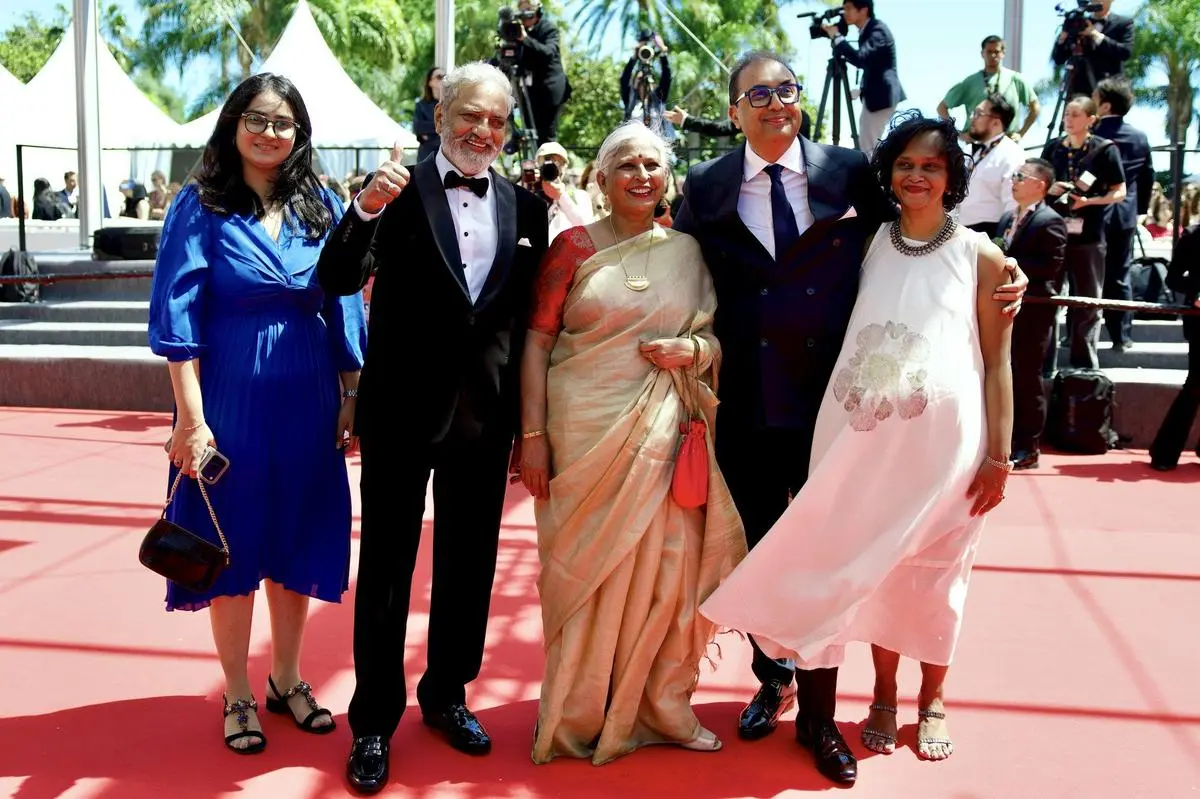
The Amma Ariyan team, including Film Heritage Foundation Director Shivendra Singh Dungarpur, lead actor Joy Mathew, and editor Bina Paul, on the red carpet at the Festival de Cannes on May 16, 2026. | Photo Credit: Film Heritage Foundation/X
True to its vision, the film never had a theatrical release, but was screened in every nook and corner of Kerala, taking it back to the people, its actual “producers”.
The Odessa experiment was a unique model of people’s cinema: a holistic intervention trying to address cinema as an industry, culture, medium and art form. The idea of “crowdfunding” came much later, though it had been attempted in Indian cinema in the form of initiatives like Manthan, Agradoot, and Chithralekha. But unlike Odessa, they all had formal structures and were confined to their own domains—milk production, the film industry—or were membership-based. In the case of Odessa, there were no such limitations to entry: anyone could contribute and be part of the activity, and whatever was produced or distributed was made accessible to all.
The idea/l of the radical
“...the question then should not be: what kind of political message or affect is communicated through cinema, but rather what kind of forms of perception and experience are shimmering on the cinematic surface and how do they resonate or dissonate within us? It is not a question of identifying and validating the reality of what is shown, but of deciding for ourselves which reality we are willing to give to what we see, prolonging its movements and sensibilities for ourselves.”—Stoffel Debuysere, Figures of Dissent: Cinema of Politics / Politics of Cinema–Selected Correspondences and Conversations
Not just in its making, but as a film too, Amma Ariyan was unique with regard to its theme, form and treatment. It is a travel movie that starts from Wayanad in northern Kerala and ends in Fort Kochi. The journey starts with the protagonist Purushan, who, on his way to meet his love in Wayanad, comes across the body of a young man who has committed suicide. For Purushan, the dead man, Hari as he is identified later, appears familiar, but he is not sure of his identity. Uncomfortable leaving the body unidentified and unclaimed, and feeling obliged to inform Hari’s mother about it, he ventures on a journey. He makes enquiries among his circle of friends, which takes him to Hari’s friends and associates. From their anecdotes and memories, the bits and pieces of Hari’s life unfold: he is a tabla player, a political activist, an anarchist, an addict, and someone who wavered between music and revolution.
This journey through space and people is also one through time and history. Most of the people Purushan meets are linked to the extremist movement, directly or indirectly, in the present or in the past. These meetings bring to life reminiscences about various struggles, references to political revolts and events, memories about martyrs, living and dead. It is a journey through the residues of radical politics as well as its emergent states.
While some of the incidents and activities in the journey are in the present, like the Medical College struggle, many are from the past: the Vadakara quarry struggle, the ration shop capture in Kodungallur, the hooch tragedy in Vypeen and the port workers’ struggle in Kochi. Thus the film also functions as a chronicle of Kerala’s radical politics, for from each person he meets and each place he visits arise memories about people’s resistance, buried in time but alive in minds and marked by spaces.
Ironically, though Amma Ariyan received many accolades at international festivals and from critics, the film was not given due recognition by the State Film Award committee. They observed that the film “lacked discipline”. Obviously, they were looking for a well-structured story with a gripping beginning-middle-end narrative, technically perfect and well acted. They found none of these in the film. Most of the actors were debutants and real-life characters, and the narrative did not follow any conventional cause-effect or good-evil logic.
When one looks back, those were exactly its strengths: true to its theme, it was chaotic, multi-linear, meandering and fragmented. Its form was open to various narrative modes and elements, eclectic in its worldview and oftentimes meandering in its treatment, one that could easily host the poems of Otto René Castillo and Pablo Neruda, lengthy monologues, vacuous ideological debates, a photo album of international events and personalities, or any such thing. There is no attempt to arrive at closure or conclusions, nor does the film offer any judgment about the radical movement or any of its characters.
Thus, the idea of the radical that Amma Ariyan proposes is not a model or something achieved, but something always in the making: an incessant process of imagination, of creating the world and shaping life.
The idea/l of the collective
“Without this non-contemporaneity with itself of the living present, without that which secretly unhinges it, without this responsibility and this respect for justice concerning those who are not there, of those who are no longer or who are not yet present and living, what sense would there be to ask the question ‘where?’ ‘where tomorrow?’ ‘whither?’”—Specters of Marx, Jacques Derrida
Made through collective action, the narrative of the film too was haunted by the idea and ideal of the collective. Most of the characters are part of collective political action, some still active, while others live with its memories or as memorials and ruins. On one side, we see the ruins of a radical past in the form of broken lives and dreams, sisters and mothers gone insane or bereaved; on the other, there are many characters involved in various political struggles, activities and performances. Though there is a poignant sense of void or absence, there is no nostalgia or “left melancholy” here.
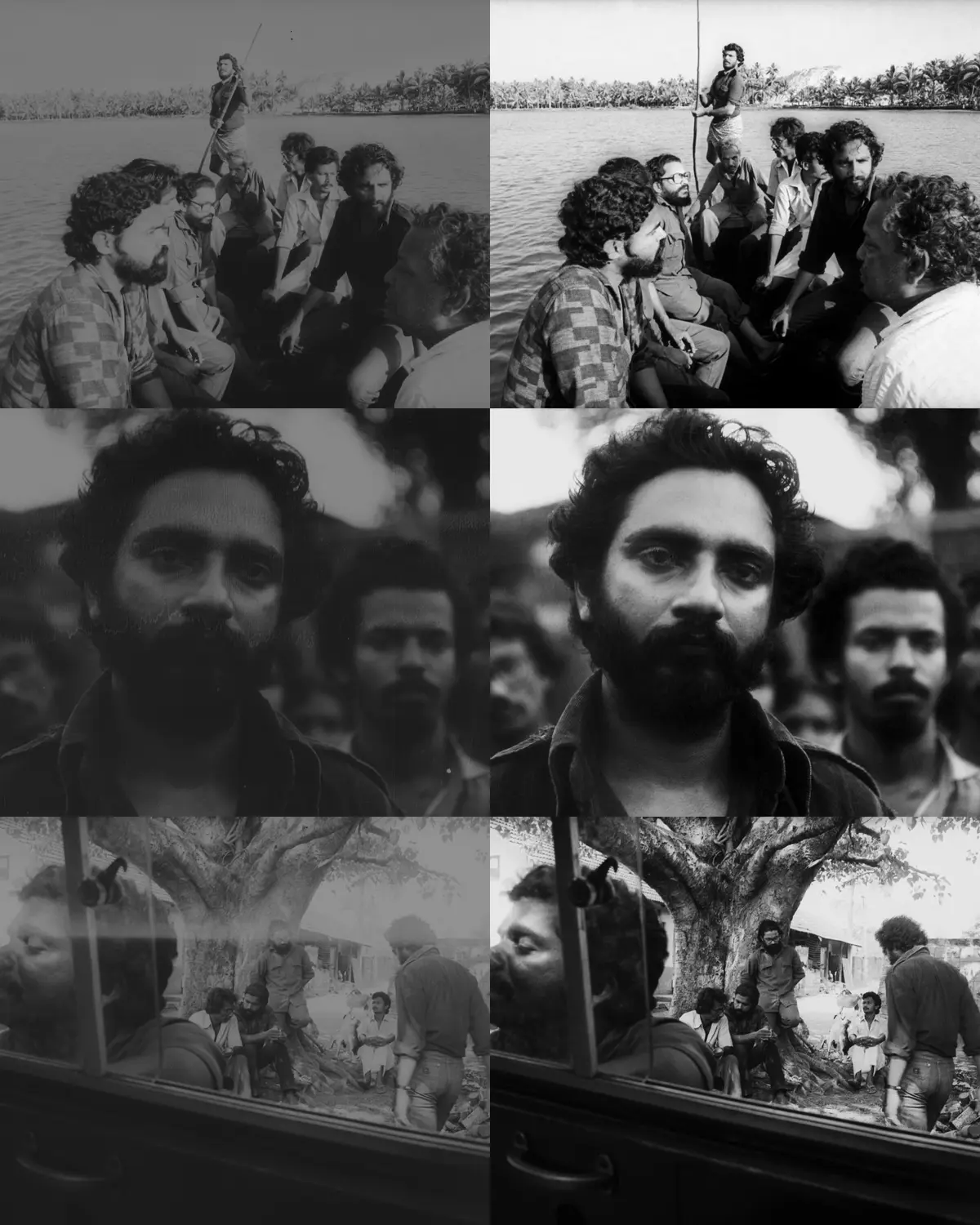
A comparison of the original film (left) and the restored version (right) of John Abraham’s Amma Ariyan. | Photo Credit: Film Heritage Foundation/X
It is also significant that at the centre of it all is a dead body, that too of a suicide, which evokes immediate identification among them, with a strong sense of potential predicament and destiny looming over everything. The dead man was their comrade and friend, one who was torn apart between art and politics, intoxication and commitment, music and murder. Thus it becomes a painful journey into the life of an artist drawn to radical politics but unable to find his way through or between it. It is also a journey through the remnants and glimmers of a radical past, of young men leaving home to venture into uncertain journeys, leaving behind mothers and sisters destined to wait eternally.
Retrospectively, this divide between the worlds of men and women appears as a fault line: while men go out, revolt and engage with the world, women are left behind inside homes, waiting, praying, agonising over their men. Which could also be the reason why Purushan, literally “male” in Malayalam, has to “report” the male world to his mother. Obviously, the collective is that of males, away from home, in pursuit of political action, art, intoxication or, in the case of the likes of Hari, death. Men act in and upon the world, while women react, wait and withdraw, sometimes stoically, as in the case of Hari’s mother, who could foresee her son’s death though unable to prevent it.
In many ways, Amma Ariyan grapples with the need, potential and pitfalls of the idea and practice of the collective. There is a need to act jointly and a yearning to connect, but along with its victories and affects, there is also the ever-present possibility of betrayal and desertion, death and self-destruction.
One poignant question the movie poses concerns the complex and traumatic legacies of collectives: what they leave behind, and how one accounts for all the human wrecks, suicides, and alcoholism. The film disturbingly reflects upon what certain kinds of political involvement leave behind in terms of social transformation or effect on the one hand, and upon individuals and their personal and artistic lives on the other. The series of mothers we encounter in this film—figures of justice, bearers of wounds, prayerful, and patient—constitute the core of its moral universe, posing disturbing questions about the disjuncture between their worlds and that of their “radical” sons.
Legacies of Amma Ariyan
Several momentous events have happened in the four decades between the making of Amma Ariyan and today. The intervening decades saw glasnost and the disintegration of the USSR, the fall of the Berlin Wall and the rise of a unipolar world. India witnessed, or was subjected to, the liberalisation of the economy, the demolition of the Babri Masjid, and the rise of Hindutva forces to power. In the media realm, the digital revolution transformed every aspect of life, culture, economy, and polity.
Forty years later, what still makes Amma Ariyan a haunting experience are the poignant questions it provokes and the self-reflexive insights it offers, provoking us to revisit and rethink the idea and ideal of the collective and collective action in our times, probing the notion of the radical both as thought and as act, in artwork, production and practice. Finally, it reminds us of the history of dissent and resistance that the idea of the radical inherits and spawns, both as a warning and as an inspiration.
In a way, the spectral presence of Hari in Amma Ariyan is a “hauntological” presence: a haunting of lost futures, of what could have been, and a persistent discontent with the loss of dreams.
C.S. Venkiteswaran is a film critic and documentary filmmaker based in Kochi.
Also Read | The mad, sad, improbable world of Jiri Menzel
Also Read | Remembering Pattukkottai Kalyanasundaram, the people’s poet who wrote from the fields