惯性聚合 高效追踪和阅读你感兴趣的博客、新闻、科技资讯
阅读原文 在惯性聚合中打开

推荐订阅源

让小产品的独立变现更简单 - ezindie.com
Microsoft Azure Blog
大猫的无限游戏
大猫的无限游戏
月光博客
月光博客
V
V2EX
PCI Perspectives
PCI Perspectives
Latest news
Latest news
博客园 - 三生石上(FineUI控件)
C
CERT Recently Published Vulnerability Notes
W
WeLiveSecurity
Last Week in AI
Last Week in AI
奇客Solidot–传递最新科技情报
奇客Solidot–传递最新科技情报
P
Palo Alto Networks Blog
T
The Exploit Database - CXSecurity.com
K
KPMG report finds enterprise disconnect between AI and its ROI | CIO
cs.AI updates on arXiv.org
WordPress大学
WordPress大学
V
Vulnerabilities – Threatpost
H
Heimdal Security Blog
Attack and Defense Labs
cs.CV updates on arXiv.org
Hacker News: Ask HN
Hacker News: Ask HN
博客园 - 叶小钗
V
Visual Studio Blog
Jina AI
Jina AI
P
Proofpoint News Feed
罗磊的独立博客
SecWiki News
SecWiki News
J
Java Code Geeks
freeCodeCamp Programming Tutorials: Python, JavaScript, Git & More
L
LINUX DO - 热门话题
Security Archives - TechRepublic
The Hacker News
The Hacker News
Hugging Face - Blog
Hugging Face - Blog
N
News and Events Feed by Topic
NISL@THU
NISL@THU
T
Tailwind CSS Blog
T
Tenable Blog
Recent Commits to openclaw:main
Recent Announcements
H
Hacker News: Front Page
Exploit-DB.com RSS Feed
T
Tor Project blog
宝玉的分享
宝玉的分享
Help Net Security
Help Net Security
S
Security Affairs
Microsoft Security Blog
Google DeepMind News
F
Fortinet All Blogs
G
GRAHAM CLULEY

博客园 - 皮皮虾的blog

visual studio 2022 安装net旧版本(net framework4.0和4.5) RxJS中高阶映射操作符的全面讲解:switchMap, mergeMap, concatMap (and exhaustMap) 从0到1: Angular + .NET Core 前后端分离项目Compass的开发过程 rxjs学习 - 2 rxjs学习 Asynchronous programming with async and await Angular 表单介绍 TypeScript null undefine判断 TypeScript 常见方法 VMware虚拟机如何设置CentOS 7 磁盘扩容? MySQL 5.7 配置 MySQL 主从复制相关 Mysql 常用命令 MySQL 5.7 Sleep 连接太多的处理方式 MySQL 5.7 CPU高的定位方法 VS2019 设置tab插入空格不好使的解决方法 CentOS 7 MySQL 5.7 主从设置 VMware安装CentOS7后配置静态IP MySQL explain,Extra分析(转) - 1
MySQL explain,type分析(转) - 2
皮皮虾的blog · 2021-10-27 · via 博客园 - 皮皮虾的blog

  MySQL的官网解释非常简洁,只用了3个单词:连接类型(the join type)。它描述了找到所需数据使用的扫描方式。

最为常见的扫描方式有:

  • system:系统表,少量数据,往往不需要进行磁盘IO;

  • const:常量连接;

  • eq_ref:主键索引(primary key)或者非空唯一索引(unique not null)等值扫描;

  • ref:非主键非唯一索引等值扫描;

  • range:范围扫描;

  • index:索引树扫描;

  • ALL:全表扫描(full table scan);

上面各类扫描方式由快到慢: system > const > eq_ref > ref > range > index > ALL

下面一一举例说明。

一、system

1

explain select from mysql.time_zone;

  上例中,从系统库mysql的系统表time_zone里查询数据,扫码类型为system,这些数据已经加载到内存里,不需要进行磁盘IO。 

  这类扫描是速度最快的。

1

explain select from (select from user where id=1) tmp;

  再举一个例子,内层嵌套(const)返回了一个临时表,外层嵌套从临时表查询,其扫描类型也是system,也不需要走磁盘IO,速度超快。

二、const

数据准备:

1

2

3

4

5

6

7

8

create table user (

    id int primary key,

    name varchar(20)

)engine=innodb;

insert into user values(1,'shenjian');

insert into user values(2,'zhangsan');

insert into user values(3,'lisi');

const扫描的条件为:

(1)命中主键(primary key)或者唯一(unique)索引;

(2)被连接的部分是一个常量(const)值;

1

explain select from user where id=1;  <em>  </em>

  如上例,id是PK,连接部分是常量1。

  这类扫描效率极高,返回数据量少,速度非常快。  

三、eq_ref

数据准备:

1

2

3

4

5

6

7

8

9

10

11

12

13

14

15

16

17

18

19

create table user (

    id int primary key,

    name varchar(20)

)engine=innodb;

insert into user values(1,'shenjian');

insert into user values(2,'zhangsan');

insert into user values(3,'lisi');

create table user_ex (

    id int primary key,

    age int

)engine=innodb;

insert into user_ex values(1,18);

insert into user_ex values(2,20);

insert into user_ex values(3,30);

insert into user_ex values(4,40);

insert into user_ex values(5,50);

1

explain select from user,user_ex where user.id=user_ex.id;

eq_ref扫描的条件为,对于前表的每一行(row),后表只有一行被扫描。

再细化一点:

 (1)join查询;

 (2)命中主键(primary key)或者非空唯一(unique not null)索引;

 (3)等值连接;

  如上例,id是主键,该join查询为eq_ref扫描。

  这类扫描的速度也异常之快。 

四、ref

数据准备:

1

2

3

4

5

6

7

8

9

10

11

12

13

14

15

16

17

18

19

20

21

create table user (

    id int,

    name varchar(20) ,

    index(id)

)engine=innodb;

insert into user values(1,'shenjian');

insert into user values(2,'zhangsan');

insert into user values(3,'lisi');

create table user_ex (

    id int,

    age int,

    index(id)

)engine=innodb;

insert into user_ex values(1,18);

insert into user_ex values(2,20);

insert into user_ex values(3,30);

insert into user_ex values(4,40);

insert into user_ex values(5,50);

1

explain select from user,user_ex where user.id=user_ex.id;

  如果把上例eq_ref案例中的主键索引,改为普通非唯一(non unique)索引。  

  就由eq_ref降级为了ref,此时对于前表的每一行(row),后表可能有多于一行的数据被扫描。  

 

1

explain select from user where id=1;

  当id改为普通非唯一索引后,常量的连接查询,也由const降级为了ref,因为也可能有多于一行的数据被扫描。

  ref扫描,可能出现在join里,也可能出现在单表普通索引里,每一次匹配可能有多行数据返回,虽然它比eq_ref要慢,但它仍然是一个很快的join类型。

五、range

数据准备:

1

2

3

4

5

6

7

8

9

10

create table user (

    id int primary key,

    name varchar(20)

)engine=innodb;

insert into user values(1,'shenjian');

insert into user values(2,'zhangsan');

insert into user values(3,'lisi');

insert into user values(4,'wangwu');

insert into user values(5,'zhaoliu');


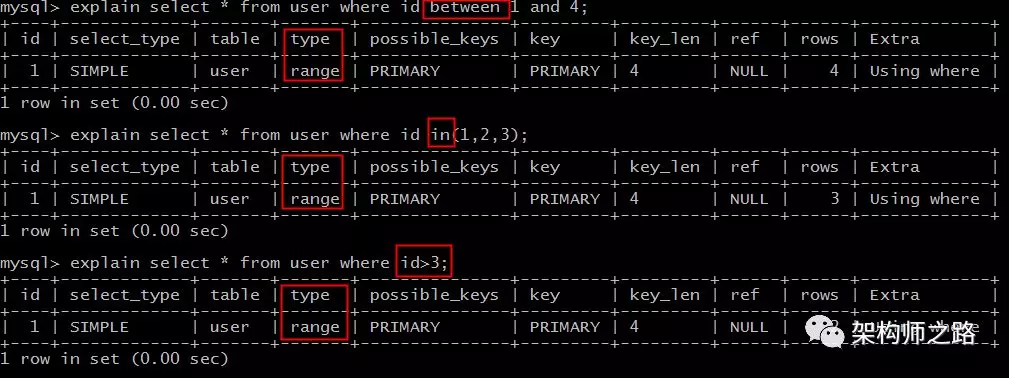
1

2

3

explain select from user where id between and 4;

explain select from user where idin(1,2,3);

explain select from user where id>3;

  range扫描就比较好理解了,它是索引上的范围查询,它会在索引上扫码特定范围内的值。

   像上例中的between,in,>都是典型的范围(range)查询。

 六、index

1

explain count (*) from user;

 index类型,需要扫描索引上的全部数据。

 如上例,id是主键,该count查询需要通过扫描索引上的全部数据来计数。  它仅比全表扫描快一点。   

七、ALL

数据准备:

1

2

3

4

5

6

7

8

9

10

11

12

13

14

15

16

17

18

19

create table user (

    id int,

    name varchar(20)

)engine=innodb;

insert into user values(1,'shenjian');

insert into user values(2,'zhangsan');

insert into user values(3,'lisi');

create table user_ex (

    id int,

    age int

)engine=innodb;

insert into user_ex values(1,18);

insert into user_ex values(2,20);

insert into user_ex values(3,30);

insert into user_ex values(4,40);

insert into user_ex values(5,50);

explain select * from user,user_ex where user.id=user_ex.id;

如果id上不建索引,对于前表的每一行(row),后表都要被全表扫描。

今天这篇文章中,这个相同的join语句出现了三次:

(1)扫描类型为eq_ref,此时id为主键;

(2)扫描类型为ref,此时id为非唯一普通索引;

(3)扫描类型为ALL,全表扫描,此时id上无索引;

  有此可见,建立正确的索引,对数据库性能的提升是多么重要。

  另外,《类型转换带来的大坑》中,也提到不正确的SQL语句,可能导致全表扫描。

  全表扫描代价极大,性能很低,是应当极力避免的,通过explain分析SQL语句,非常有必要。

总结

(1)explain结果中的type字段,表示(广义)连接类型,它描述了找到所需数据使用的扫描方式;

(2)常见的扫描类型有:

system>const>eq_ref>ref>range>index>ALL

其扫描速度由快到慢;

(3)各类扫描类型的要点是:

  • system最快:不进行磁盘IO

  • const:PK或者unique上的等值查询

  • eq_ref:PK或者unique上的join查询,等值匹配,对于前表的每一行(row),后表只有一行命中

  • ref:非唯一索引,等值匹配,可能有多行命中

  • range:索引上的范围扫描,例如:between/in/>

  • index:索引上的全集扫描,例如:InnoDB的count

  • ALL最慢:全表扫描(full table scan)

(4)建立正确的索引(index),非常重要;

(5)使用explain了解并优化执行计划,非常重要;

 出处:https://mp.weixin.qq.com/s/uenONvfT0ZcXl5-WIZtFHQ