


The fallout from the recent NEET-UG paper leak, leading to exam cancellations, re-tests, and the sudden Government’s decision to conduct the examination in Computer Based Testing (CBT) mode from 2027 has exposed the flaws in the functioning of the National Testing Agency (NTA), as an organization. The time for temporary, quick fixes has run out. If India is to protect the future of its students and preserve the public trust, transforming the NTA into a robust, resilient, and equity-driven testing organisation is no longer just a policy recommendation, but an immediate national priority.
Weak outsourcing setup
Approved by the Union Cabinet in 2017, as an independent testing group, the NTA lacks the legal weight of other major statutory bodies. Unlike the Union Public Service Commission (UPSC) or the University Grants Commission (UGC), the NTA was registered in 2018, as a society, under the Societies Registration Act, 1860, operating under the administrative control of the Ministry of Education. The major policy decisions are taken by a Governing Body (GB), consisting of a 14-member team, headed by the chairperson, appointed by the MOE. The executive branch is headed by the Director General (DG), who acts as the Chief Executive Officer, reporting to Joint Secretary (Technical Education), who takes care of Centrally funded technical institutions such as the IITs, the IIITs and the IISERs. This bureaucratic position has left the agency structurally weak in several critical areas, impacting its performance adversely.
First, it faces severe staffing shortages. The NTA handles over 1.25 crore candidates every year across more than 18 entrance exams, with just four major tests—NEET-UG, CUET-UG, JEE Main, and UGC-NET—making up half that volume. Yet, as revealed in Rajya Sabha on December 11, 2024, its manpower consists of predominantly non-permanent employees, 22 on deputation, 38 contract employees , and 138 outsourced staff. Because the NTA is an administrative society rather than a statutory entity, it has no direct regulatory enforcement power to control the private infrastructure and third-party companies, it hires to run the massive national exams.
Finally, the agency has historically kept unused funds rather than building its own infrastructure. Despite sitting on an unused cash surplus of over ₹448 crore collected from student registration fees, the agency has not invested in permanent, secure testing centers. Instead, it chose to rely entirely on rented private colleges, commercial computer labs, and third-party software providers
Track record
Over the last seven years, the conduct of the national competitive tests has been plagued by several issues like leakage of question papers, wrong questions and technical issues during the online examination and cyber security, resulting in delays in declaration of results, in turn delaying the start of the academic years.
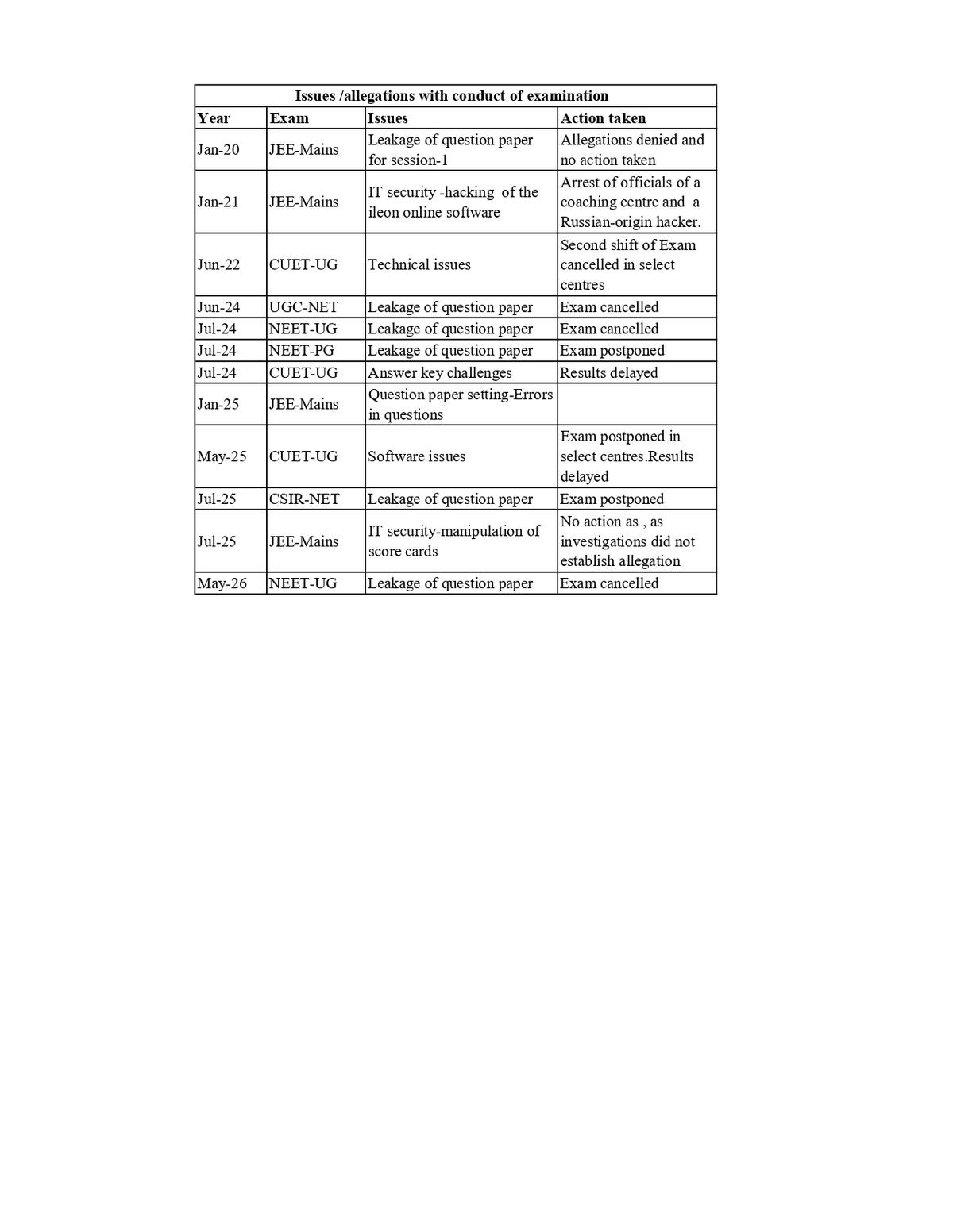
The best-run Indian competitive exams are often cited as JEE and UPSC. These systems are seen as comparatively stable because they are more centralized in governance, more mature in paper-setting routines, and less dependent on a broad outsourced technology chain. However, the process knowledge is not transferred across the divisions, as its internal structure is fragmented into isolated silos, like JEE division and NEET-UG division, lacking effective internal knowledge transfer.
Unlike global testing organisations, the NTA functions as a passive administrator, bound by the varying mandates of the “indenting agencies” (such as the National Medical Commission for NEET, or the UGC for CUET). Interestingly, NEET-UG is the only major examination, conducted using pen and paper (OMR) in a single shift-single day.
The agency has historically lacked the legislative weight or internal domain expertise to push back against logistically unviable testing mandates. The lack of research at NTA is evident, going by the fact that a progressive initiative such as adaptive testing for JEE-advanced is being driven independently by IIT Kanpur and the JEE Apex Board (JAB), not the NTA.
NEP mandate and shortfalls
NEP 2020 charges the NTA with developing high-quality common aptitude tests and specialized subject exams that evaluate conceptual understanding and higher-order critical thinking, rather than memorized patterns. The policy recommended reforms to synchronise the system of Board examinations for class 10 and 12 with the common entrance examination to eliminate the need for undertaking coaching classes. The policy mandates that the NTA conduct common subject tests across the sciences, humanities, languages, arts, and vocational streams at least twice every year, allowing students to choose test combinations and submit their best portfolios to target universities. By creating a single gateway, the NTA is expected to eliminate the financial and mental toll of candidates writing hundreds of independent institutional admission tests.
Appointed in June 2024, in the wake of NEET UG paper leak in 2024, to re-engineer the NTA, a high level committee of experts , chaired by former ISRO Chief Dr. K. Radhakrishnan, submitted its report in October 2024. It made 101 recommendations, which included short term ( 60) , long term ( 35) and monitoring(6). It recommended introduction of multi-stage examination, on similar lines as JEE, and transition to hybrid question paper delivery, wherein they are digitally transmitted and papers are printed inside the exam centre 30 minutes before the test to bypass transit risks. In line with the spirit of NEP-2020, the committee recommended research and adoption of new technologies such as AI/ML, Block Chain, and adaptive testing by NTA at all levels. It also advised the NTA to imbibe best practices from global testing agencies through collaborative efforts.
The 371st parliamentary panel report tabled in parliament on Dec 8, 2025, raised alarms over the NTA’s procurement vulnerabilities, particularly with regard to using the firms involved in outsourcing paper setting, logistics, and data translation, which were blacklisted by specific State governments due to the absence of a centralized Nationwide Blacklisted Firm Registry. The panel, in its 364th report (tabled on March 26, 2025), mandated presentation of a comprehensive annual report on its activities directly to Parliament. It was repeated in its 371st report, as well. Appalled by technical remote-access hacks at commercial computer centres, the panel recommended that computer-based tests be scaled back or conducted exclusively inside government or government-controlled educational institutions to ensure security.
Towards a robust NTA
If the NTA is to salvage its credibility and safely execute the government’s 2027 online mandate for NEET-UG, it must transition from an examination administrative agency into a research-driven full-fledged digital testing institution, modelled after global entities like Educational Testing Service (ETS), which manages annually, over 5 crore tests, like GRE and TOEFL, globally.
The future business blueprint must turn the NTA into a statutory body through an Act of Parliament, backed by adequate owned resources and permanent employees. The agency must establish over 1,000 secure, government-controlled testing hubs, thereby investing its massive capital reserves directly into building public digital infrastructure.
It should transition large exams like NEET and CUET-UG into a two-stage pattern. Stage 1 (Screening) is run purely as a multi-shift CBT over an extended window, screening the candidates to a smaller number, who will progress to Stage 2 (Mains). It should channelize its surplus to fund about 1,000 permanent secure test centres in IT labs across every district, utilizing existing infrastructure at Kendriya Vidyalayas (KVs), Jawahar Navodaya Vidyalayas (JNVs), and Government ITIs.
For highly remote or mountainous areas, like in the North Eastern states, NTA should deploy Mobile Testing Units—fleets of rugged, all-terrain buses fitted with satellite-linked, and secure computer terminals to bring the test directly to rural students. Furthermore, the initial online test interface must be kept simple and multilingual, requiring zero advanced computer skills to use.
The upcoming 2027 digital mandate for NEET-UG is a launch pad for transformation of NTA into a global testing hub. By investing the substantial financial reserves of NTA into public digital infrastructure, India has a golden opportunity to bridge the rural-urban divide and build a world-class testing institution, driven by pioneering psychometric research and AI-led technologies. India can turn a flawed exam system into a global gold standard for testing. Failing to do so, will risk harming the future of the students.
(O R S Rao is the Chancellor of the ICFAI University, Sikkim. Views are personal)