


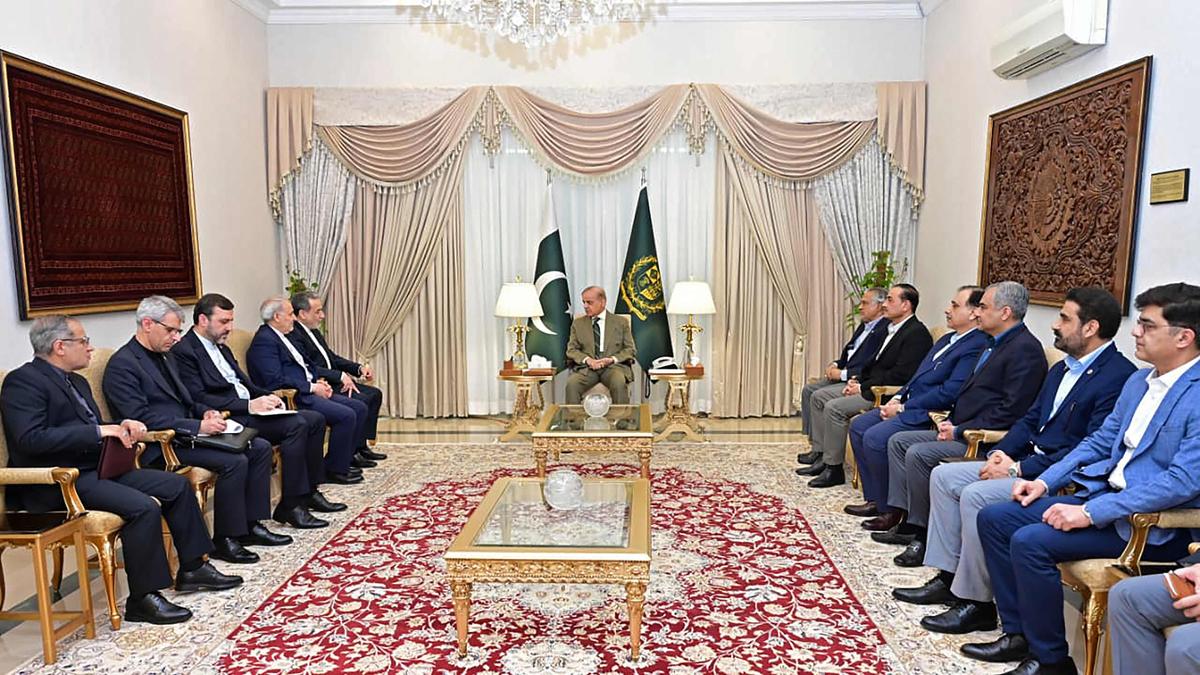
In recent weeks, an intense debate has emerged in India regarding Pakistan’s rising diplomatic stature, following its role as mediator and venue for negotiations between the United States and Iran. Iranian and American officials — including U.S. President Donald Trump — have publicly acknowledged Pakistan’s leadership, specifically Field Marshal Asim Munir and Prime Minister Shehbaz Sharif, for their role in precipitating and sustaining the ceasefire, and maintaining channels of communication.
While Pakistan is now seen as central to diplomacy around the Iran war, India’s response has been marked by silence — variously interpreted as caution toward Mr. Trump or as strategic restraint. India has not criticised Israel or the U.S. for their actions, and this contrast with Pakistan’s rising role has fuelled debate within India’s strategic community about the shifting balance between the two countries.
Gains from enhanced diplomatic visibility
Pakistan’s diplomatic visibility has increased not only due to its mediation role but also because of its expanding engagement with Washington and its growing influence in Gulf security. Its relationship with the U.S. — particularly under Mr. Trump — has elevated Pakistan’s profile. At the same time, its defence partnership with Saudi Arabia, and possibly a similar security partnership with Qatar, have further reinforced its strategic relevance in the region.
This enhanced diplomatic position has translated into economic and political gains. Saudi Arabia’s pledge of billions of dollars highlights the financial dividends of Pakistan’s rising influence. Since the end of Operation Sindoor, Pakistan has also secured several diplomatic wins denying India’s efforts to portray it as a state sponsor of terrorism and diplomatically isolate it. India’s efforts have been undermined by Pakistan’s growing alignment with the U.S. as a counterterrorism partner against al-Qaeda and the Islamic State, as well as its role in Gaza-related discussions and the Iran crisis. Together, these developments suggest that Pakistan’s recent diplomatic momentum has blunted India’s strategy, raising broader questions about whether the regional balance of power in South Asia is beginning to shift.
Pyramid of power
According to scholars of international relations, states are often understood within a hierarchy of power based on their capacity to project influence and shape outcomes beyond their borders. At the apex are superpowers such as the U.S. and China — states with the ability to project power globally and to shape, the international order itself; their influence spans military, economic and institutional domains on a worldwide scale. The next tier consists of global powers, which, while not able to unilaterally shape the global order, possess sufficient capabilities to project power across multiple regions, as illustrated by Russia. Below them are middle powers, which lack comprehensive global reach and do not dominate multiple regions, yet exert meaningful influence through partnerships and economic and military capacity; countries such as Türkiye, South Korea, Indonesia and Brazil are often cited as examples. Next are regional powers, which dominate a specific geographic area but have limited ability to project influence beyond it, such as Saudi Arabia in the Gulf. Finally, there are minor powers, comprising most states whose influence remains largely confined within their own borders and whose role in shaping regional or global outcomes is limited.
The Lowy Institute operationalises comprehensive national power by combining hard and soft capabilities into a single analytical framework. It assigns roughly 55% weight to material power — economic size, military capability, and resources — and 45% to softer dimensions such as diplomacy, economic networks, and institutional influence.
Before Operation Sindoor, using the Lowy Institute metric, I would place India in the second tier from the top as a global power given both its hard power and soft power capabilities, while Pakistan would fall into the second tier from the bottom as a regional power. However, developments over the past few months suggest movement in opposite directions. India’s performance during Operation Sindoor has not been widely seen as commensurate with its perceived stature or the expectations surrounding its rise, whereas Pakistan has been viewed by many as performing above its capacity. At the same time, India’s continued silence or restraint— particularly in relation to Mr. Trump and major geopolitical developments — has contributed to its marginalisation from key global events. This perception has been reinforced by economic and geopolitical shifts, including a decline in India’s ranking from the fourth to the sixth largest economy and the waning visibility of groupings that once elevated its profile, such as I2U2, BRICS, and the Quadrilateral Dialogue.
In contrast, Pakistan, without any change in material capabilities, has significantly enhanced its diplomatic profile and relevance. The result is a perceptible shift: India appears to be moving from a global power toward the characteristics of a middle power, while Pakistan is emerging as a more consequential regional power with aspirations toward middle-power status. This evolving dynamic — India trending downward and Pakistan upward in relative standing — may help explain the intensity of current debates within India’s strategic community, as well as the more confident and optimistic mood within Pakistan’s strategic discourse.
In context
My final observation for Indian policymakers is that whatever constraints India faces with regard to the U.S. and Israel — whether driven by ideological alignment or dependence on defence technology — the choices it is making will inevitably affect the softer dimensions of its power. While these softer elements can enhance or diminish a country’s influence in global affairs, they are not a substitute for hard power: military capability, a robust economy, demographic scale, and cutting-edge technological capacity. In these foundational areas, there has been no significant relative change between India and Pakistan.
While India remains firm in the elements of hard power, Pakistan while gaining in soft power is still nursing a fragile economy. And that matters.
Muqtedar Khan is Professor of International Relations at the University of Delaware. He is also a Senior Non-Resident Fellow at the Middle East Policy Council and hosts a YouTube channel on global affairs called Khanversations.
Published - April 30, 2026 12:08 am IST