











What draws a traveller to Telangana? Is it the layered history of its forts, the stillness of its lakes, the pull of its temples or the rhythm of its festivals? According to the Telangana chapter of NITI Aayog’s ‘Divya Bharat: A Window to the Soul of India’ report, the answer lies in all of these, presenting the State as a destination catering to a wide spectrum of travellers.
Telangana recorded 8.49 crore domestic tourists and 1.71 lakh foreign tourists in 2025, according to the Telangana Socio Economic Outlook 2026.
At the centre of this narrative is Hyderabad, a metropolis that anchors Telangana’s identity with its blend of heritage and urban energy. Yet, the report makes it clear that the State’s appeal stretches far beyond the capital, unfolding across districts rich in natural beauty, architectural heritage and cultural depth.
Nature tourism features prominently, with sites such as Pakhal Lake in Warangal, Bogatha Waterfall and Laknavaram Lake in Mulugu, Kuntala Waterfall in Adilabad and Ananthagiri Hills in Vikarabad highlighted as key destinations. Closer to the city, Mrugavani National Park offers a quick retreat into nature. The report identifies October to April as the most favourable period to visit, coinciding with festivals such as Bathukamma and Medaram Jatara.
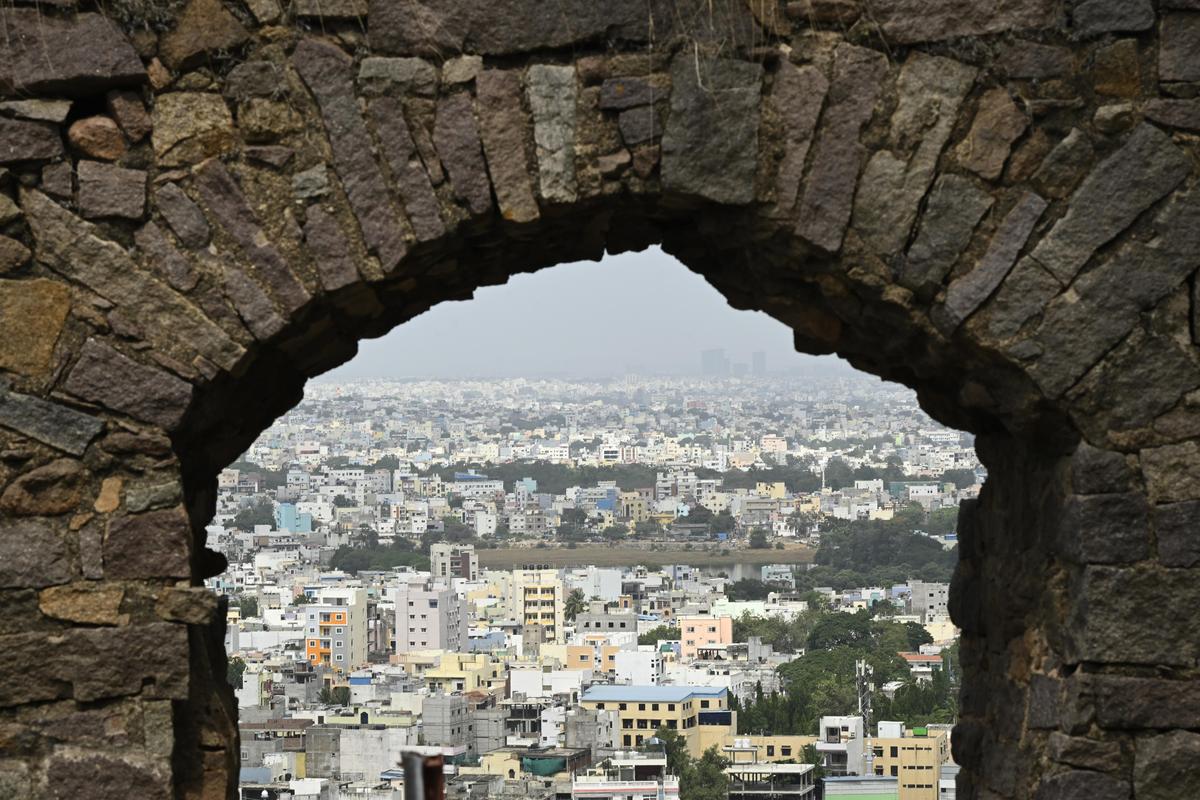
A view of the Hyderabad city from Golconda Fort in Hyderabad on Wednesday. | Photo Credit: File Photo
The report also lists lesser-known attractions across districts, including Pocharam Wildlife Sanctuary in Medak, Kolanupaka Jain Temple and Bhongir Fort tunnel in Yadadri Bhuvanagiri, Jogulamba Temple in Gadwal, Neelakanteshwar Temple in Nizamabad and Domakonda Fort in Kamareddy.
— NITI Aayog (@NITIAayog) April 29, 2026Telangana is a state where history, architecture, and modern development come together to form a dynamic identity. From historic landmarks to vibrant urban spaces, it offers a blend of tradition and progress.
The Charminar in Hyderabad stands as a symbol of its heritage, while… pic.twitter.com/QWlEnpqD4a
Adventure tourism forms another dimension of Telangana’s offering. The steep climb at Bhongir Fort is highlighted for trekking enthusiasts while water-based activities such as speed boating, parasailing and jet-skiing are available at Hussainsagar and Durgam Cheruvu. The granite terrains of Bhuvangiri, Shamirpet and Moula Ali are identified as suitable for rock climbing and bouldering while the aerial adventure zone at Hussainsagar adds to the experience.
Wildlife and eco-tourism also find mention, with reserves such as Eturnagaram Wildlife Sanctuary, Kinnerasani Wildlife Sanctuary and Kawal Tiger Reserve offering opportunities for nature-based exploration. Meanwhile, Pandavula Gutta stands out for its prehistoric rock art and trekking trails.

Ramappa Temple in Mulugu district, which was declared a UNESCO World Heritage Site. | Photo Credit: File Photo
Heritage tourism continues to be a major draw, with landmarks such as Golconda Fort, Medak Fort and the Medak Cathedral reflecting different historical periods. The intricately carved Thousand Pillar Temple and the UNESCO-recognised Ramappa Temple are highlighted for their architectural significance. Other sites mentioned include Kota Gullu temples, Bhongir Fort and the Koilsagar Dam and Fort.
Pilgrimage tourism forms another key pillar, with sites such as Keesaragutta Temple, Sita Ramachandraswamy Temple in Bhadrachalam, Yadagirigutta Temple and Basara Gnana Saraswati Temple attracting devotees, alongside the Kondagattu Anjaneya Swamy Temple.
The report describes Telangana’s culture as a blend of Telugu and Deccani traditions, reflected in festivals such as Sammakka Saralamma Jatara, Nagoba Jatara, Deccan Festival, Lumbini Festival and Peerla Panduga. Its cuisine, marked by bold flavours, includes dishes such as Hyderabadi biryani, Sarva Pindi, Kodi Kura and Pachi Pulusu, along with traditional foods like Jonna Rotte, Khubani ka Meetha, Double ka Meetha, Hyderabadi Haleem and Mirchi ka Salan.