


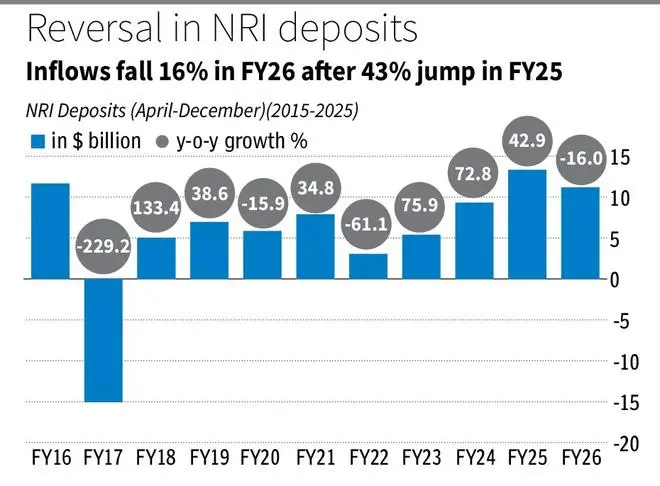
NRI deposit inflows declined 16 per cent to $11.20 billion during April-December FY26, reversing a sharp 42.8 per cent surge to $13.33 billion in the corresponding period of FY25.
The moderation comes after two years of strong growth. Inflows had risen 72.7 per cent in FY24 and 42.8 per cent in FY25, marking a sharp recovery from the 61.1 per cent contraction recorded in FY22. Over the past decade, flows have remained episodic, swinging between double-digit growth and sharp contractions.
“Growth in NRI deposits has always been very episodic and inconsistent,” said Prof Anil Sood of the Institute for Advanced Studies in Complex Choices (IASCC). He noted that inflows had stabilised at around $6 billion annually between 2017-18 and 2022-23 before rising to $9 billion in 2023-24 and $13 billion in 2024-25. The current reduction may just be bringing flows back to the normal level of less than $10 billion.
Vivek Iyer, Partner and Financial Services Risk Advisory Leader, Grant Thornton Bharat, attributed the latest slowdown to currency expectations. “NRI deposits slowed down because of an expectation of a weaker rupee amid global geopolitical uncertainties. It was more of a timing game to ensure that more rupees were received for the same amount of dollars,” he said, adding that the change appears tactical rather than structural.
FCNR (B) deposits decline
Category-wise data shows that the decline in overall NRI deposit flows was led by FCNR(B) accounts, where inflows declined sharply by 68.4 per cent year-on-year to $2.04 billion in FY26, compared to $6.46 billion in the same period last year.
FCNR(B) deposits are foreign currency-denominated term deposits that protect investors from exchange rate risks, as both principal and interest are maintained in foreign currency.
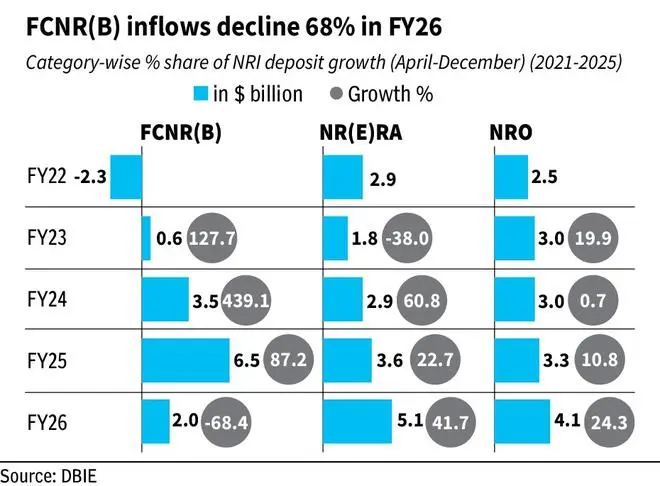
In contrast, NRE deposits grew 41.7 per cent to $5.06 billion in FY26, up from $3.57 billion a year earlier. These accounts are rupee-denominated deposits where both principal and interest are fully repatriable and tax-free in India.
Meanwhile, NRO accounts, which are rupee-denominated accounts used to manage income earned in India, such as rent or dividends, and offer limited repatriation benefits, expanded 24.3 per cent to $4.09 billion in FY26, compared to $3.29 billion in the corresponding period last year.
Nearly 80 per cent of NRI deposits are held in repatriable accounts — FCNR(B) and NRE — making them sensitive to interest rate differentials and currency expectations. According to Sood, macroeconomic stability combined with relatively higher interest rates, driven at times by RBI incentives, has historically supported inflows.
Experts pointed out that FCNR(B) deposits have historically been more volatile, as investors in these foreign currency accounts are more yield-sensitive and wary of exchange rate risks. In contrast, NRE deposits, which are largely held by workers with long-term ties to India, tend to be more stable and less sensitive to short-term currency fluctuations.
They also added that in a phase of rupee depreciation, NRE accounts, being rupee-denominated, become more attractive as they translate into higher rupee returns for the same dollar inflow.
Looking ahead, analysts expect flows to stabilise rather than surge. “We may see stable flows only if INR is stable and the RBI does not cut policy rate,” Sood said, cautioning that rate cuts or expectations of depreciation could deter deposits.
More Like This




Published on February 26, 2026