
惯性聚合 高效追踪和阅读你感兴趣的博客、新闻、科技资讯
阅读原文 在惯性聚合中打开

推荐订阅源

Blog — PlanetScale
Blog — PlanetScale
Y
Y Combinator Blog
G
Google Developers Blog
Cyber Security Advisories - MS-ISAC
L
LangChain Blog
S
SegmentFault 最新的问题
J
Java Code Geeks
V
Visual Studio Blog
H
Help Net Security
Stack Overflow Blog
Stack Overflow Blog
aimingoo的专栏
aimingoo的专栏
OSCHINA 社区最新新闻
OSCHINA 社区最新新闻
T
Tailwind CSS Blog
Microsoft Azure Blog
博客园_首页
H
Hackread – Cybersecurity News, Data Breaches, AI and More
奇客Solidot–传递最新科技情报
奇客Solidot–传递最新科技情报
博客园 - Franky
B
Blog RSS Feed
The Cloudflare Blog
MyScale Blog
MyScale Blog
月光博客
月光博客
Microsoft Security Blog
美团技术团队

Latest BL Data Stories News, Business, Economic Data Stories - BusinessLine | The HinduBusinessLine

Mega IPOs do not always deliver The quick-commerce battle The biggest World Cup yet India is largest source for immigrant founders of US unicorns, but still not shooting for the stars South Korea records high FPI outflows of $69 billion in 2026, followed by India with $26 billion Health insurance coverage crosses 60% of households, NFHS How AT1 bond issuances have hit a rough patch since 2025 Nifty-50 valuation faces test as global capital chases faster earnings growth RBI balance sheet expanded 21% in FY26 led by rising gold valuation Gender parity in government services still a long way away Infrastructure project additions surge in Q4 FY26 led by highway projects RBI records highest-ever dollar sales to defend rupee in FY26 India sees 15% jump in education loans, touches decade-high ₹8.58 lakh crore in FY26 Fuel price hikes renew focus on high state taxes on petrol and diesel Stolen identities fuel cyberattacks Quick-commerce firms spend ₹98-100 per order despite increasing dark stores, says Bernstein research IPL economy AI apps, UPI drive India’s digital shift Gold bars and coins make up 41% of gold demand in January-March 2026 How FIIs and DIIs are taking opposing positions Southern States recorded inflation above national average in April 2026 Gold held by Indian gold ETFs up 79% in the past year India’s forex reserves contract 5% since March, one of the highest among oil importing EMs Tamil Nadu’s winners: Youngest and wealthiest Profile of the whistle brigade SIR impact on close contests: How sub-10,000 margins reshaped the electoral map Indian firms boost global acquisitions to $17.3 billion led by Sun Pharma deal External commercial borrowings fall 25% in FY26 amid currency risks, shift to domestic funding Gaps in financial maturity Palash Rana tops wealth chart in Bengal Phase 2 with ₹104 crore-plus assets
Sixteenth Finance Commission: Slight course correction bu...
2026-02-02 · via Latest BL Data Stories News, Business, Economic Data Stories - BusinessLine | The HinduBusinessLine
The 16th FC has also re-defined this demographic change to account for population growth between 1971 and 2011, instead of relying on change in Total Fertility Rates, as it earlier used to

The 16th FC has also re-defined this demographic change to account for population growth between 1971 and 2011, instead of relying on change in Total Fertility Rates, as it earlier used to | Photo Credit: Getty Images

The 16th Finance Commission report placed before the Parliament on the Budget day has sought to stick to its core principle of equitable redistribution of resources among the poorer States. While the formula for arriving at the devolution has been changed across parameters, it has not resulted in material change in the share among States.

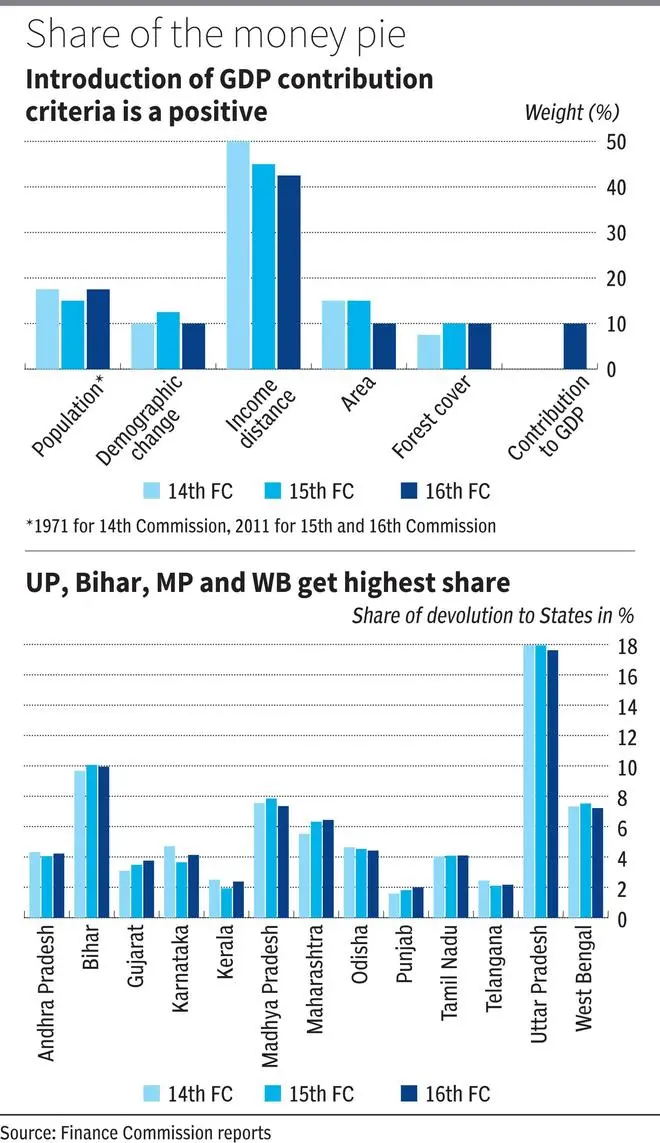
The commission has retained the vertical devolution share at 41 per cent but the weights have been changed in various parameters. 

The most significant change in the formula is the introduction of the new horizontal criterion to reward State’s contribution to the overall economy. This ensures that the fast-growing States are rewarded. Rewarding larger States in terms of area is not a great idea and the reduction in this weight from 15 per cent to 10 per cent is a good move.

But the positives have been negated by increasing the weightage for population and decreasing that of demographic change.

Income distance criterion (the gap between a State’s per capita income and the State with the highest per capita income), still retains the highest weight, though it has reduced slightly from 45 to 42.5 per cent. This limits changes in the overall share among the States.

The 16th FC has also re-defined this demographic change to account for population growth between 1971 and 2011, instead of relying on change in Total Fertility Rates, as it earlier used to.

Dr M Govinda Rao, a former member of the 14th Finance Commission, said it is a good and balanced report overall and does not disturb the status quo. The ‘GDP contribution’ factor seems to have been brought in to appease the Southern States that have been demanding it. However, the ‘Income Distance’ factor still holds a large share, and one must consider that the character of the per capita income in some States is such that it does not contribute to consumption leading to low GST revenue, such as in the case of Tamil Nadu.
Share largely unchanged

While the share of Southern States like Karnataka, Kerala, AP, Telangana and Tamil Nadu saw a marginal growth due to the introduction of the GDP Contribution criteria, most of them still get a share smaller than their shares under 14th FC, given they have higher per capita income and have managed to implement population control measures.

Uttar Pradesh (17.6 per cent), Bihar (9.9 per cent), Madhya Pradesh (7.3 per cent), and West Bengal (7.2 per cent), which have seen a slight decline in share in the 16th FC, still hold a lion’s share of the grants, essentially due to the large weightage given to the ‘Income Difference’ criteria.

Dr KR Shanmugham, former director, Madras School of Economics, said that the equity-efficiency balance, which was earlier at 45 per cent-15 per cent ratio, is now at 42.5 per cent-12.5 per cent, thanks to the introduction of the GDP Contribution criteria. This moves the needle towards rewarding high growth, but is still at some distance from the demand of the States to take it higher.

Published on February 2, 2026