





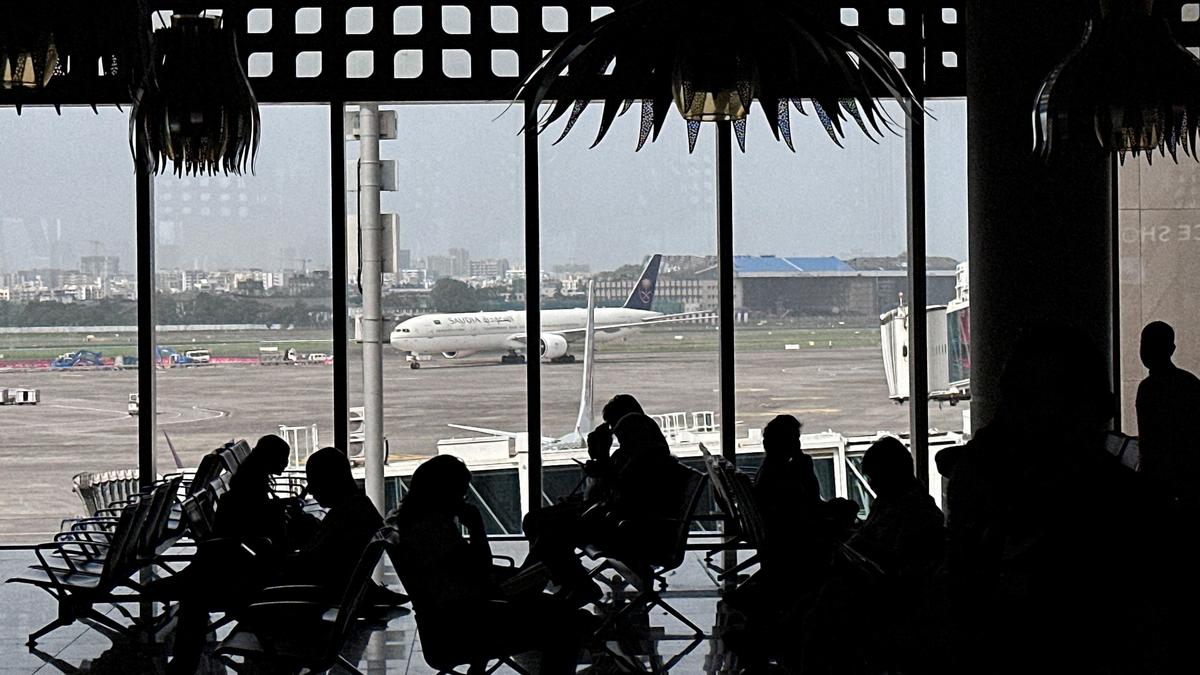
Globally, 40% report they at least sometimes or often avoid the news, the highest figure ever recorded. People shared consistent reasons for this: the news put them in a bad mood, they felt overwhelmed and powerless to act | Photo Credit: FRANCIS MASCARENHAS
During several recent conversations, people have told me that they’ve stopped checking their phones in the morning. Not because nothing was happening, but because everything was. They described the feeling as standing under a waterfall of perpetual bad news.
This experience is far from an isolated one. According to Reuters Institute’s 2025 Digital News Report, 69 per cent of Canadians at least occasionally avoid the news now.
Globally, 40 per cent report they at least sometimes or often do the same, the highest figure ever recorded. People shared consistent reasons for this: the news put them in a bad mood, they felt overwhelmed and powerless to act.
As a researcher in developmental psychology, focusing on social development and psychological well-being, I argue that news fatigue is not laziness, weakness or a generational decline in civic interest. It’s the predictable response of a human brain meeting an environment it was never designed to navigate.
Long before smartphones or even the printing press, our cognitive architecture was shaped by a single problem: stay alive long enough to reproduce. Our ancestors whose attention drifted past the rustle in the grass left fewer descendants than those who froze, looked and listened.
The brain that paid attention to threats was the brain that survived.
This is the foundation of what psychologists call the negativity bias, one of the most replicated findings in cognitive science. Across decades of research, the human mind has been shown to weigh negative information more heavily than positive, attend to it faster and remember it longer.
A predator nearby mattered more than a beautiful sunset. The cost of missing a real threat was death, while the cost of overreacting was a few minutes of wasted vigilance. The asymmetry made this bias adaptive.
Here is the problem: the human brain has not changed since then. We are the same species as we were thousands of years ago. What’s changed is the size of the world it’s asked to scan for threats.
For most of human history, the threats our nervous system processed were local. A neighbouring tribe. A drought. The illness of a child we personally knew. Information about distant places would barely arrive, and if it did, it was mainly irrelevant.
In 2026, the same neurological system is being asked to absorb a war in one region, a financial shock in another, a climate disaster in a third and a violent crime in a fourth, all before lunchtime.
A study published in the scientific journal Nature Human Behaviour examined more than 105,000 real news headlines viewed nearly six million times. Each additional negative word increased click-through rates, while positive words had the opposite effect.
Recent studies suggest people around the world demonstrate measurably stronger physiological responses to negative news than to positive news. The body is reacting before the mind has decided whether the threat is relevant.
Some researchers have introduced a clinical framework for what happens in this instance called Problematic News Consumption (PNC) — a pattern of news engagement that results in preoccupation, dysregulation and disruption to daily functioning. In their 2022 study, the researchers found that 17 per cent of American adults qualified as having severe levels of PNC. Among that group, 61 per cent reported feeling unwell quite a bit or very much, compared with six per cent of those who didn’t.
For minority populations, news fatigue may be even more consequential.
Repeatedly witnessing harm directed at our own groups, even when we’re not the immediate target, can have a significant psychological impact on people from the same group affiliation. For racialised communities, such as immigrants, the cognitive load could be even heavier, and the option to simply stop watching is much harder to exercise when the news is about their country of origin.
What’s the solution to news fatigue? Well, it’s not avoidance. A democracy depends on informed citizens.
Many adults already cite the spread of misleading information as a major source of stress. Withdrawing from accurate, trustworthy information only deepens the problem. We’re wired to pay more attention to bad news, and that kind of content will find its way to us one way or another.
The fix is to manage the consumption and the sources.
Several approaches can help manage news fatigue and protect mental health. Containing news consumption to defined windows of time reduces the sense of being overwhelmed. Choosing depth over volume also matters: one carefully reported long-form article will inform you better than bursts of random, unreliable and emotionally loaded posts on Instagram.
There is also value in distinguishing between information and action — research on perceived control and stress consistently shows that the gap between awareness and agency is one of the strongest predictors of psychological distress. Identifying what you can actually do about what you read in the news, however small, regulates that response.
Finally, be wary of “rage bait” — intentionally provocative messages or content designed to boost engagement on social media platforms by eliciting negative reactions. Recognising that certain content creators want to provoke rather than reflect reality creates useful cognitive distance.
The news will not become less “heavy.” But our relationship with it can become more deliberate. Our brains were not built for this scale of input. They were, however, built to learn to adapt.
(By Ali Jasemi, Wilfrid Laurier University)
Published on May 26, 2026
此内容由惯性聚合(RSS阅读器)自动聚合整理,仅供阅读参考。 原文来自 — 版权归原作者所有。