惯性聚合 高效追踪和阅读你感兴趣的博客、新闻、科技资讯
阅读原文 在惯性聚合中打开

推荐订阅源

B
Blog RSS Feed
Spread Privacy
Spread Privacy
T
Threatpost
C
Cisco Blogs
P
Palo Alto Networks Blog
AI
AI
Cyberwarzone
Cyberwarzone
NISL@THU
NISL@THU
P
Privacy & Cybersecurity Law Blog
G
GRAHAM CLULEY
Simon Willison's Weblog
T
Tor Project blog
Latest news
Latest news
AWS News Blog
AWS News Blog
D
Docker
S
SegmentFault 最新的问题
博客园 - 聂微东
WordPress大学
WordPress大学
Vercel News
Vercel News
S
Securelist
爱范儿
爱范儿
J
Java Code Geeks
Know Your Adversary
Know Your Adversary
S
Schneier on Security
Hugging Face - Blog
Hugging Face - Blog
F
Fortinet All Blogs
Last Week in AI
Last Week in AI
D
DataBreaches.Net
宝玉的分享
宝玉的分享
D
Darknet – Hacking Tools, Hacker News & Cyber Security
MongoDB | Blog
MongoDB | Blog
Engineering at Meta
Engineering at Meta
K
Kaspersky official blog
美团技术团队
博客园 - 叶小钗
阮一峰的网络日志
阮一峰的网络日志
量子位
博客园_首页
Attack and Defense Labs
S
Secure Thoughts
Google Online Security Blog
Application and Cybersecurity Blog
Threat Intelligence Blog | Flashpoint
腾讯CDC
T
Threat Research - Cisco Blogs
雷峰网
雷峰网
有赞技术团队
有赞技术团队
www.infosecurity-magazine.com
P
Privacy International News Feed
S
Security Affairs

Business Tech News: Latest Updates on Innovations, Startups, and Market Trends | The HinduBusinessLine

Geo-engineering against climate change ZincGel vs Li-ion battery Why the energy sector isn’t AI-ready yet IT services giant TCS takes an AI-led avatar IIT-M revives forgotten route to industrial wastewater treatment IIT-Kanpur-incubated start-up develops unique battery technology Two faces of water Why the made-in-India ePlane is unique Moving satellite data at laser speed Longer-lasting zinc battery How simulation tech can ready robots for the real world DAE commissions world’s first nuclear heat-based copper-chlorine hydrogen plant DAE commissions world’s first nuclear heat-based copper-chlorine hydrogen plant Subterranean forest of fungi Using sound waves to bypass charge-based circuits AI aides to decode Indian law How the US funding cut impacts cancer research The time to deploy thorium is now The protein-peptide bonds that heal IIT-Kanpur hosts India’s first DORIS beacon How plants summon help Fishing out fake news using a deep-learning neural network IIT-Madras sets up testing tank for ships, submarines Dentistry’s prehistoric drill With AI, science is borderless How ‘spent’ graphite breathes new life into fuel cell Coal gas can yield clean hydrogen at $1.25 a kg Light, compact antennas IMD launches pilot weather forecast within 1 km radius in UP, national roll out in 2-3 years Nationwide ban soon on Paraquat herbicide over toxicity concerns, health risks ParvAI: ‘Windows to the soul’ and workplace safety Why agreeable AI is a liability in competitive markets Indian material for magnet making Using lasers to punch holes in cell walls When the grid becomes an all-knowing data system Micro-mining for critical rare earth minerals Half the capex, less carbon: The molten magic inside Tata Steel’s HIsarna bet Cosmic aid for miners Efficient brakes and EV range India contributes ₹745 crore to multi-country ITER Big budgets, slow science: BARC under-spends on R&D Artemis-2: Hurtling moon-ward on an epochal mission Power supply lessons for AI Why nuclear fusion is gaining funding Defence research stays underfunded Micro attacks on sewer lines Turning the ubiquitous optical fibre into a sensor The PRAGYA tokamak Mind-reading tech No exam is too hard for AI? Carnot battery: Carbon dioxide as ideal ‘working fluid’ On a leash of light On a wing and an AI-powered tool How do ‘natural polypills’ work? AI tool for capturing and managing hospital records How sea microbes can protect agri fields Why India should choose to build not just powerful, but also governable AI Flaring and quaking Qualcomm has an Edge in India Soil testing of rhizosphere CMFRI achieves captive breeding of threatened mangrove clam No erasures RDI scheme could be operationalised this year IIT-M’s ramjet shell is an engineering marvel Sun-powered supercapacitor 10 years on, NALCO yet to start gallium extraction project Budget doubles allocation for nuclear research to ₹2,410 cr Underwater water Recent successes in science-led atmanirbharta Electric mobility may take wing in the not-too-distant future Eco-friendly semiconductors Twinning prayers and AI at mega temple festival Solar cells of efficiencies above 30% A lesson from Germany on infrastructure maintenance Fabled city in the high mountains Optimising bioreactor design Sensing UV-C in femtoseconds ISRO to kick off 2026 with launch of Earth Observation Satellite Thriving in extremes Indo-Lankan leg-up for S&T Using AI to better assess cyclone damage War on drug resistance goes undersea Big, bad business of junk food Rosatom’s mini variant of small modular reactor Clear thinking on pranayama Can GenAI be a responsible teaching assistant? Pharma PLI fetches ₹26,832 cr sales ‘Scripting’ ideal AI output Honeywell’s technology may bring biomass to the centre stage India-made human-like robot Scorched by 163-year drought NTT’s quantum leap into near sci-fi realm A reality check on AI’s negotiation skills Salinity-proof epoxy coating for marine installations Cross-species transplantation is at a regulatory crossroads Nature, the ultimate climate warrior Breakthrough in desalination technology, using carbon ‘flowers’ Epidemiology-ML collab decodes India’s struggles with air quality
Heat from small-scale solar units could accelerate India’s net-zero transition
2025-11-28 · via Business Tech News: Latest Updates on Innovations, Startups, and Market Trends | The HinduBusinessLine
Energy from the sun currently powers most renewable resources worldwide, due to widespread availability

Energy from the sun currently powers most renewable resources worldwide, due to widespread availability | Photo Credit: jokerpro

India’s target for achieving net-zero emissions hinges wholly on large-scale adoption of renewable energy. Currently, coal accounts for more than 80 per cent of the country’s energy production, and this emits more than 2.4 billion tonnes of carbon dioxide annually.

Energy from the sun currently powers most renewable resources worldwide, due to widespread availability, but conventional solar photovoltaic (PV) units require a huge investment. PV modules also have a significant ecological impact and their effectiveness declines at high temperatures.

One alternative to PV cells is solar thermal power, where solar energy is converted into heat to generate electricity. When combined with thermal energy storage devices (TES), it offers several advantages over conventional PV systems, such as lower investment and increased reliability.

In a paper titled ‘Techno economic feasibility study of solar organic Rankine cycle in India’, submitted to the Physics and Society journal last week, the authors point out that TES devices are a sound alternative in solar power harvesting, vis-a-vis the environmental impact of solar panels.

The study — conducted by researchers from the Indian Institute of Engineering Science and Technology, Shibpur; Imperial College, London; and the Indian Institute of Technology, Kharagpur — evaluates the performance and cost-effectiveness of solar organic Rankine cycle (ORC) technology under Indian climatic conditions.

The paper notes that India aims to generate 40 per cent of its electricity from renewable sources by 2030. The country has achieved a 226 per cent increase in renewable energy installation, now accounting for about 25 per cent of total installed capacity.

‘Optimal fluid’

Solar ORC technology converts heat into electricity. Compared to traditional steam-based Rankine cycle technology, it generates heat at lower temperatures, making it suitable for low-power electricity generation (up to 100 kWe). The system uses solar energy to heat an organic fluid, which then expands to generate mechanical power and, in turn, electricity.

The study evaluated seven fluids. The findings suggest that ‘R 1233zd (E)’ is the optimal fluid, in terms of cost and environmental impact. This organic fluid belongs to the category of hydrofluoro-olefin refrigerants.

In the ORC system, heat from a solar collector is transferred via the fluid to an evaporator. The fluid is pumped to a high pressure, where it absorbs the heat in the evaporator, turning into a superheated vapour. This vapour then expands in an ‘expander’ to generate mechanical power, which drives a generator to produce electricity. Finally, the fluid cools in a condenser to repeat the cycle.

Competitive costs

The study shows that ORC systems are competitive compared with solar PV technology and their cost is significantly lower than that of biomass-based ORC systems across various power targets. For instance, the cost for a 100 kW S-ORC unit is $895-1,122 per kWh. A comparable solar PV system would cost $988 per kWh.

Developing countries, including India, would likely benefit from investing in this efficient, low-cost solar thermal option. But not all is rosy yet. There is still work to be done on the thermal solar front, too. The authors point out that there is further scope to reduce costs by optimising components such as the solar collector and expander, and improve efficiency even further.

More Like This

majivecka

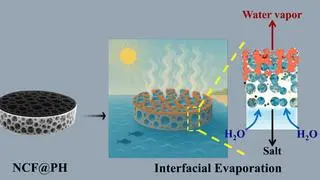
JANUS-FACED FLOATING FILM: Schematic representation of the steps involved in the fabrication of an NCF@PH solar–thermal interfacial evaporator

Published on November 28, 2025