

惯性聚合 高效追踪和阅读你感兴趣的博客、新闻、科技资讯
阅读原文 在惯性聚合中打开

推荐订阅源

Forbes - Security
Forbes - Security
C
CERT Recently Published Vulnerability Notes
T
The Exploit Database - CXSecurity.com
T
Threatpost
P
Privacy International News Feed
C
Cisco Blogs
P
Privacy & Cybersecurity Law Blog
Cyberwarzone
Cyberwarzone
Scott Helme
Scott Helme
O
OpenAI News
K
Kaspersky official blog
Latest news
Latest news
PCI Perspectives
PCI Perspectives
Recent Commits to openclaw:main
The Last Watchdog
The Last Watchdog
Threat Intelligence Blog | Flashpoint
T
Threat Research - Cisco Blogs
cs.CV updates on arXiv.org
C
Cyber Attacks, Cyber Crime and Cyber Security
H
Heimdal Security Blog
Application and Cybersecurity Blog
N
News | PayPal Newsroom
C
CXSECURITY Database RSS Feed - CXSecurity.com
Security Latest
Security Latest
www.infosecurity-magazine.com
N
News and Events Feed by Topic
C
Check Point Blog
人人都是产品经理
人人都是产品经理
让小产品的独立变现更简单 - ezindie.com
博客园_首页
腾讯CDC
G
GRAHAM CLULEY
阮一峰的网络日志
阮一峰的网络日志
TaoSecurity Blog
TaoSecurity Blog
freeCodeCamp Programming Tutorials: Python, JavaScript, Git & More
S
Secure Thoughts
C
Cybersecurity and Infrastructure Security Agency CISA
博客园 - 叶小钗
Jina AI
Jina AI
Know Your Adversary
Know Your Adversary
V
Visual Studio Blog
T
Tailwind CSS Blog
L
LINUX DO - 热门话题
J
Java Code Geeks
爱范儿
爱范儿
博客园 - 三生石上(FineUI控件)
Exploit-DB.com RSS Feed
钛媒体:引领未来商业与生活新知
钛媒体:引领未来商业与生活新知
酷 壳 – CoolShell
酷 壳 – CoolShell
GbyAI
GbyAI

Business Tech News: Latest Updates on Innovations, Startups, and Market Trends | The HinduBusinessLine

Geo-engineering against climate change ZincGel vs Li-ion battery Why the energy sector isn’t AI-ready yet IT services giant TCS takes an AI-led avatar IIT-M revives forgotten route to industrial wastewater treatment IIT-Kanpur-incubated start-up develops unique battery technology Two faces of water Why the made-in-India ePlane is unique Moving satellite data at laser speed Longer-lasting zinc battery How simulation tech can ready robots for the real world DAE commissions world’s first nuclear heat-based copper-chlorine hydrogen plant DAE commissions world’s first nuclear heat-based copper-chlorine hydrogen plant Subterranean forest of fungi Using sound waves to bypass charge-based circuits AI aides to decode Indian law How the US funding cut impacts cancer research The time to deploy thorium is now The protein-peptide bonds that heal IIT-Kanpur hosts India’s first DORIS beacon How plants summon help Fishing out fake news using a deep-learning neural network IIT-Madras sets up testing tank for ships, submarines Dentistry’s prehistoric drill With AI, science is borderless How ‘spent’ graphite breathes new life into fuel cell Coal gas can yield clean hydrogen at $1.25 a kg Light, compact antennas IMD launches pilot weather forecast within 1 km radius in UP, national roll out in 2-3 years Nationwide ban soon on Paraquat herbicide over toxicity concerns, health risks ParvAI: ‘Windows to the soul’ and workplace safety Why agreeable AI is a liability in competitive markets Indian material for magnet making Using lasers to punch holes in cell walls When the grid becomes an all-knowing data system Micro-mining for critical rare earth minerals Cosmic aid for miners Efficient brakes and EV range India contributes ₹745 crore to multi-country ITER Big budgets, slow science: BARC under-spends on R&D Artemis-2: Hurtling moon-ward on an epochal mission Power supply lessons for AI Why nuclear fusion is gaining funding Defence research stays underfunded Micro attacks on sewer lines Turning the ubiquitous optical fibre into a sensor The PRAGYA tokamak Mind-reading tech No exam is too hard for AI? Carnot battery: Carbon dioxide as ideal ‘working fluid’ On a leash of light On a wing and an AI-powered tool How do ‘natural polypills’ work? AI tool for capturing and managing hospital records How sea microbes can protect agri fields Why India should choose to build not just powerful, but also governable AI Flaring and quaking Qualcomm has an Edge in India Soil testing of rhizosphere CMFRI achieves captive breeding of threatened mangrove clam No erasures RDI scheme could be operationalised this year IIT-M’s ramjet shell is an engineering marvel Sun-powered supercapacitor 10 years on, NALCO yet to start gallium extraction project Budget doubles allocation for nuclear research to ₹2,410 cr Underwater water Recent successes in science-led atmanirbharta Electric mobility may take wing in the not-too-distant future Eco-friendly semiconductors Twinning prayers and AI at mega temple festival Solar cells of efficiencies above 30% A lesson from Germany on infrastructure maintenance Fabled city in the high mountains Optimising bioreactor design Sensing UV-C in femtoseconds ISRO to kick off 2026 with launch of Earth Observation Satellite Thriving in extremes Indo-Lankan leg-up for S&T Using AI to better assess cyclone damage War on drug resistance goes undersea Big, bad business of junk food Rosatom’s mini variant of small modular reactor Clear thinking on pranayama Can GenAI be a responsible teaching assistant? Pharma PLI fetches ₹26,832 cr sales ‘Scripting’ ideal AI output Honeywell’s technology may bring biomass to the centre stage India-made human-like robot Scorched by 163-year drought NTT’s quantum leap into near sci-fi realm A reality check on AI’s negotiation skills Salinity-proof epoxy coating for marine installations Heat from small-scale solar units could accelerate India’s net-zero transition Cross-species transplantation is at a regulatory crossroads Nature, the ultimate climate warrior Breakthrough in desalination technology, using carbon ‘flowers’ Epidemiology-ML collab decodes India’s struggles with air quality
Half the capex, less carbon: The molten magic inside Tata Steel’s HIsarna bet
By M Ramesh · 2026-04-20 · via Business Tech News: Latest Updates on Innovations, Startups, and Market Trends | The HinduBusinessLine
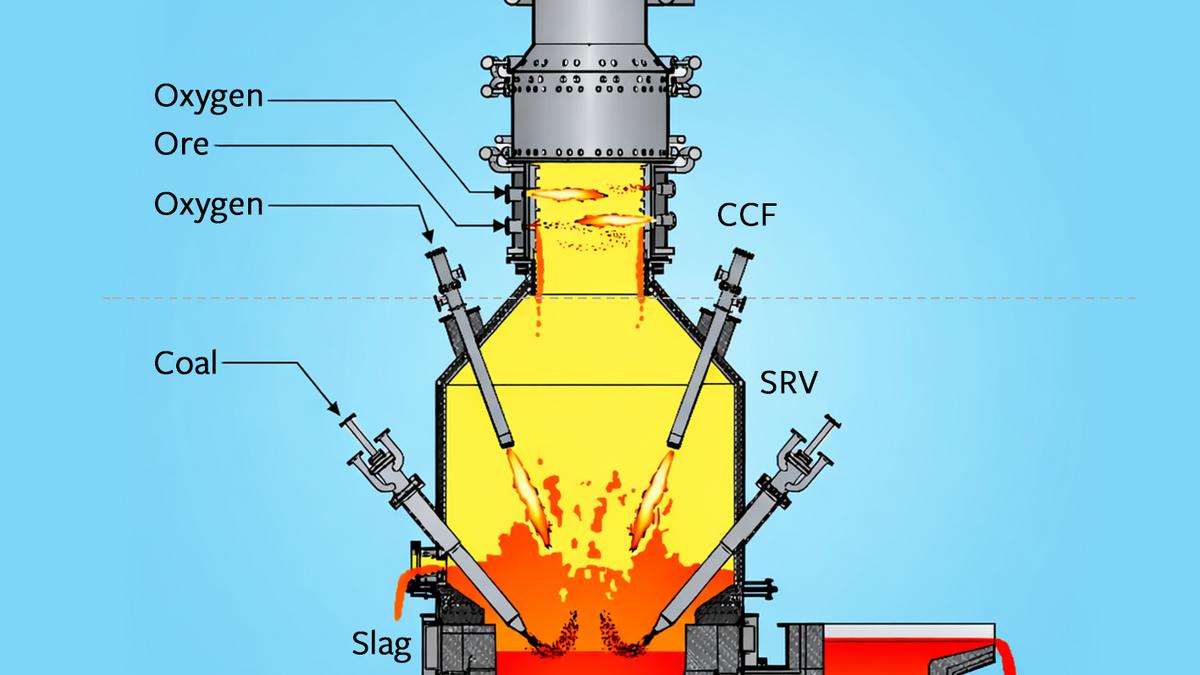
 HIsarna furnace for steel making

 HIsarna furnace for steel making

It costs about a billion dollars (₹9,000 crore) to set up a steel plant with a capacity of one million tonnes. But Tata Steel is planning one at Jamshedpur for roughly ₹4,000 crore.

This is magic made possible by an entirely new steel-making process — HIsarna. Tata Steel had a big hand in its development and now owns the patent.

HIsarna has the potential to revolutionise steel making — once perfected in a commercial plant, it is expected to elbow out all other conventional methods of steel making, such as blast furnace or electric arc furnace.

Its advantages are striking. First, it eliminates two unavoidable steps in traditional steel-making processes — coke-making and the agglomeration of iron ore (into sinter or pellets). That alone knocks off chunks of capital cost. Second, HIsarna doesn’t care about ore quality — low-grade iron ore, abundantly available in eastern India, works just as well. Third, carbon dioxide emissions are estimated to be about 20 per cent lower than in a conventional plant of comparable size. Moreover, the carbon dioxide stream is relatively pure, making carbon capture easier and cheaper, without any need for separation from other flue gases.

How does HIsarna achieve this? The answer lies in its architecture.

Leaving aside the minutiae, the HIsarna furnace has two chambers, one above the other. Powdered iron ore is injected into the top chamber, where it spirals downward. The spiralling keeps it longer in the chamber, which is essential. The powder injection is also the technology’s biggest challenge: The iron ore particles must neither fly out nor fall straight through.

Non-coking coal is injected into the lower, smelting vessel. Oxygen is introduced at multiple points. The coal reacts with oxygen to produce carbon monoxide (CO), which rises to the top chamber. There it meets oxygen again, burns into carbon dioxide, and releases intense heat. This heat melts the ore, which then drips into the lower chamber.

Iron ore (ferric oxide or Fe₂O₃) must be reduced — its oxygen removed — to yield iron. In HIsarna, this happens in two stages. In the upper chamber, ferric oxide is partly reduced to ferrous oxide (FeO) as it encounters the rising CO and injected oxygen; the heat generated also melts the ore. The molten ferrous oxide then falls into the lower chamber, where it reacts with the carbon in coal. The oxygen bonds with carbon, leaving behind molten iron. The outputs are liquid iron and a relatively pure stream of carbon dioxide.

Light footprint

The process can use low-grade ore, which would otherwise be discarded. The plant footprint is about half that of a comparable blast furnace setup. The slag can go straight into a cement kiln, unlike the steel-making slag. Taken together, these factors could lower operating costs by around 10 per cent, according to Subodh Pandey, Vice-President (Technology, R&D, NMB and Graphene) at Tata Steel. The HIsarna plant in Jamshedpur is expected to go on stream by 2030.

How did Tata Steel get here? “Perseverance,” says Pandey — and there’s a story behind that.

The idea of a new steel-making route was first pursued in Europe under the Ultra-Low CO₂ Steelmaking (ULCOS) initiative, a consortium of 48 companies. One of them was Koninklijke Hoogovens, which later merged with British Steel to form Corus Group and was acquired by Tata Steel in 2007.

The construction of a pilot plant in the Netherlands began in 2010, followed by years of trials. Rio Tinto, the British-Australian mining major, joined in 2011, bringing its HIsmelt technology (the bottom chamber). Tata Steel acquired the technology from Rio Tinto in 2017.

Initially, there were many setbacks — refractories failed, operations proved unstable — and most partners lost interest. In 2021, Tata Steel, along with US company Nucor, revived the effort with new operating protocols. The results improved. “We have reached higher operating capacity than originally planned: 14 tonnes of ore per hour against 12 tonnes,” Pandey says.

Perseverance paid off for Tata Steel — in results and in patents. For Nucor, which largely produces steel from scrap, HIsarna offers a route to higher-end products that are not easily made via scrap. Nucor holds rights to build a HIsarna plant in the US, subject to a licence fee — and intends to do so.

More Like This

Published on April 20, 2026