


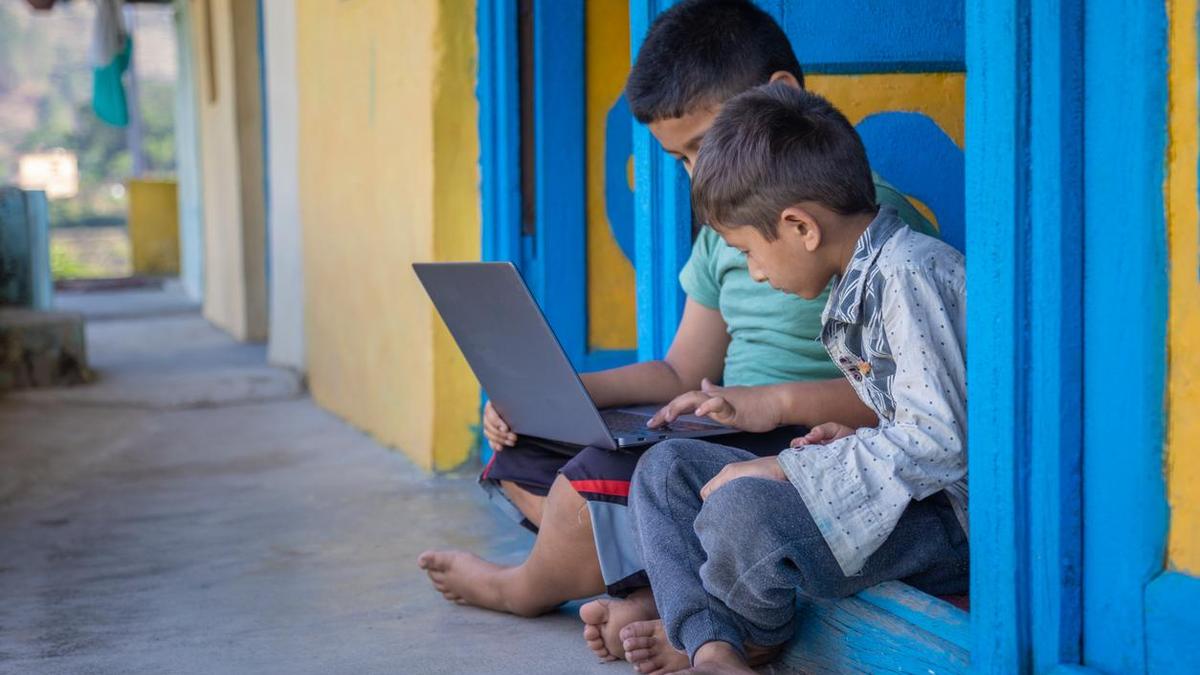
Education: Digital divide | Photo Credit: Umesh Negi
India’s education policy today rightly emphasises better learning outcomes, equitable and inclusive education, and the human capital required to achieve the country’s developmental goals. But for millions of children, the basic condition that makes all of this possible - uninterrupted schooling- is increasingly becoming a challenge.
This is different from school dropout, which is usually seen as the primary cause of learning disruption. The reasons for dropout are many in India, like poverty or social factors like child marriage and gender roles prioritising boys’ education, leaving girls to perform domestic chores, etc. This is particularly seen at the secondary level, where dropout rates are substantially higher than in primary schooling, and retention remains a challenge despite higher enrolment.
Added to this is the problem of disruptions in schooling, mostly due to environmental factors, the COVID-19 pandemic being the exception in recent times. In recent years, schools in Delhi and across parts of North India have been repeatedly shut down due to severe air pollution. Across the country, schools face similar interruptions at different times of the year due to heatwaves, dense fog, heavy rainfall, cyclones and floods. On April 19, the Odisha government ordered schools in nine districts to remain shut for a few days from April 20 due to a heatwave warning.
For the current summer, IMD has already warned of severe above-normal heatwave days across several parts of the country during the April-June period. Such weather-induced disruptions show that school closures are no longer just a pandemic-era exception. It is becoming a recurring feature of educational life at a time of growing extreme climate shocks.
The problem is not only about schools being shut, but that the alternative is far from equal. For many children, a shift to online classes is not a smooth substitute for classroom learning, but it is just the beginning of exclusion. The experience of the COVID-19 pandemic provides important evidence of how school closures widen educational inequalities.
Findings from the latest third round of the India Human Development Survey (IHDS-3), conducted in 2022–24, clearly capture this divide. Among children aged 5-15 who were enrolled during the pandemic, 52 per cent of those in private schools were offered online classes during the closure period, compared with only 30 per cent in government schools.
Similarly, 45 per cent of private-school students received educational videos or other online learning material, compared with just 25 per cent of government-school students. Most strikingly, 61 per cent of children in government schools reported that their school shared nothing at all, compared with 43 per cent in private schools. These findings reflect a wider national pattern, with a Ministry of Education report showing that in several large states, between 40 and 70 per cent of school-going children lacked access to digital devices during the pandemic.
Teachers’ accounts from the IHDS-3 survey help explain why this gap was so difficult to bridge. Among Grade 3 teachers, those in government schools were more likely than their private-school counterparts to report barriers such as poor electricity, weak internet access, and lack of devices - constraints that students themselves had to grapple with. They were also more likely to point to limited digital skills among students and parents, as well as home circumstances that hindered learning. Remote education fell short not only due to technological gaps, but also because learning from home was shaped by unequal household circumstances.
Closures do not create a temporary and uniform pause in learning; they produce an unequal shock. Children already studying in less advantaged settings are more likely to lose access to instruction altogether and less likely to recover quickly. Educational disruption, therefore, does not merely interrupt learning in the short term. It can deepen longer-term inequalities in human capital formation.
That is why the challenge goes beyond curriculum, teacher training, and school infrastructure, even though all of these are important. Such discussions often assume that schooling continues without interruption. But when environmental shocks repeatedly push children out of classrooms and into highly unequal home-based learning conditions, the central policy question becomes one of continuity: who can remain connected to learning when the school gates are shut?
India is not short of digital education initiatives. PM eVIDYA was launched to provide multimodal access to education, while DIKSHA serves as a national platform for digital learning content. Samagra Shiksha has also expanded digital and ICT support within the broader school education framework, and NEP 2020 places clear emphasis on equitable and inclusive education. But the existence of schemes does not by itself guarantee continuity in learning. Where households lack stable connectivity, adequate devices, digital familiarity, or supportive learning environments, the children are unable to benefit from them.
As environmental disruptions become more frequent, measures for continuity in learning can no longer be treated as part of crisis management. They must be built into mainstream education policy through stronger digital access, low-tech alternatives, community-based support, and effective last-mile delivery. Otherwise, every school closure will widen the gap between children who can continue learning and those who cannot, turning such interruptions into inequality.
The writer is an Associate Fellow, NCAER - National Data Innovation Centre. Views expressed are personal
Published on May 23, 2026
此内容由惯性聚合(RSS阅读器)自动聚合整理,仅供阅读参考。 原文来自 — 版权归原作者所有。