


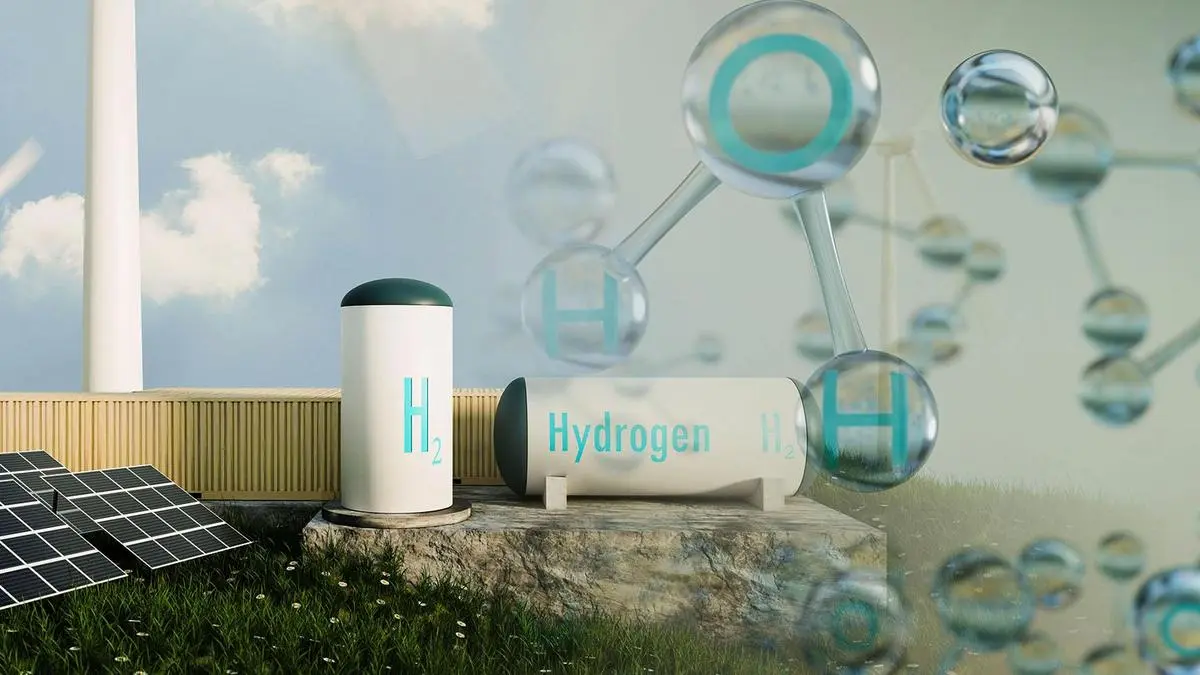
If green hydrogen is to reduce fossil-import dependence inside industry, electrolysers must run on renewable power that is cheap, reliable and dispatchable | Photo Credit: angkhan
Prime Minister Narendra Modi’s appeal to use petrol and diesel sparingly has brought India’s energy vulnerability back into focus. India’s response, however, cannot stop at short-term restraint by households alone. Imported fossil energy is built into India’s industrial economy — in fertilizers, refineries, ammonia and other energy-intensive production chains. Therefore, any serious response must reduce fossil-fuel dependence where it is embedded in production.
In this regard, the National Green Hydrogen Mission (NGHM) needs to be reviewed through a sharper energy-security lens. The Mission’s 2030 target of 5 million tonnes (mt) of annual green hydrogen capacity is ambitious, but to create resilience, the immediate task must be to convert existing demand for grey hydrogen and ammonia into green, contract-backed demand that firms can finance and use at scale. For accelerated adoption, several policy imperatives follow.
First, green hydrogen adoption must be expedited in core industries like fertilizers and refineries, where existing grey hydrogen and ammonia use can be converted into durable and bankable green demand. SECI’s 10-year agreements to supply 7,24,000 tonnes of green ammonia annually to 13 fertilizer units, with estimated forex savings of about $2.5 billion over a decade, and refinery-linked green hydrogen projects covering 30,000 tonnes per annum, are useful steps. Their real value lies in the demand signal. India’s hydrogen policy will acquire substance only when existing industrial demand becomes credible long-term demand for green hydrogen, reducing fossil-import dependence where it is embedded in production.
Second, hydrogen economics must be judged by delivered cost, not production cost alone. Cheap production can still become uncompetitive once transport, storage, conversion losses and purification are added. If delivered costs remain high, green hydrogen will not work as an import-substitution strategy. Evidence from advanced hydrogen markets suggests that midstream and end-use infrastructure can account for 70-85 per cent of the final delivered cost, even when production costs are only $2-3 per kg.
India should therefore avoid building the early market only around large coastal hubs and long-distance supply chains. Such hubs matter for exports and large industrial users, but they cannot by themselves serve the dispersed domestic industries whose fossil dependence the Mission must reduce.
Third, hydrogen adoption should not be built only around large, centralised projects. Many small and mid-sized industrial users need reliable, high-quality hydrogen in modest quantities, close to the point of use. For them, modular, on-site or near-site production may be more economical than sourcing from distant hubs. Policy should therefore focus on building domestic competence in modular electrolysers, high-purity hydrogen systems and application-specific engineering. There are wider opportunities in specialty chemicals, advanced materials, and, over time, in derivatives such as green ammonia and synthetic fuels. A hydrogen ecosystem built around only a few large public-sector applications will not create the engineering firms, component suppliers and specialised manufacturers needed for a durable market.
Fourth, electrolyser policy must support both scale and distributed use. The NGHM’s ₹4,440 crore incentive scheme has awarded 15 companies domestic manufacturing capacity of 3,000 MW per annum, but its design remains tilted towards larger manufacturers. The main bidding buckets had 100 MW thresholds, though one smaller bucket allowed bids from 10 MW. Since electrolysers form a large share of green hydrogen costs, scale and efficiency matter. But if the mission is to reduce fossil dependence across industry, it must also support modular applications. A calibrated SME window for 10 kW to 2 MW stacks could enable small-scale, near-site electrolysis for dispersed industrial users and MSMEs that cannot viably connect to coastal hubs. Studies suggest such systems can match or improve large-hub break-even periods once transport and grid-access costs are included, especially with targeted capital subsidies of 20-30 per cent.
Finally, a hydrogen policy cannot be separated from power-sector reform. If green hydrogen is to reduce fossil-import dependence inside industry, electrolysers must run on renewable power that is cheap, reliable and dispatchable. India has built a strong baseline, surpassing 50 per cent non-fossil installed capacity ahead of its 2030 National Determined Contribution timeline. However, if grid transmission bottlenecks, storage gaps, and open-access frictions persist, domestic hydrogen will remain too expensive to compete.
The Mission will count only when green hydrogen becomes commercially usable in ordinary industrial settings.
Nandy is Associate Professor in the Economics & Public Policy Area at IIM Ranchi, and Dalapati is Chief Technology Officer at Hydrogen Innovation Pte. Ltd. Views are personal
Published on June 1, 2026
此内容由惯性聚合(RSS阅读器)自动聚合整理,仅供阅读参考。 原文来自 — 版权归原作者所有。