


The Indian Institute of Technology (Ropar) has launched an agricultural intelligence ecosystem comprising advanced weather stations called Swan, Krishi intelligence call centres and Annam chat engine (ACE).
The ecosystem is scalable and is India’s first fully integrated agricultural intelligence system. It has been launched by the institution’s Centre of Excellence (CoE) in AI for Agriculture, ANNAM.AI, project director Pushpendra P. Singh told businessline.
“The intelligence ecosystem is designed to support the entire agricultural value chain,” he said. It integrates, apart from AI, Internet of Things (IoT), climate science and multilingual advisory systems into one integrated ecosystem.
“It offers ‘AI‑driven insights, precision advisories, hyperlocal climate intelligence, and crop diagnostics all in one platform’,” said Singh.
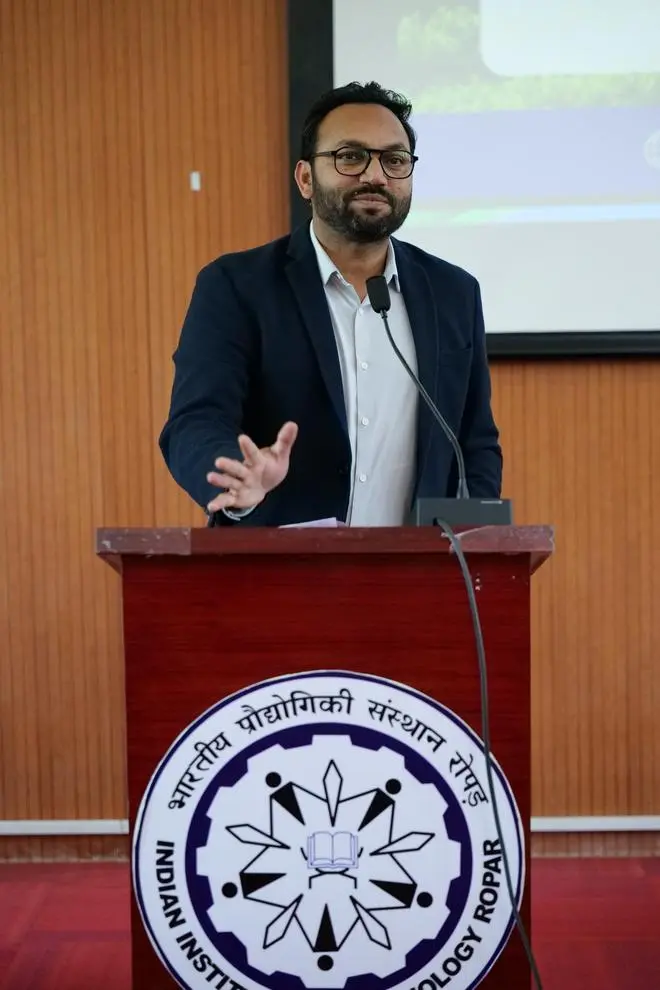
Pushpendra P. Singh, project director, Centre of Excellence in AI for Agriculture, IIT (Ropar)
Three layers
The AI architecture has three layers. One is the infrastructure layer. It comprises micro‑climate intelligence units and advanced weather stations that capture field‑level data, temperature, humidity, wind, and rainfall. It enables precise irrigation, pest prediction, and risk mitigation.
Second is the intelligence layer, Krishi AI, which uses computer vision and analytics to identify crops, detect pests, and assess damage, turning raw data into predictive intelligence. The third is the engagement layer, where Annam chat engine (ACE) delivers multilingual, expert‑validated advisories directly to farmers, covering weather alerts, crop planning, pest management, and market trends.
The system is up and running on the ground. “Instead of waiting for a single ceremonial launch, we chose a phased rollout so farmers could start benefiting immediately,” he said.
The Centre of Excellence at IIT Ropar was established under the Government’s ₹990‑crore national initiative to create three AI Centers of Excellence, including one dedicated to agriculture at Ropar. “This positions ANNAM.AI as a flagship, government‑backed programme with a mandate to build large‑scale digital public infrastructure for farming,” said Singh.
Gains for farmers
By mid-2026, AI‑powered weather stations, micro‑climate intelligence units, and advisory systems have begun operating in Punjab. The platform is now generating real‑time insights for farmers in pilot regions, with a clear roadmap for pan‑India expansion.
“ANNAM.AI will redefine climate‑smart farming for the next decade,” he said.
Gains for farmers will be significant and measurable from these initiatives. With hyperlocal weather intelligence and AI‑based advisories, farmers can reduce water usage by 20–30 per cent, avoid unnecessary pesticide use and prevent 9–12 per cent of crop losses caused by sudden weather events.
“Even a small reduction in climate‑related losses translates into meaningful financial savings. Over time, we help farmers improve productivity, reduce risks, and make confident, data‑driven decisions, leading to more stable and sustainable incomes,” said Singh.
On how ANNAM.AI prepared for this, he said it required a blend of deep research, field validation, and national‑scale engineering. IIT Ropar focused on designing technology that works in real Indian conditions, not just controlled labs. It ensured the platform is farmer‑friendly, multilingual, and accessible and built systems that function even in low‑connectivity rural areas.
Extensive trials
It also ensured interoperability with future national digital agriculture frameworks. The guiding principle was simple: technology must adapt to the farmer, not the other way around, he said.
Extensive trials have been carried out across various districts in Punjab for the ecosystem. “We did field testing of Swan micro‑climate units, deployed advanced weather stations, rolled out pilots of ACE, validated Krishi AI’s crop and pest detection models,” said the IIT Ropar project head.
Hundreds of farmers have participated in the pilot phase and received real‑time alerts and advisories. “As the rollout expands, the platform is expected to reach lakhs of farmers across multiple states,” said Singh.
On the uniqueness of the ecosystem, he said offline AI capability that allows farmers to access insights even without internet connectivity, the platform can be scaled to support millions of farmers across diverse agro‑climatic zones. It has been built to integrate with upcoming national frameworks in digital agriculture, climate resilience and rural development.
“ANNAM.AI’s ecoysystem is not just a technology platform; it is a nation‑building initiative aimed at empowering farmers, strengthening food security, and preparing India for a climate‑challenged future,” said Singh.
Published on April 21, 2026