


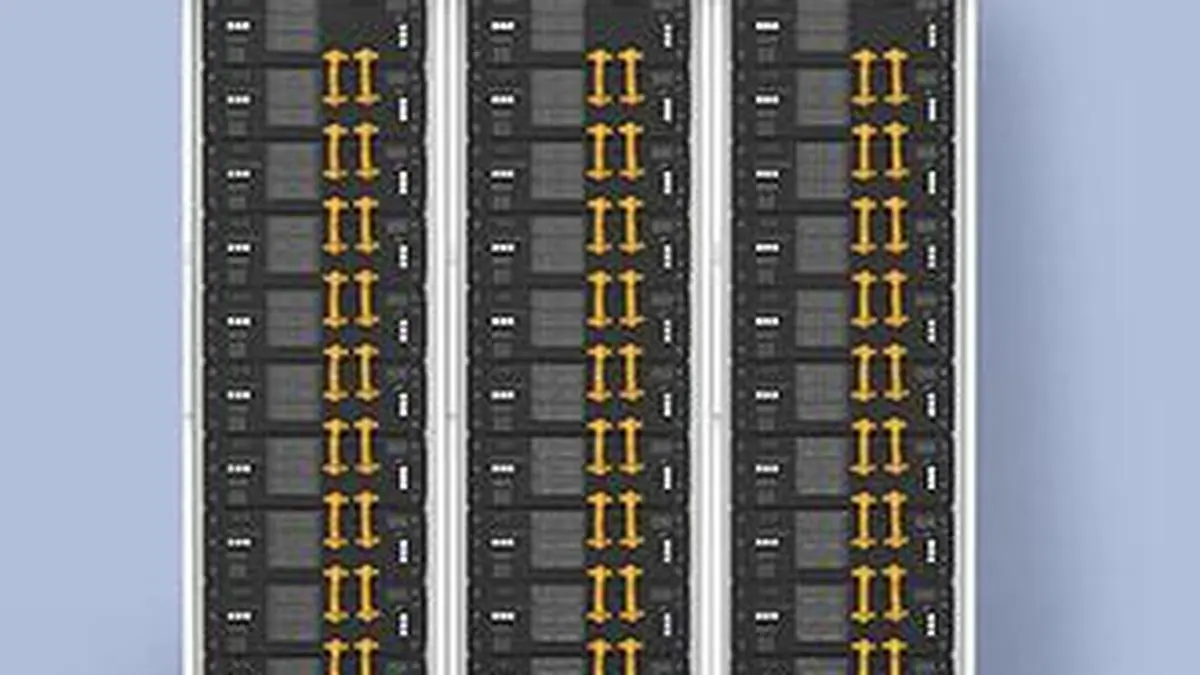
3D rendering of an energy storage system with transparent cover and battery container units inside | Photo Credit: PhonlamaiPhoto
As the need for reliable storage for India’s record renewable capacity addition grows, more solar energy players are now building Battery Energy Storage Systems (BESS) manufacturing capabilities.
For instance Waaree Energies, the largest solar module maker, has set itself a target of 20 Giga Watt Hours (GWh) in BESS capacity by FY28, which will include the manufacturing of cells, battery packs and large-scale BESS containers. Through its subsidiary Waaree Energy Storage Solutions, the company has proposed capital expenditure of ₹10,000 crore for BESS, with a ₹8,000-crore battery gigafactory in Andhra Pradesh. Waaree expects 3.5GWh of BESS production capacity to be operational by FY27.
Similarly, Kolkata-based Vikram Solar has also announced a target of 15GWh of BESS capacity by 2030. The company will initially focus on assembling battery packs and containerised storage systems using externally sourced cells with plans to have 7.5 GW in integrated battery cell manufacturing.
Premier Energies has also announced plans for a 6GWh BESS container facility. In its recent earnings call Vinay Rustagi, Chief Business Officer, Premier Energies, said the company has acquired land for the project and expects the capacity to be operational by March 2027.
In the southern market, Swelect Energy Systems has called out BESS to be a critical growth engine going forward with the company launching products for both residential and large-scale commercial/industrial (C&I) energy storage applications. Arulkumar Shanmugasundaram, CEO and MD said that Swelect will initially focus on BESS system integration with pre-assembled battery modules sourced from global suppliers and plan to build a manufacturing capacity over time.
Other module makers like Adani Solar, Grew Solar and Goldi Solar have also expressed intent to enter the BESS manufacturing businesses.
Ankit Jain, Vice President and Co Group Head, ICRA says that renewable power tenders in India are increasingly requiring battery storage as a necessary component. “We do not have pure-play solar or wind projects in the bidding stage anymore and customers are now asking for battery storage as an in-built component,” he said. He added that at a time when there are some signs of demand flattening for solar capacity addition, BESS can open up ‘another stream of revenue’ for solar manufacturers.
Despite this, competition from Chinese imports is said to be a significant challenge for Indian BESS manufacturing.
“The likelihood of any localization policy from the government in storage is expected to become effective only by around FY28. The industry currently is primarily relying on imports from China on which there is no constraint right now,” Rustagi said in their earnings call.
Anand Kulkarni, Director - Crisil Ratings suggests that for now, players are likely to focus on pack-level assembly capacities as cell-level localisation requires technology tie-ups and reliable raw material access, which will gradually pick up pace in the medium-to-long term.
“The central challenge for battery manufacturing is cost competitiveness against China, which controls 75-80% of the global battery production and dominates critical mineral refining, translating into lower unit cost. The landed cost of a Chinese battery is $105-$110 per kilowatt-hour, which is at least 20-30% lower than the estimated domestic manufacturing costs,” he said.
Currently, industry estimates peg India’s BESS capacity at 1.1 GWh and expects this to expand multifold to 236 GWh by FY32.
Published on May 26, 2026
此内容由惯性聚合(RSS阅读器)自动聚合整理,仅供阅读参考。 原文来自 — 版权归原作者所有。