


Serving tech enthusiasts for over 25 years.
TechSpot means tech analysis and advice you can trust.
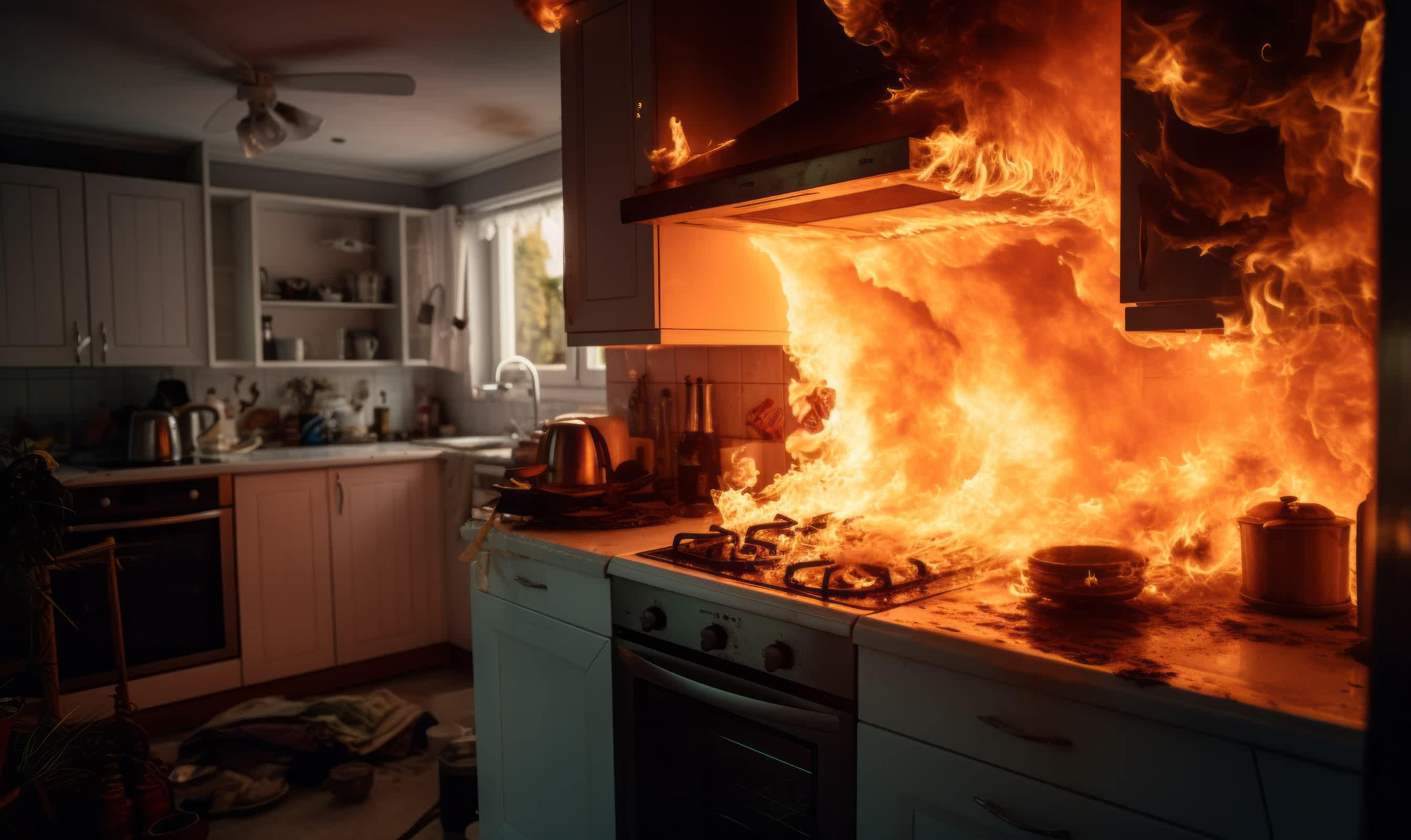
TL;DR: In California, a small fire in a test kitchen is giving fire safety engineers and firefighters a closer look at an unusual idea: putting out flames with sound instead of water. During a recent demo, an overhead AI-powered sensor picked up signs of trouble and triggered wall-mounted emitters that blasted low-frequency infrasound toward the stovetop. Within a few seconds, the flames went out. The company says this is not just a lab trick but a preview of a full building system that could replace traditional sprinklers in homes and commercial spaces.
The underlying concept is not new. Acoustic fire suppression has been studied for years as a means of disrupting combustion by pushing oxygen away from the fuel surface.
Sonic Fire Tech's twist is to package that physics into an automated system built around infrasound – sound waves below 20 hertz, so low that people cannot hear them – and to tie it to fast detection and control.
The company uses an array of sensors, including infrared, and an AI-driven controller to spot early signs of ignition, then drive an acoustic generator that feeds sound into ducting routed through a structure's attic and eaves. "We were able to not just point-and-shoot like a fire extinguisher; we figured out how to run it through ducting and distribute it like a sprinkler system," Sonic Fire Tech co-founder and CEO Geoff Bruder told attendees at the Concord demo event.
The system targets several weaknesses of conventional sprinklers. Water-based systems typically trigger only after heat builds to a set threshold at the sprinkler head, and when they do, they can dump large amounts of water onto electronics, finishes, and furnishings.
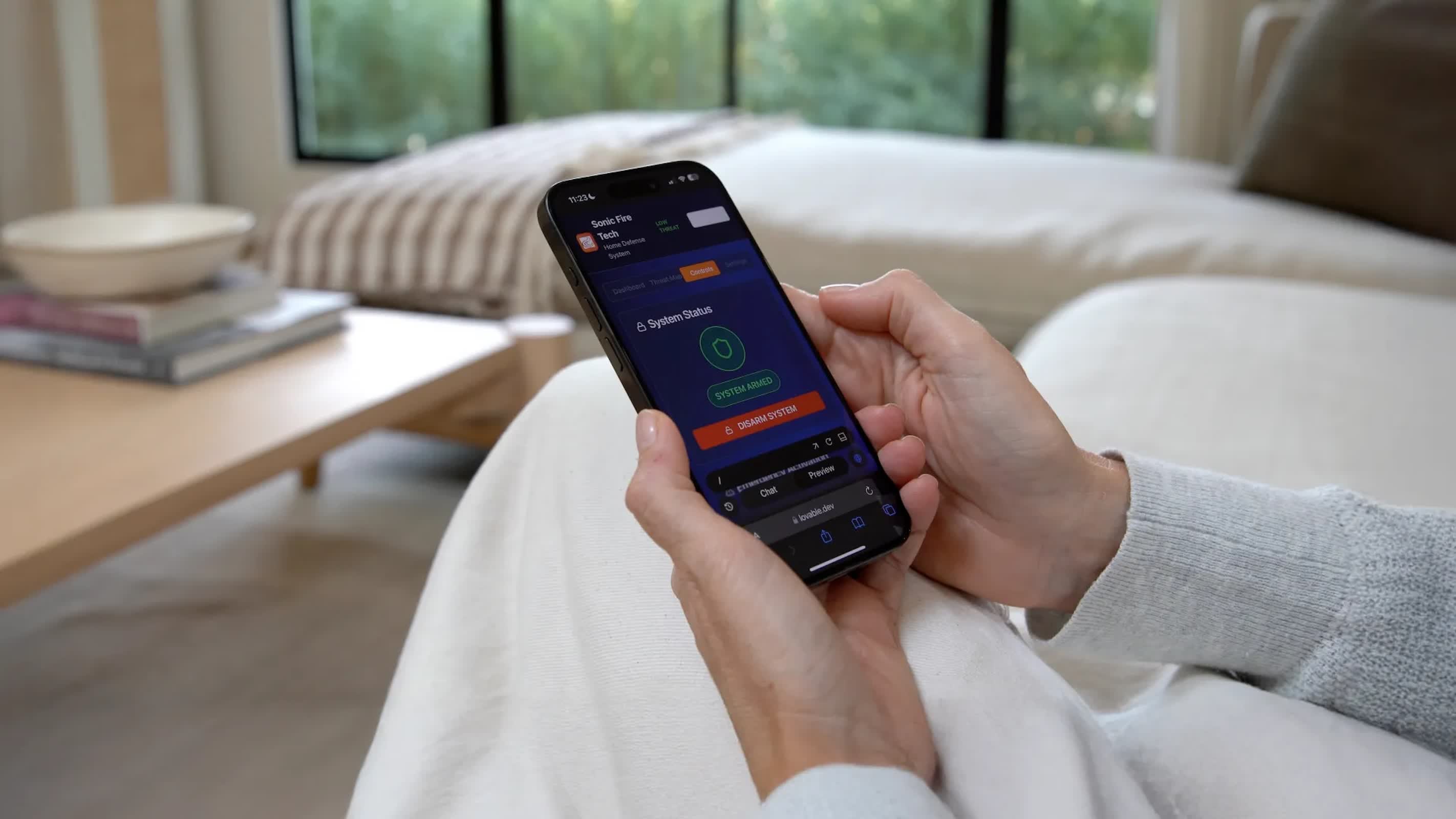
Sonic Fire Tech promotes its Sonic Home Defense product as a faster, cleaner alternative that, it says, can deploy in milliseconds using infrasound to stop combustion before flames spread, without plumbing or the risk of flooding a room. The company is also promoting the idea for data centers and other high-value electronics environments, along with a backpack version for wildland firefighters.
To back its claims, Sonic Fire Tech points to an evaluation performed by Fire Solutions Group, a consultancy led by fire protection engineer James Andy Lynch. According to the company, the executive summary of the report concludes that Sonic Fire Tech's system can detect fires very quickly, significantly reduce or extinguish them, and operate reliably in many different installation setups.
It also says the system could work alongside, or in some cases instead of, traditional suppression methods, but that more testing is needed to show where it's reliable. Sonic Fire Tech has said this work amounts to "third-party validation" that its system can serve as an NFPA 13D-equivalent alternative to standard residential sprinklers.
That is where other experts start asking for more detail. NFPA 13D, the residential sprinkler standard from the National Fire Protection Association, is well established and widely used as the baseline for one- and two-family home systems. "Equivalency [to the 13D standard] can only be approved by the appropriate authority having jurisdiction and requires technical documentation be submitted demonstrating the equivalency," Jonathan Hart, NFPA Technical Lead, Fire Protection Technical Resources, told Ars Technica.
Sonic Fire Tech has not publicly released the full Fire Solutions Group report or a complete set of test protocols and results that would allow outside engineers to assess its performance against that standard.
Los Angeles-based fire protection engineer Nate Wittasek said sprinklers do more than simply knock down open flames. "Sprinklers have a well-established role," he told the publication. "They apply water directly to the fuel, cool the space, slow or stop flashover, and give people time to get out while reducing risk to firefighters. Sound may knock down a small flame, but it does not cool hot surfaces or wet fuel. That raises real questions about re-ignition, smoldering fires, hidden fires, and fires that are partially blocked by contents."
He added that if Sonic Fire Tech plans to claim parity or superiority to 13D systems, it should spell out "who validated it, what test protocols were used, what fire scenarios were included, and how success was defined."
Academic research has also flagged limits on what sound alone can do. University of California, Berkeley mechanical engineering professor Michael Gollner pointed to a 2018 paper that found "acoustics alone are insufficient to control flames beyond the incipient stage." He noted that sprinklers are "extensively tested and certified" under standards developed over many years.
"I think this product needs to demonstrate the same or better performance with the same reliability before it can be considered to replace any existing safety measure," he said. "While I am absolutely supportive of out-of-the-box thinking, lives are truly at stake, and new technologies must carefully demonstrate effectiveness and reliability before being entrusted by society."
For now, fire departments are treating Sonic Fire Tech's system as something to study rather than something to endorse. Contra Costa County Fire Protection District Deputy Fire Chief Tracie Dutter said the agency does not recommend specific products but wants to understand how new tools might fit into its work.
According to Dutter, Sonic representatives are talking with departments about testing the infrasound system on a bulldozer used for wildland operations, and her district "would be open to testing this system on one of our dozers" to better understand "its limitations and potential failure points."
She also pointed to practical questions that any such system would have to answer, including long-term maintenance requirements, whether it needs routine testing or calibration to stay reliable, and how it detects and reports failures in its sensors or acoustic generators to the owner.
The Concord demo shows that an infrasound system can put out a small kitchen fire without a drop of water. But turning that into a full replacement for a century-old sprinkler standard will require far more public data on how the technology behaves in real homes, with real contents, and in uncontrolled fires.
此内容由惯性聚合(RSS阅读器)自动聚合整理,仅供阅读参考。 原文来自 — 版权归原作者所有。