


Serving tech enthusiasts for over 25 years.
TechSpot means tech analysis and advice you can trust.
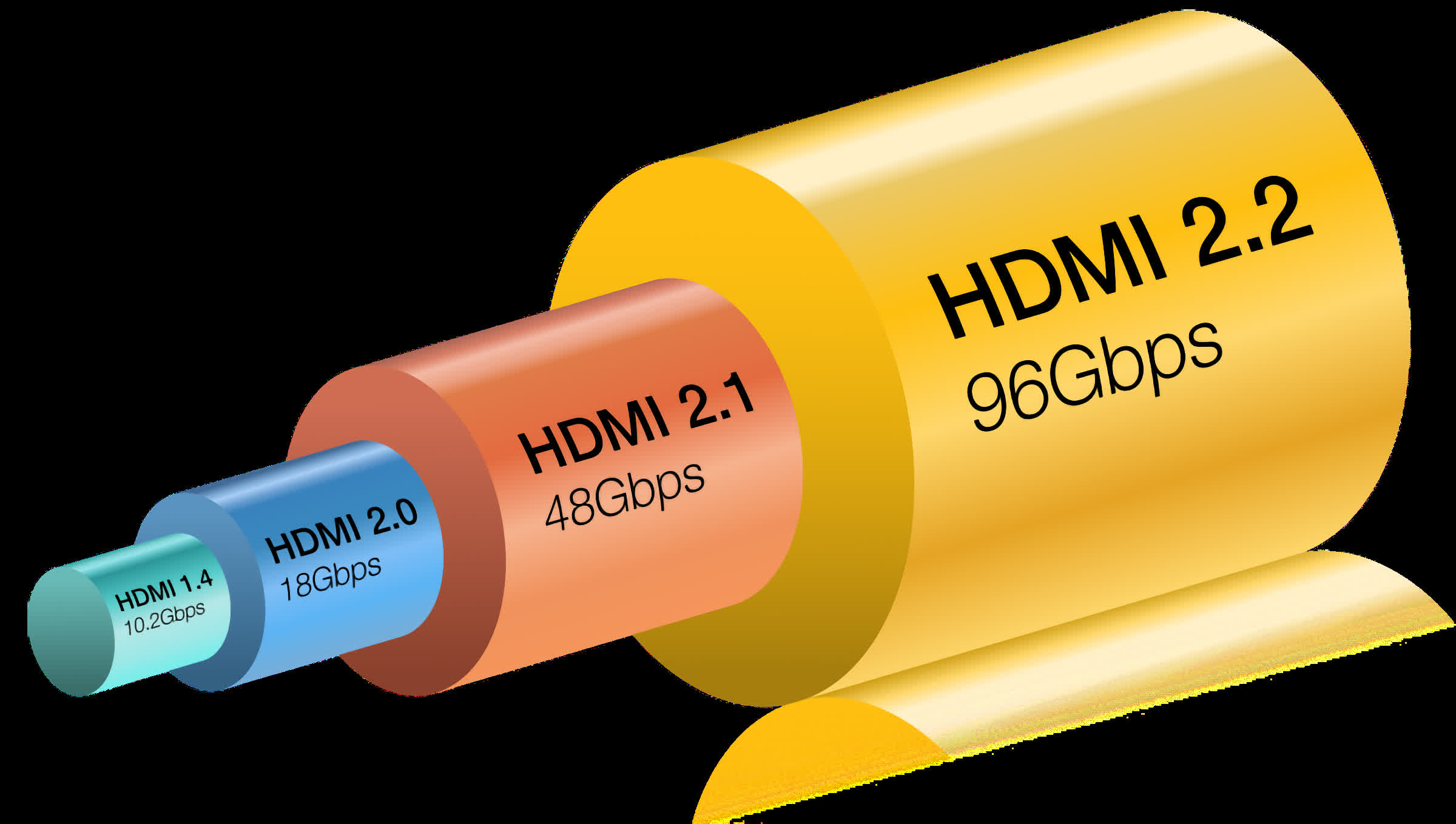
Forward-looking: The next version of HDMI is mainly about pushing bandwidth higher to carry better video and audio, not small, incremental tweaks. HDMI 2.2, teased at CES 2025 and formally released by the HDMI Forum in June of that year, raises maximum bandwidth to 96Gbps, twice that of HDMI 2.1, allowing more uncompressed video data to move between devices.
HDMI 2.2 can carry uncompressed 4K video at up to 240Hz, something that currently requires Display Stream Compression (which as we've shown however, is not a big limitation). It can also reach 4K at 480Hz using 4:2:0 chroma subsampling, and handle uncompressed RGB 8K at 60Hz.
The added bandwidth cuts down on the compression and other tricks current hardware has had to rely on to push high frame rates. For gamers, that extra headroom makes it easier to drive high refresh rates at 4K and beyond without leaning as heavily on compression or workarounds.
With compression still in the toolkit when needed, the spec allows for more extreme modes, too, including 1440p at refresh rates above 1,000Hz – numbers that, for now, sit well beyond everyday use.
That leap is tied to FRL2, the updated signaling technology underpinning HDMI 2.2. The transition is already underway at the hardware level. "We're hearing chip manufacturers will start to sample their FRL2 chips this year," Rob Tobias, CEO and president of the HDMI Licensing Administrator, told ARMdevices at Computex 2026. "And so we should start to see some 96 or up to 96 gigabit HDMI 2.2 products next year." Certification efforts are ongoing, and the first wave of compatible devices is expected in 2027.
Still, the headline number – 96Gbps – doesn't tell the whole story. HDMI 2.2 rolls out in multiple tiers, including 64Gbps and 80Gbps versions, and certification doesn't require manufacturers to hit the top speed. That means two devices both labeled "HDMI 2.2" could perform very differently depending on how they're built. For buyers, that puts more weight on spec sheets than branding.
In the PC space, the timing is complicated by the fact that DisplayPort 2.1 already delivers up to 80Gbps and is widely used in high-end monitors. For enthusiasts running multi-display setups, HDMI hasn't been the primary interface for some time, and that's unlikely to change overnight. Licensing costs may also factor into how quickly HDMI 2.2 gains traction compared with DisplayPort.
Where HDMI continues to hold ground is in the living room. Features like ARC, CEC, and ALLM are already deeply integrated into TVs and home theater systems, and HDMI 2.2 adds another layer with Latency Indication Protocol, or LIP, aimed at tightening audio-video synchronization – a persistent issue with soundbars and AV receivers. It's a small but practical upgrade, and one that targets a problem many users encounter even in otherwise high-end setups.
Even so, there's a gap between what the specification allows and what current content actually demands. Most games and video still operate well below the limits of HDMI 2.1, and 4K at 120Hz – already supported – remains underutilized. It's easy enough to imagine future consoles taking advantage of higher refresh rates, but widespread use will depend on both hardware and software catching up.
That lag is likely to show up in the rollout. GPU support isn't expected until late 2027 or later, and early adoption will likely be confined to premium hardware. On the TV side, HDMI capabilities often depend on the underlying processing chips, which have historically led to uneven feature support even among top-tier models. There's little reason to expect a cleaner transition this time around.
For now, HDMI 2.2 is more about preparing for future hardware than something people need to upgrade to right away. The spec sets a high ceiling, but it may take several product generations before most users see a tangible benefit. In the meantime, its presence will likely be felt more in product positioning than in everyday performance.
此内容由惯性聚合(RSS阅读器)自动聚合整理,仅供阅读参考。 原文来自 — 版权归原作者所有。