


Serving tech enthusiasts for over 25 years.
TechSpot means tech analysis and advice you can trust.
Why it matters: The largest IPO in history did two things at once: it made Elon Musk the world's first trillionaire, and it quietly converted a privately held rocket company into a stock that millions of investors may soon own whether they chose to or not. SpaceX isn't asking Wall Street to price its launches or its satellites. It's asking the market to bet that a rocket company is on its way to becoming one of the most valuable AI companies on Earth, and to start paying for that future today.
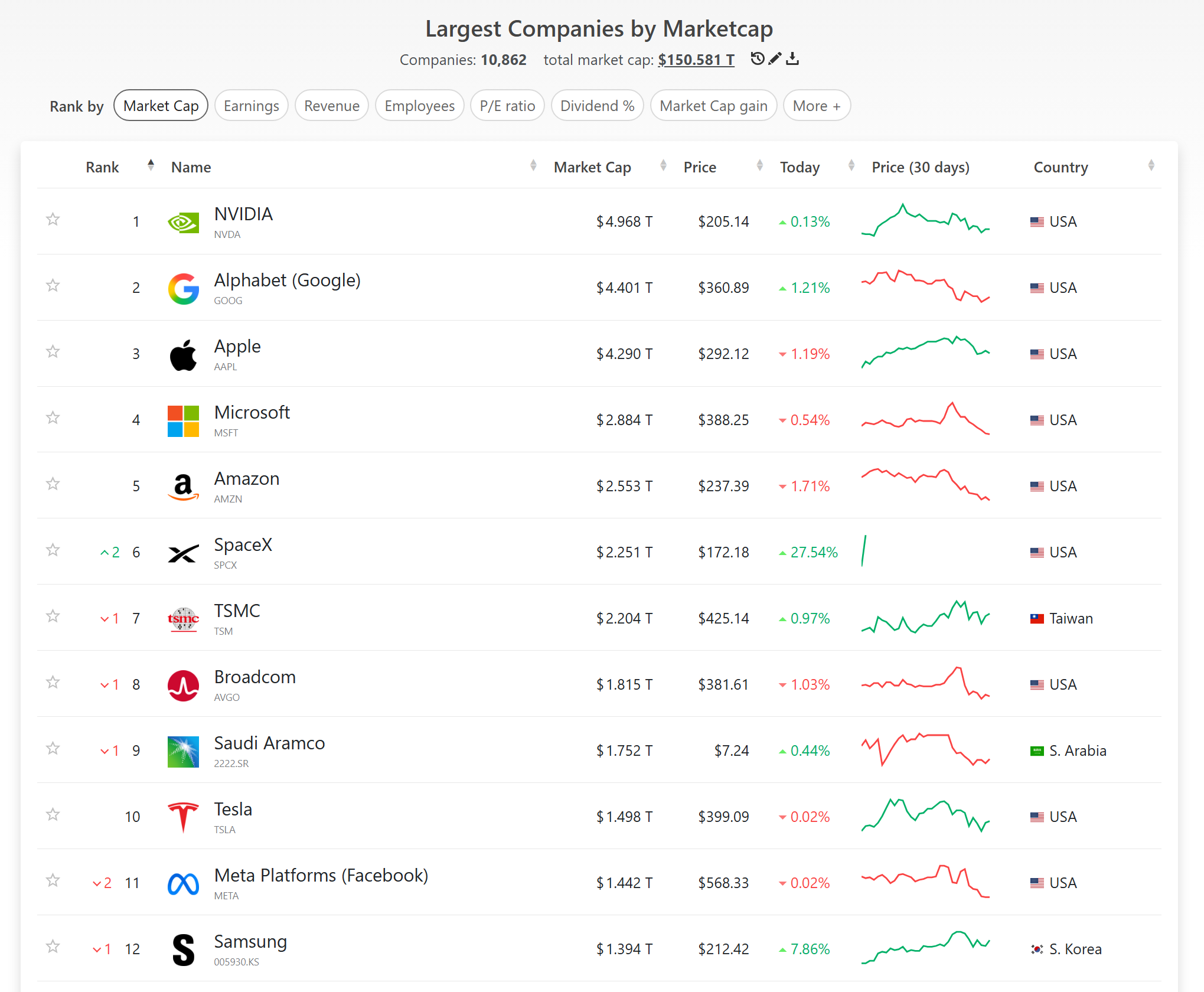
SpaceX began trading on the Nasdaq on Friday under the ticker SPCX, and the numbers attached to the debut are the kind that usually require a footnote to believe. The company priced 555.6 million Class A shares at $135 on Thursday evening, raising roughly $75 billion and valuing the firm at about $1.77 trillion before a single share changed hands. That makes it the biggest initial public offering in history, nearly triple Saudi Aramco's $29 billion listing in 2019, the record it displaced.
The stock did what hotly anticipated debuts tend to do. It opened around $150, about 11% above the offer price, then swung as high as the $168 to $175 range in the first minutes of live trading before settling near $158 to $165 by midday. At those levels SpaceX briefly carried a market capitalization north of $2 trillion, placing it among the most valuable public companies in the world on day one.
But not to be surprised, the headline most news outlets led with was personal rather than corporate. Elon Musk, who holds an estimated 42% of SpaceX and acts as chairman, chief executive, and controlling shareholder, became the world's first trillionaire, at least on paper. That wealth is tied up in stock and options across SpaceX and Tesla.
Musk rang the opening bell from SpaceX's headquarters in Starbase, Texas alongside hundreds of employees, while president Gwynne Shotwell and CFO Bret Johnsen handled the ceremony in New York. "Take the fiction out of science fiction," Musk said before the session opened, restating the Mars ambitions that have always been part of the pitch.
Strip away the spectacle and the SpaceX's trillion-dollar valuation rests on a forecast, not a balance sheet. SpaceX reported a net loss of $4.9 billion in 2025 on revenue of about $18.6 billion, so investors are not paying $1.77 trillion for current profits. They are paying for what the company says comes next.
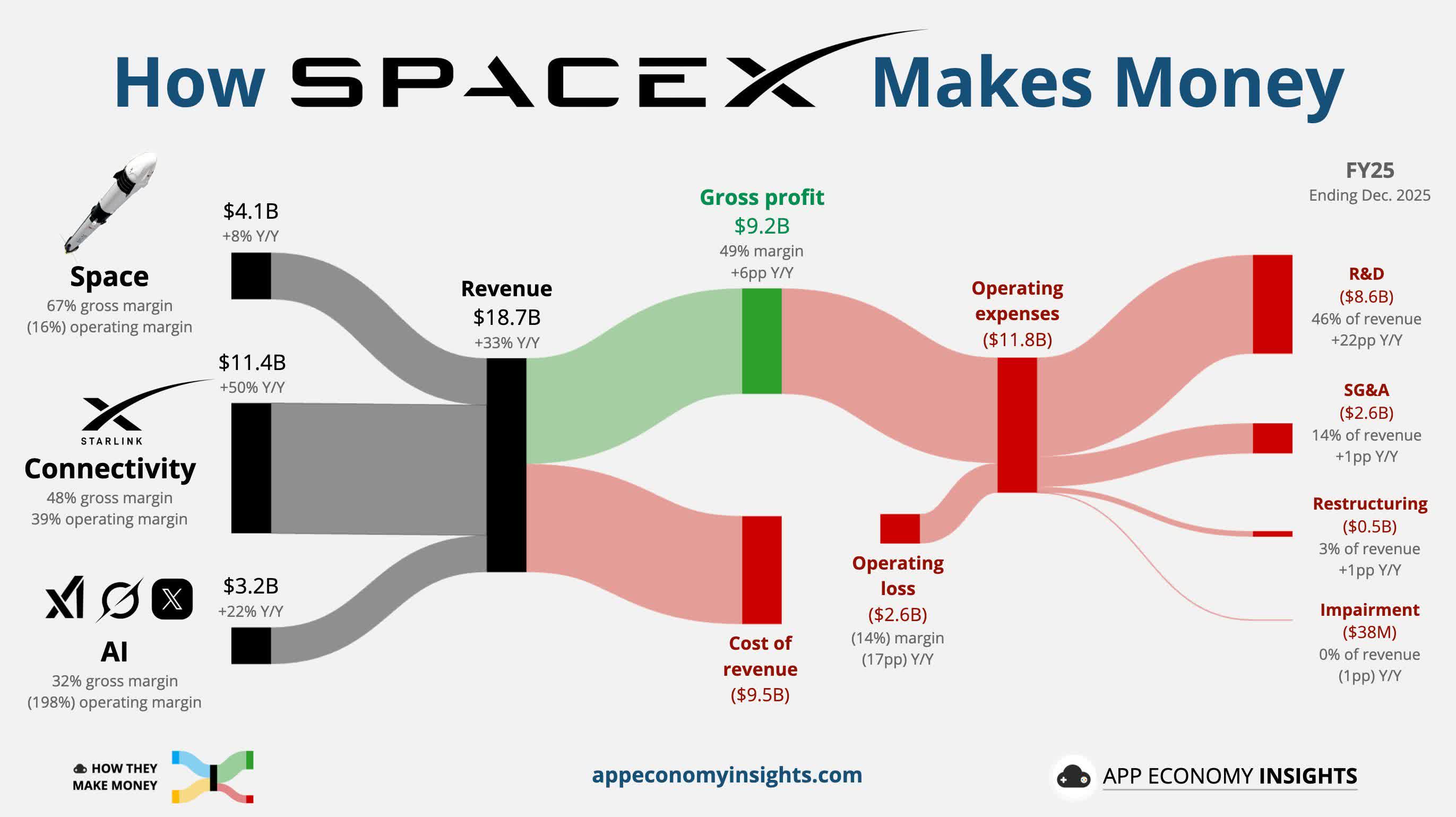
Credit: App Economy Insights
The filing makes that explicit. SpaceX estimates a total addressable market of $28.5 trillion, with roughly $26.5 trillion of it attributed to AI, a category the company entered in earnest after absorbing Musk's xAI earlier this year. Beyond Starship and Starlink, the SEC documents describe plans for terrestrial data centers, custom AI microchips, and what SpaceX calls orbital AI compute infrastructure.
In other words, the rocket company is asking the market to value it largely as an AI company, which is why the offering is being read as the first in an expected wave that includes OpenAI and Anthropic.
For retail investors, that framing is the appeal. SpaceX targeted about 30% retail participation, well above the 10% typical of a large IPO, and the listing offers one of the few direct routes into a major AI player outside Meta, Microsoft, and Alphabet. Fidelity reported more than 500,000 buy orders within the first hour.
The skeptics are loud, and they are not all anonymous. Morningstar this week pegged SpaceX's fair value at roughly $63 a share, less than half the IPO price, calling the offering overvalued. That is a striking gap for a name generating this much demand.
The sharper critique concerns who ends up holding the stock. Several index providers, including Nasdaq and FTSE Russell, recently adopted fast-entry rules that could add SpaceX to major indexes well inside the year that benchmarks have historically required after an IPO. Because index funds must mirror their benchmarks, inclusion forces automatic buying, which means millions of savers could gain exposure to an unprofitable company without ever choosing the stock. S&P Dow Jones declined to bend its rules, so the S&P 500 will wait, but the broader point stands.

Economist Paul Krugman put it most bluntly, describing Musk as a "human Ponzi scheme" and arguing that the rule changes effectively conscript ordinary investors into propping up a valuation built on belief rather than fundamentals. He notes that index and index-based funds now hold roughly 52% of mutual fund assets, which is how a debut like this reaches people who never opted in.
That is the tension worth watching. SpaceX has a real and rare asset in Starlink, a launch business with no genuine competitor, and an engineering record that few firms can match.
Whether any of that justifies a two-trillion-dollar valuation, or whether the AI pivot is doing more lifting than the engineering, is a question the next few quarters will start to answer. For now, the most-watched stock chart in the market belongs to a company that is selling tomorrow harder than it is selling today.
此内容由惯性聚合(RSS阅读器)自动聚合整理,仅供阅读参考。 原文来自 — 版权归原作者所有。