
惯性聚合 高效追踪和阅读你感兴趣的博客、新闻、科技资讯
阅读原文 在惯性聚合中打开

推荐订阅源

云风的 BLOG
云风的 BLOG
M
MIT News - Artificial intelligence
博客园 - Franky
J
Java Code Geeks
V
Visual Studio Blog
G
Google Developers Blog
罗磊的独立博客
MongoDB | Blog
MongoDB | Blog
奇客Solidot–传递最新科技情报
奇客Solidot–传递最新科技情报
Recent Announcements
Last Week in AI
Last Week in AI
Cyber Security Advisories - MS-ISAC
Stack Overflow Blog
Stack Overflow Blog
博客园 - 司徒正美
The GitHub Blog
The GitHub Blog
腾讯CDC
阮一峰的网络日志
阮一峰的网络日志
V
V2EX
博客园 - 【当耐特】
IT之家
IT之家
I
InfoQ
U
Unit 42
C
Check Point Blog
Martin Fowler
Martin Fowler

Latest from Live Science

Naked mole rats wage bloody wars of succession to choose a new queen — but one colony did something scientists… Can the US be trusted with the moon? A law scholar raises concerns after Artemis II Lyrid meteor shower 2026: See spring's first rain of 'shooting stars' peak in moonless skies $3 million prize goes to duo whose research led to first sickle cell CRISPR therapy 700-year-old mummy from Bolivia contains earliest confirmed evidence of strep throat bacteria in the Americas New pain-relief opioid could be much less addictive than morphine, rodent study finds Experimental drug doubles one-year survival in pancreatic cancer Science news this week: Physicists witness faster-than-light darkness pinpricks, humans are still evolving, and some… Archaeologists discover perfectly circular ancient Egyptian temple that may have been used for sacred water rituals Some polar bears are adapting to their melting habitat. Will it be enough to save the iconic species? 2 supermassive black holes may collide 100 years from now ‪—‬ and Earth would feel it Anglo-Saxon burial holds an older sister cradling her little brother after they both died 1,400 years ago, possibly of… Colorado River may have pooled and spilled over to form the Grand Canyon, solving a long-standing mystery ‪—‬… 'We all screamed when it happened': Bright-green fireball meteor caught exploding over famous Viking raid site… Northern lights may be visible from several US states Friday and Saturday as giant hole opens up in sun Hackers used AI to steal hundreds of millions of Mexican government and private citizen records in one of the largest… The first black hole ever discovered is spewing 'dancing jets' at half the speed of light Stephen Hawking's black hole information paradox could be solved — if the universe has 7 dimensions 'Something's missing': Most thorough-ever study of the cosmos proves we still can't explain how the… 'Human evolution didn't slow down; we were just missing the signal': Large DNA study reveals natural selection led to more redheads and less male-pattern baldness Artemis II quiz: Is your knowledge of NASA New study confirms lobsters feel pain, driving scientists to call for a ban on boiling them alive This humanoid robot does all your housework for you ‪—‬ and its makers say it Ancient process that created rare earth elements discovered — and it could help us locate desperately needed deposits Strange mammal ancestor laid huge, leathery eggs —‬ and it was key to surviving the world 73 moon landings? NASA Diagnostic dilemma: A woman heard voices telling her she had a brain tumor ‪—‬ and scans confirmed she did Triassic croc relative from Ghost Ranch, New Mexico finally identified after nearly 80 years in museum basement There were Physicists witness pinpricks of darkness moving faster than the speed of light ‪—‬ without breaking the laws of relativity
New York City is at major risk of flooding that could lea...
Sophie Berdu · 2026-04-24 · via Latest from Live Science
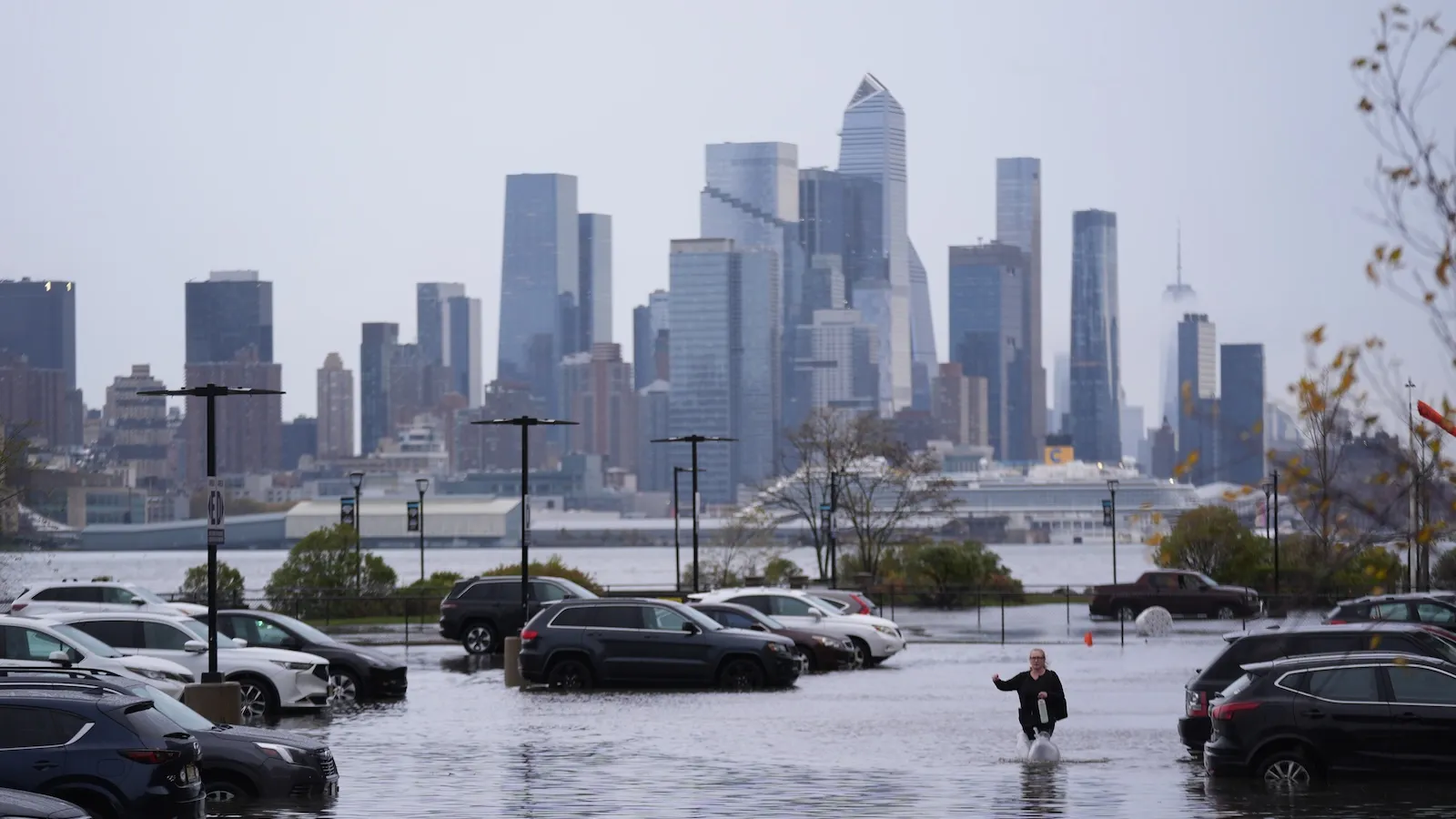
Cars submerged in flood water with New York City in the background
New York City had the largest absolute number of people and buildings at high risk of being exposed to extreme flood damage of all cities along the East Coast. (Image credit: Anadolu / Contributor via Getty images)

Eight U.S. East Coast cities are at high or very high risk of "extreme" flood damage based on current scenarios, with New York and New Orleans facing some of the greatest dangers, a new study finds.

New York could see the highest number of people affected by flooding: 50% of New York City's population ‪—‬ around 4.4 million people ‪—‬ and 47% of its buildings are currently at high risk of exposure to extreme flood damage if a major flood occurs, according to a flood risk assessment published Wednesday (April 22) in the journal Science Advances.

New Orleans faces the greatest relative risk, with 98% of its population ‪—‬ about 375,000 people ‪—‬ and 99% of its infrastructure at high risk of being exposed to extreme damage, according to the study.

The other six cities mentioned in the report are Houston; Miami; Norfolk, Virginia; Charleston, South Carolina; Jacksonville, Florida; and Mobile, Alabama.

The heightened threat and damage levels these cities face result from their low elevation, high population density, poor drainage, building height, rainfall and proximity to water. The study authors urged policymakers to work with local stakeholders to mitigate flood risk using nature-based solutions alongside structures like floodgates, levees and dikes.

"Such policies should restrict further urban development in high-risk zones while promoting the systematic incorporation of nature-based solutions," the authors wrote.

Flood risk

Flooding is the most expensive natural disaster in the U.S., costing billions a year. By 2050, sea levels along the contiguous U.S. coastline are projected to rise by up to 1 foot (0.3 meters), and flooding following hurricanes is also increasing along the East Coast due to climate change.

Get the world’s most fascinating discoveries delivered straight to your inbox.

With around 30% of counties along the U.S. Gulf and Atlantic coasts at high flood risk, it's essential to understand which measures will prevent flood damage most effectively, the authors wrote in the study.

The researchers used machine learning to assess flood risk along the U.S. East Coast, using historical flood damage data from the Federal Emergency Management Agency. This data is of visual, bird's-eye-view damage to properties associated with recent major flooding events, including Hurricane Isaac in 2012 and Hurricane Irma in 2017. The study classified properties that were fully destroyed as "extreme flood damage."
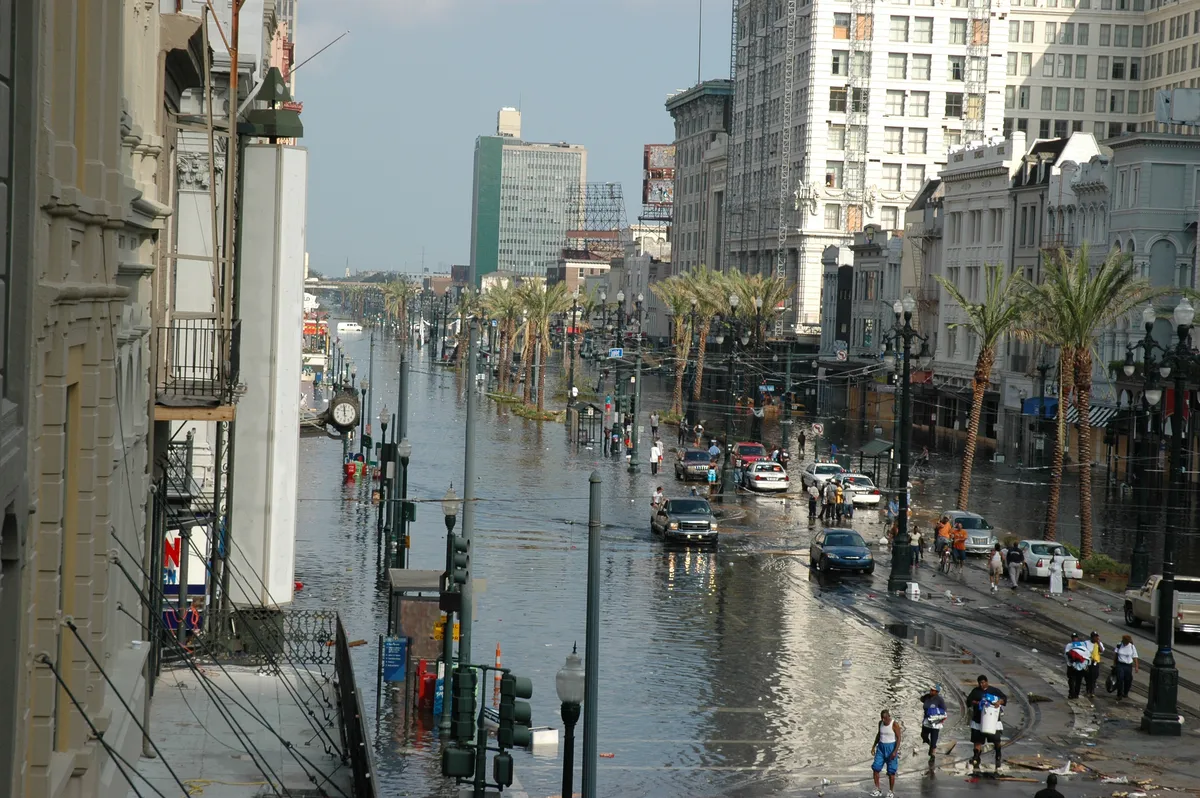
Submerged street in New Orleans after Hurricane Katrina

Hurricane Katrina in August 2005 led to 1,833 fatalities and caused catastrophic damage to New Orleans. (Image credit: imaginewithme via Getty images)

The team then compiled data on 16 flood risk factors and developed a flood risk map, using these risk factors to predict exposure to flood damage The flood risk factors included natural hazards, such as distance from the water and elevation; exposure factors, such as population density; and the vulnerability of the population, such as the percentage of people living in poverty.

Based on these factors, the model produced a "flood risk index" of probability scores ranging from "very low" to "very high" risk. The coastal cities at the highest risk of floods leading to extreme flood damage could then be estimated. The team calculated the number of people and buildings that would be exposed to this damage.

RELATED STORIES

The results showed that New York City and New Orleans share the "grim reality" of being "major flood-risk cities," the authors wrote in the study. Almost 4.4 million people in New York City and over 215,000 buildings could face extreme flood damage. Over 98% of New Orleans' population and buildings face similar damage.

Houston and Mobile, Alabama, are also at high risk of extreme flood damage, so, along with New York and New Orleans, these cities demand "prioritized attention from policy-makers," the authors wrote in the study.

The authors noted several ways to potentially reduce flood damage. For example, parking lots built with impermeable concrete should be replaced with grass tiles to allow the soil to soak up the water, and wetlands and river floodplains should be restored and linked to drainage systems like gutters to support the fast removal of water from cities.

Article Sources

Dey, H., & Shao, W. (2026). A tale of two coasts: Unveiling US Gulf and Atlantic coastal cities at high flood risk. Science Advances, 12. http://doi.org/10.1126/sciadv.aec2079

Sophie is a U.K.-based staff writer at Live Science. She covers a wide range of topics, having previously reported on research spanning from bonobo communication to the first water in the universe. Her work has also appeared in outlets including New Scientist, The Observer and BBC Wildlife, and she was shortlisted for the Association of British Science Writers' 2025 "Newcomer of the Year" award for her freelance work at New Scientist. Before becoming a science journalist, she completed a doctorate in evolutionary anthropology from the University of Oxford, where she spent four years looking at why some chimps are better at using tools than others.

You must confirm your public display name before commenting

Please logout and then login again, you will then be prompted to enter your display name.