
惯性聚合 高效追踪和阅读你感兴趣的博客、新闻、科技资讯
阅读原文 在惯性聚合中打开

推荐订阅源

宝玉的分享
宝玉的分享
B
Blog RSS Feed
Cyber Security Advisories - MS-ISAC
MyScale Blog
MyScale Blog
freeCodeCamp Programming Tutorials: Python, JavaScript, Git & More
S
SegmentFault 最新的问题
Y
Y Combinator Blog
月光博客
月光博客
IT之家
IT之家
T
Tailwind CSS Blog
Last Week in AI
Last Week in AI
L
LangChain Blog
博客园_首页
MongoDB | Blog
MongoDB | Blog
P
Proofpoint News Feed
博客园 - Franky
WordPress大学
WordPress大学
云风的 BLOG
云风的 BLOG
M
MIT News - Artificial intelligence
V
Visual Studio Blog
小众软件
小众软件
博客园 - 叶小钗
博客园 - 三生石上(FineUI控件)
N
Netflix TechBlog - Medium

Latest from Live Science

Loneliness may contribute to memory issues, but not dementia — they are 'not the same thing' Naked mole rats wage bloody wars of succession to choose a new queen — but one colony did something scientists… Can the US be trusted with the moon? A law scholar raises concerns after Artemis II Lyrid meteor shower 2026: See spring's first rain of 'shooting stars' peak in moonless skies $3 million prize goes to duo whose research led to first sickle cell CRISPR therapy 700-year-old mummy from Bolivia contains earliest confirmed evidence of strep throat bacteria in the Americas New pain-relief opioid could be much less addictive than morphine, rodent study finds Experimental drug doubles one-year survival in pancreatic cancer Science news this week: Physicists witness faster-than-light darkness pinpricks, humans are still evolving, and some… Archaeologists discover perfectly circular ancient Egyptian temple that may have been used for sacred water rituals Some polar bears are adapting to their melting habitat. Will it be enough to save the iconic species? 2 supermassive black holes may collide 100 years from now ‪—‬ and Earth would feel it Anglo-Saxon burial holds an older sister cradling her little brother after they both died 1,400 years ago, possibly of… Colorado River may have pooled and spilled over to form the Grand Canyon, solving a long-standing mystery ‪—‬… 'We all screamed when it happened': Bright-green fireball meteor caught exploding over famous Viking raid site… Northern lights may be visible from several US states Friday and Saturday as giant hole opens up in sun Hackers used AI to steal hundreds of millions of Mexican government and private citizen records in one of the largest… The first black hole ever discovered is spewing 'dancing jets' at half the speed of light Stephen Hawking's black hole information paradox could be solved — if the universe has 7 dimensions 'Something's missing': Most thorough-ever study of the cosmos proves we still can't explain how the… 'Human evolution didn't slow down; we were just missing the signal': Large DNA study reveals natural selection led to more redheads and less male-pattern baldness Artemis II quiz: Is your knowledge of NASA New study confirms lobsters feel pain, driving scientists to call for a ban on boiling them alive This humanoid robot does all your housework for you ‪—‬ and its makers say it Ancient process that created rare earth elements discovered — and it could help us locate desperately needed deposits Strange mammal ancestor laid huge, leathery eggs —‬ and it was key to surviving the world 73 moon landings? NASA Diagnostic dilemma: A woman heard voices telling her she had a brain tumor ‪—‬ and scans confirmed she did Triassic croc relative from Ghost Ranch, New Mexico finally identified after nearly 80 years in museum basement There were
Deadly, vivid-green mass sprawls across South African res...
2026-04-07 · via Latest from Live Science
Satellite photo of a large reservoir with bright green masses spreading across its surface
Vibrant, verdant masses of algae and invasive aquatic plants frequently cover the surface of the reservoir at South Africa's Hartebeespoort Dam. (Image credit: NASA/Landsat 8)

QUICK FACTS

Where is it? Hartbeespoort Dam, North West province, South Africa [-25.74486936, 27.858152164]

What's in the photo? A vivid-green bloom of toxic algae and planets spreading across a reservoir

Which satellite took the photo? Landsat 8

When was it taken? Aug. 10, 2022

This striking satellite snap shows a verdant mass of algae and other aquatic plants sprawling across the surface of a recreational reservoir in South Africa. This frequent phenomenon releases toxic chemicals into the water and gives rise to hidden "dead zones" that can cause widespread fish fatalities.

Most large bodies of water experience seasonal blooms, where photosynthetic algae, or cyanobacteria, rapidly multiply and spread across their surfaces due to changes in weather or nutrient inflow. However, the Hartbeespoort reservoir is in a constant state of "hypereutrophication," which means it has an overabundance of nutrients, such as nitrogen and phosphorus. As a result, the blooms there are much more frequent and intense, according to NASA's Earth Observatory.

"On clear days … satellite images often reveal a reservoir with shades of deep blue interrupted by drifting patches of vivid green," Earth Observatory representatives wrote.

However, it is not just algae that bloom across the reservoir's surface. The verdant masses also include aquatic plants, including water hyacinths (Pontederia crassipes) and Salvinia minima, both of which are invasive species and grow across the reservoir's surface in large, intertwined mats.

A photo of water rushing through a gate in in the Hartebeespoort Dam

Hartebeespoort Dam was constructed in the 1920s and has been in a near constant state of hypereutrophication for around 50 years. (Image credit: THEGIFT777 via Getty Images)

Eutrophication occurs when too many nutrients are added to a body of water, often due to human influences, and can lead to unnaturally large algal blooms. "It's like having a garden," Bridget Seegers, an oceanographer at Goddard Space Flight Center in Maryland who leads NASA's Cyanobacteria Assessment Network, told the Earth Observatory. "If you add a lot of nutrients, you're going to have a lot of growth." (Hypereutrophication is a more extreme version of this phenomenon.)

However, unlike in a garden, you cannot simply cut back the blooms you don't want, and the consequences of not being able to contain the plant life are much more severe. For example, some of the algae within the Hartbeespoort reservoir can produce toxins that must be filtered out of the water for it to be safe to drink.

Get the world’s most fascinating discoveries delivered straight to your inbox.

However, the bigger issue is that the excessive growth of plant life on the surface sucks up the oxygen from the water below, making it toxic to fish that need to extract oxygen from water via their gills to breathe. These areas of oxygen-poor water are often dubbed "dead zones," and when the blooms spread widely, there are few safe spaces for the fish to go.

A photo of a thick green mat of aquatic plants on the surface of the reservoir at Hartebeespoort Dam

The abundance of invasive aquatic plants, such P. crassipes and S. minima, created oxygen-depleted "dead zones" across the reservoir. (Image credit: Olga Ernst/Wikimedia)

In April 2023, a lack of oxygen in part of the reservoir was linked to a mass die-off of fish, including hundreds of large carp, according to a government report. And in November 2025, another bloom likely triggered a similar die-off and left fish "gasping for air" at the reservoir's surface, according to South Africa-based News 24. These blooms eventually disappear, but the next one is rarely far behind.

The Hartbeespoort reservoir has experienced near-continuous hypereutrophication since the 1970s, excluding a brief period in the 1990s when a successful bioremediation program was introduced but then was quickly scrapped due to high costs. As a result, algae have been blooming constantly, spreading and dying across the reservoir's surface for decades.

You can see this in the animation below, which was made from aerial images collected by the Landsat 8, Landsat 9 and Sentinel satellites between June 2022 and July 2023.
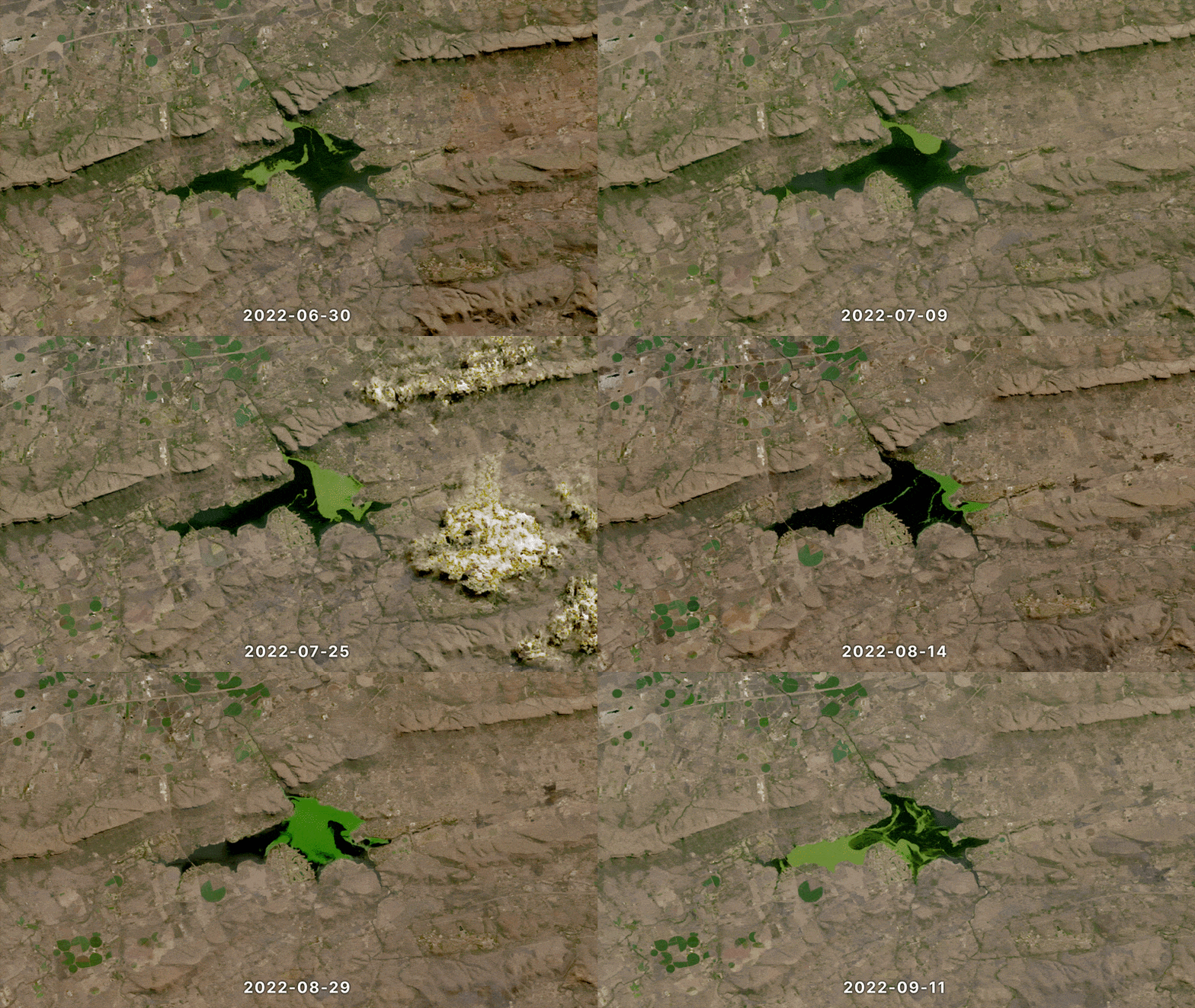
Looped video footage of time-lapse photos of algal blooms spreading across the surface of Hartebeespoort Dam

(Image credit: NASA)

A 2023 study that analyzed data from the previous four decades found that the main culprit was the Crocodile River, which has become extremely polluted with runoff from farms and golf courses that use nutrient-rich fertilizers.

In addition to threatening wildlife, the toxins in the water have been known to cause rashes on water-sports enthusiasts and sicken dogs.


See more Earth from space

Large swirls of green seen on the ocean's surface from space Mystery swirls in the Baltic Sea

A 2018 satellite photo shows an unknown substance swirling across the Gulf of Gdańsk in Poland. Scientists were shocked to discover what it really was.

A satellite photo of a lake in the desert with dark green swirling waters from an algal bloom Toxic bloom in Nevada

A 2024 satellite photo shows an unusually active bloom of toxic cyanobacteria swirling in the water of Nevada's Pyramid Lake. Research suggests that the algae has been blooming there for at least 9,000 years.

An astronaut photo of a deep blue lake in Turkey with milky light blue swirls spinning in the water Milky spirals in Turkish lake

A 2016 astronaut photo shows surprising plumes of milky material swirling in the waters of Turkey's Lake Van — the largest alkaline lake on Earth.


Harry is a U.K.-based senior staff writer at Live Science. He studied marine biology at the University of Exeter before training to become a journalist. He covers a wide range of topics including space exploration, planetary science, space weather, climate change, animal behavior and paleontology. His recent work on the solar maximum won "best space submission" at the 2024 Aerospace Media Awards and was shortlisted in the "top scoop" category at the NCTJ Awards for Excellence in 2023. He also writes Live Science's weekly Earth from space series.

You must confirm your public display name before commenting

Please logout and then login again, you will then be prompted to enter your display name.