
惯性聚合 高效追踪和阅读你感兴趣的博客、新闻、科技资讯
阅读原文 在惯性聚合中打开

推荐订阅源

阮一峰的网络日志
阮一峰的网络日志
博客园 - 司徒正美
D
DataBreaches.Net
宝玉的分享
宝玉的分享
奇客Solidot–传递最新科技情报
奇客Solidot–传递最新科技情报
博客园 - 【当耐特】
人人都是产品经理
人人都是产品经理
博客园 - Franky
让小产品的独立变现更简单 - ezindie.com
IT之家
IT之家
博客园 - 三生石上(FineUI控件)
J
Java Code Geeks
腾讯CDC
博客园_首页
The Cloudflare Blog
S
SegmentFault 最新的问题
C
Check Point Blog
美团技术团队
爱范儿
爱范儿
大猫的无限游戏
大猫的无限游戏
Hugging Face - Blog
Hugging Face - Blog
T
The Blog of Author Tim Ferriss
A
About on SuperTechFans
Blog — PlanetScale
Blog — PlanetScale

Latest from Live Science

Loneliness may contribute to memory issues, but not dementia — they are 'not the same thing' Naked mole rats wage bloody wars of succession to choose a new queen — but one colony did something scientists… Can the US be trusted with the moon? A law scholar raises concerns after Artemis II Lyrid meteor shower 2026: See spring's first rain of 'shooting stars' peak in moonless skies $3 million prize goes to duo whose research led to first sickle cell CRISPR therapy 700-year-old mummy from Bolivia contains earliest confirmed evidence of strep throat bacteria in the Americas New pain-relief opioid could be much less addictive than morphine, rodent study finds Experimental drug doubles one-year survival in pancreatic cancer Science news this week: Physicists witness faster-than-light darkness pinpricks, humans are still evolving, and some… Archaeologists discover perfectly circular ancient Egyptian temple that may have been used for sacred water rituals Some polar bears are adapting to their melting habitat. Will it be enough to save the iconic species? 2 supermassive black holes may collide 100 years from now ‪—‬ and Earth would feel it Anglo-Saxon burial holds an older sister cradling her little brother after they both died 1,400 years ago, possibly of… Colorado River may have pooled and spilled over to form the Grand Canyon, solving a long-standing mystery ‪—‬… 'We all screamed when it happened': Bright-green fireball meteor caught exploding over famous Viking raid site… Northern lights may be visible from several US states Friday and Saturday as giant hole opens up in sun Hackers used AI to steal hundreds of millions of Mexican government and private citizen records in one of the largest… The first black hole ever discovered is spewing 'dancing jets' at half the speed of light Stephen Hawking's black hole information paradox could be solved — if the universe has 7 dimensions 'Something's missing': Most thorough-ever study of the cosmos proves we still can't explain how the… 'Human evolution didn't slow down; we were just missing the signal': Large DNA study reveals natural selection led to more redheads and less male-pattern baldness Artemis II quiz: Is your knowledge of NASA New study confirms lobsters feel pain, driving scientists to call for a ban on boiling them alive This humanoid robot does all your housework for you ‪—‬ and its makers say it Ancient process that created rare earth elements discovered — and it could help us locate desperately needed deposits Strange mammal ancestor laid huge, leathery eggs —‬ and it was key to surviving the world 73 moon landings? NASA Diagnostic dilemma: A woman heard voices telling her she had a brain tumor ‪—‬ and scans confirmed she did Triassic croc relative from Ghost Ranch, New Mexico finally identified after nearly 80 years in museum basement There were
Western states face above-normal wildfire threats this su...
2026-04-09 · via Latest from Live Science
A helicopter drops water over a raging wildfire.
New research from the National Interagency Coordination Center predicts where wildfires might occur in the western US. (Image credit: PATRICK T. FALLON via Getty Images)

Every state in the West is expected to face an above-normal threat of wildfire this summer, according to the latest projections, released Wednesday by the National Interagency Coordination Center.

The government-run center publishes monthly reports predicting fire risk for the four months ahead, and the change since the March outlook is staggering. The agency denotes elevated risk in red on its maps, and the June forecast from March 2 showed a small swath of rouge in the Southwest. But, citing an ongoing snow drought, rapid snowmelt, and a recent unprecedented heat wave, the latest maps feature red spilling across the Southwest and into the Rockies, Pacific Northwest, and northern California.

June typically sees snow lingering in many mountain ranges and snowmelt wetting the landscape, he said. Not this year.

The latest outlook reports that the snow melt-off in the Four Corners region came "not just several weeks or months earlier than normal, but also four to six weeks earlier than the previously recorded earliest melt-off dates." The recent heat wave also desiccated the West. Albuquerque, for example, recorded its earliest ever 90-degree reading on March 21, more than six weeks sooner than its previous earliest date, in 1947. The daily average of 73.1 degrees Las Vegas recorded in March would have broken the city's April record.

Image

1

of

2
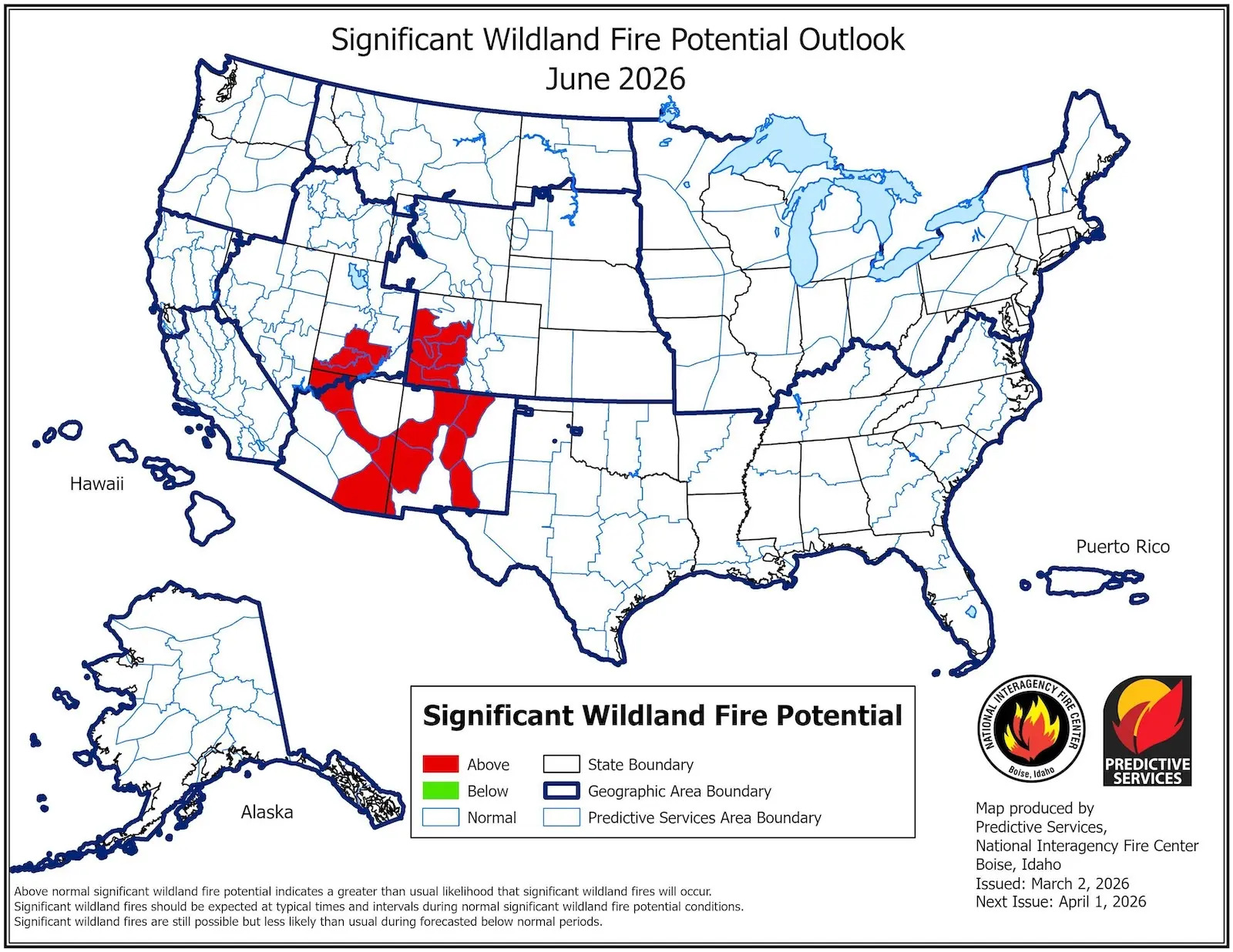
A map of the continental US in white, with red areas showing increased fire concern.
(Image credit: National Interagency Coordination Center)

Projections for June wildland fire risk from the National Interagency Coordination Center released on March 2, 2026 (left image) and updated on April 1, 2026 (right image).


Overall, there's been less snowpack and higher temperatures than pretty much any winter on record. It's a situation that climatologists have said would be virtually impossible without climate change, and the maps reflect that reality.

"It doesn't mean that all of these areas are going to burn," said Alastair Hayden, professor at Cornell University and a former division chief in the California Governor’s Office of Emergency Services. Last year, for example, the Pacific Northwest saw an above-normal risk but was largely spared. Local patterns, such as wind and precipitation, play a major role, too. "But, when I look back at the forecast, fires usually tend to be in one of these locations."

Get the world’s most fascinating discoveries delivered straight to your inbox.

The one notable spot on the latest maps that seems safe for now is Southern California, though that's because the fire season there doesn't usually start until later in the summer, or even into fall. There are also surprising splotches of red, like in Florida, which is experiencing a drought. But the West is by far the largest area of concern. "Keep an eye on July," said Hurteau. "The Fourth of July is the single highest ignition day of the year."

The sheer expanse of land that could be at risk simultaneously worries Hurteau. "Our fire suppression apparatus is in part dependent on the whole region not being on fire at the same time," he said. Fire crews count on being able to hop from hot spot to hot spot. If there are too many at once, resources could run thin.

RELATED STORIES

The number of acres across the country that have burned through March is already 231 percent of the 10-year average. A wet spring, however, could change everything. It recently rained in Albuquerque where Hurteau is based, and, if it continues, the fire risk could go down dramatically. That's what happened last year.

"I'm sure that's what all the fire people are hoping for too, because that would be nice," said Hurteau. "But hope is not a great strategy."

This story was originally published by Grist. Sign up for Grist’s weekly newsletter here.

Tik Root covers climate solutions and economics at Grist. He started his career as a freelance journalist in Yemen, and has since covered everything from Al Qaeda to the Olympics for outlets such as National Geographic, The New York Times, and The Atlantic, among others. He previously worked at The Washington Post and Scripps News. Tik lives in Vermont with his wife and son.

You must confirm your public display name before commenting

Please logout and then login again, you will then be prompted to enter your display name.