


Most AI policies are written in the future tense.
Employees use AI in the present tense.
That gap explains a lot about shadow AI. A governance committee may still be defining good AI use. Meanwhile, AI has already become part of how work moves: in the browser, inside SaaS platforms, and across everyday applications.
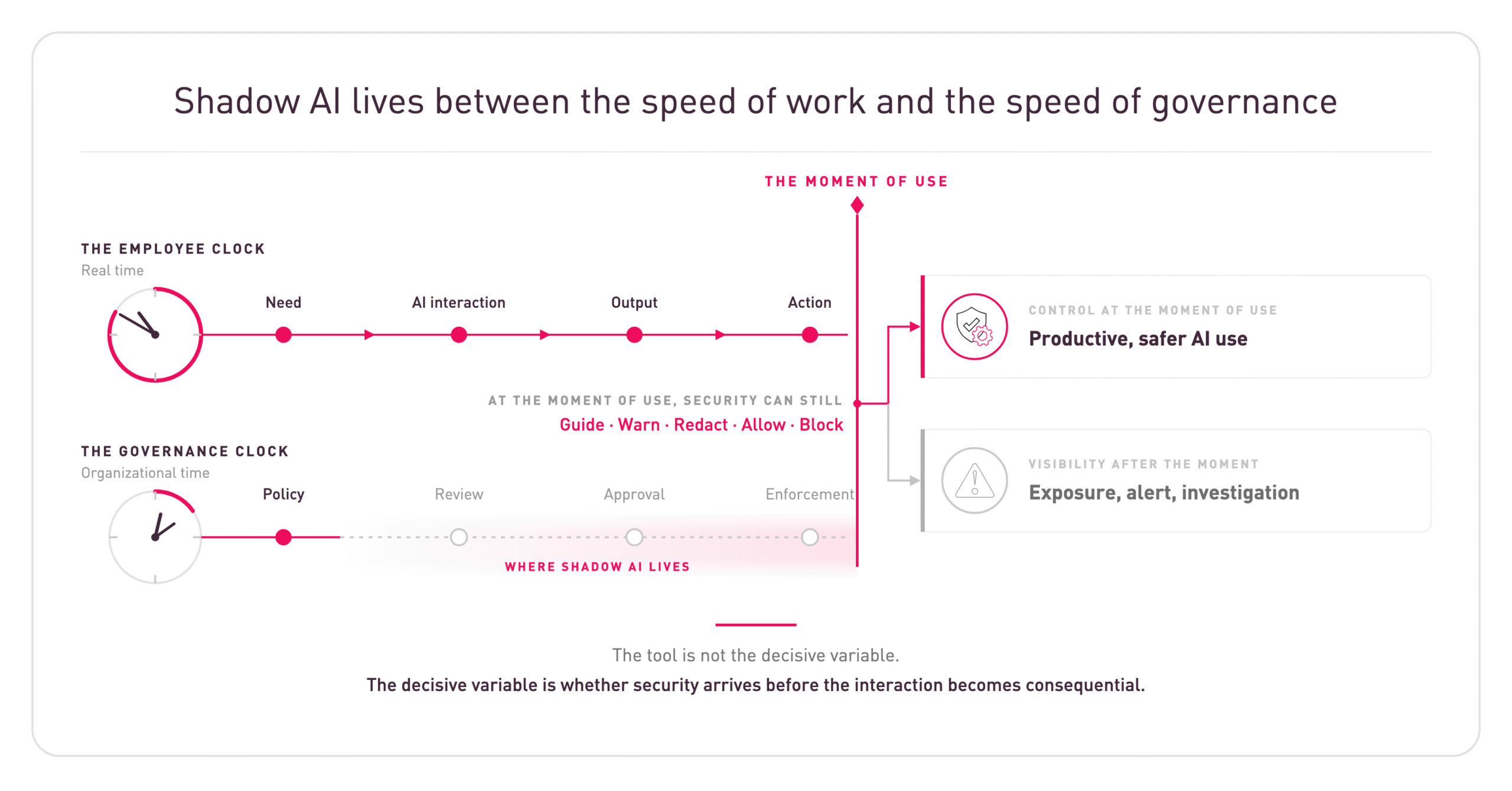
The mismatch is not only organizational. It is temporal.
AI governance often moves through meetings, documents, reviews, and audits. Employee AI use moves through prompts, uploads, browser tabs, and embedded copilots that operate in seconds.
That is why shadow AI is not just a tool problem. It is a timing problem.
If security only learns about the interaction after it happens, the most important decision has already passed. The prompt has been submitted, the file has been processed, or the AI system has already taken the next step.
At that point, the organization may have a log, a policy gap, or an investigation.
What it needed was a decision in the moment.
Upcoming webinar
Ready or Not: Securing the AI Enterprise
Session 3: Workforce AI Security
Tuesday, July 14, 2026 · 10:00 AM PT · 45-minute live session
Explore how organizations can close the timing gap around shadow AI, protect sensitive data at the point of use, and give employees a safer path to AI-powered productivity.
Security teams are used to asking familiar access questions: is the application approved, is the user allowed, and should this data leave a trusted environment?
AI adds a new control point: the moment before context enters the AI system.
That context may be source code, a customer record, a contract clause, or the accumulated knowledge inside a SaaS workspace. It may not look sensitive in isolation. The risk depends on the surrounding situation: who is using it, where it is going, and what the AI system can do next.
This is what makes employee AI use different from ordinary application governance. The question is not simply, “Is this app allowed?”
It becomes:
Those are timing-sensitive questions. They lose value when answered too late.
The phrase “shadow AI” can make the problem sound like a disciplinary issue: employees using tools they should not use, outside processes they should follow.
Sometimes that is true. But it is not the whole story.
Shadow AI is also a signal that employee workflows have changed faster than enterprise controls. People have discovered that AI can remove friction from work. They are not waiting for a perfect operating model before using it.
Microsoft and LinkedIn’s 2024 Work Trend Index captured this shift clearly: 75% of global knowledge workers were already using AI at work, and 78% of AI users were bringing their own AI tools.
That is the human reason shadow AI spreads. AI is useful at the exact moment work becomes too slow, too messy, or too much.
Security programs that treat this only as unauthorized tool use risk missing the deeper lesson. The business has found a faster path. If the secure path is slower, unclear, or less useful, employees will keep reaching for the faster one.
The answer is not to pretend the pressure is not real. It is to make the safer path work at the same speed as the business.
Visibility is essential. Security teams need to know where AI is being used and where patterns suggest risk.
But visibility is not the same as control.
A report can show that employees are using unsanctioned AI tools. It cannot redact sensitive data that has already been pasted. A dashboard can show which applications are popular. It cannot decide whether one specific upload should have been allowed.
The risk in employee AI use is often perishable. It appears, changes shape, and resolves into an outcome quickly.
That outcome may be benign: a better draft, a faster analysis, a solved issue.
Or it may create exposure. Sensitive data leaves the expected boundary. Confidential context enters an unmanaged service. An AI assistant acts on data it should not have used.
The difference may depend on context that static tools were not built to understand. That is why AI data security has to account for how information is used at runtime, not only where it is stored.
That is why security needs both visibility and intervention. Not intervention everywhere, and not intervention for its own sake. But the ability to make a risk-based decision before the interaction becomes a record of something that already happened.
NIST’s AI Risk Management Framework frames AI risk management as an ongoing discipline: organizations need to govern, map, measure, and manage risk in context. For employees using AI tools, that context lives at the point of use.
That is where policy becomes practical or theoretical. A rule that says “do not submit sensitive data to unmanaged AI tools” is necessary. But the real test is whether the organization can recognize the risk while there is still time to change the outcome.
The same is true for sanctioned tools. An approved AI feature can still create risk if it is used with the wrong data or account. Approval lowers one kind of risk; it does not remove the need for context.
The control model has to be more granular than yes or no: allow ordinary low-risk use, coach when behavior is risky but fixable, and block interactions that cross a clear line.
This is how AI policy becomes operational. It stops being only a document employees are expected to remember and becomes help at the moment they need it.
Traditional access control asks whether a user has permission.
Securing employee AI use has to ask whether the interaction makes sense.
That is a subtle but important difference. A user may be allowed to access a document, but that does not mean the document should be uploaded to a public AI tool. A developer may be allowed to view source code, but that does not mean the surrounding context belongs in an unmanaged assistant.
Permission is necessary. Judgment is contextual.
AI forces more of those contextual judgments to happen at machine speed. The model does not wait for a quarterly governance cycle. The browser does not wait for the next policy update. When AI can retrieve, connect, or act, agentic AI security risks make that timing gap even sharper.
That does not make employees careless. It makes the control model incomplete.
If AI is now part of the workflow, security has to become part of the workflow too.
Shadow AI will not be solved by naming every tool employees might use. The list changes too quickly, and the tool name is only one part of the risk.
The more durable question is whether the organization can act at the moment AI use becomes consequential.
That means giving employees a safer path, not forcing them back into slower work they will route around. It means policy that reflects real workflows, visibility that arrives early enough to matter, and controls that can protect sensitive data before exposure becomes an incident.
For security leaders, the shift is subtle but important. The question is no longer only, “How do we stop unauthorized AI tools?”
It is, “How do we help employees use AI safely at the speed of work?”
That is also where a broader enterprise AI security strategy and AI Defense Plane become useful: security has to follow AI across employees, applications, and agents. For employee AI usage specifically, Check Point helps organizations secure AI interactions across browsers, SaaS tools, copilots, and shadow AI workflows without forcing productivity back into older patterns.
Upcoming webinar
Ready or Not: Securing the AI Enterprise
Session 3: Workforce AI Security
Tuesday, July 14, 2026 · 10:00 AM PT · 45-minute live session
Explore how organizations can close the timing gap around shadow AI, protect sensitive data at the point of use, and give employees a safer path to AI-powered productivity.
此内容由惯性聚合(RSS阅读器)自动聚合整理,仅供阅读参考。 原文来自 — 版权归原作者所有。