
惯性聚合 高效追踪和阅读你感兴趣的博客、新闻、科技资讯
阅读原文 在惯性聚合中打开

推荐订阅源

Vercel News
Vercel News
The GitHub Blog
The GitHub Blog
博客园 - 【当耐特】
Cyber Security Advisories - MS-ISAC
Recent Announcements
D
Docker
GbyAI
GbyAI
酷 壳 – CoolShell
酷 壳 – CoolShell
WordPress大学
WordPress大学
The Cloudflare Blog
雷峰网
雷峰网
A
About on SuperTechFans
小众软件
小众软件
博客园 - Franky
博客园 - 聂微东
F
Full Disclosure
大猫的无限游戏
大猫的无限游戏
C
Check Point Blog
MongoDB | Blog
MongoDB | Blog
G
Google Developers Blog
Microsoft Azure Blog
U
Unit 42
freeCodeCamp Programming Tutorials: Python, JavaScript, Git & More
V
V2EX
Engineering at Meta
Engineering at Meta
宝玉的分享
宝玉的分享
aimingoo的专栏
aimingoo的专栏
量子位
P
Proofpoint News Feed
Hugging Face - Blog
Hugging Face - Blog
博客园_首页
罗磊的独立博客
Martin Fowler
Martin Fowler
D
DataBreaches.Net
cs.CL updates on arXiv.org
S
Secure Thoughts
Project Zero
Project Zero
L
LangChain Blog
阮一峰的网络日志
阮一峰的网络日志
C
Cybersecurity and Infrastructure Security Agency CISA
T
Tailwind CSS Blog
S
Schneier on Security
Blog — PlanetScale
Blog — PlanetScale
The Hacker News
The Hacker News
Spread Privacy
Spread Privacy
Security Latest
Security Latest
NISL@THU
NISL@THU
奇客Solidot–传递最新科技情报
奇客Solidot–传递最新科技情报
C
CXSECURITY Database RSS Feed - CXSecurity.com
J
Java Code Geeks

Check Point Blog

AI Security Is Never Finished: Building the Continuous Red Teaming Loop  - Check Point Blog AI Security Threats in 2026: Annual Insights from Check Point Research - Check Point Blog AI Agents are Only As Effective as Their Harness - Check Point Blog Email Agent Hijacking: The Hidden Threat That Breaks Post-Delivery Security - Check Point Blog How Check Point Email Security Stopped a Student Job Scam Before It Reached the Inbox - Check Point Blog Redefining the CISO Contract: From Securing the Business to Securely Doing Business - Check Point Blog A New Ransomware Leader Emerges as June 2026 Attack Volumes Climb Worldwide How Unified Policies Close Security Gaps - Check Point Blog Under Pressure: Insights from the 2026 Exposure Gap Report - Check Point Blog When AI Invents the Attack: Browser-Native Ransomware - Check Point Blog Check Point and the AWS European Sovereign Cloud: Securing Europe’s Digital Future - Check Point Blog Shadow AI Is Not a Tool Problem. It's a Timing Problem. - Check Point Blog AI Is Changing Cyber Careers. NICE 2026 Showed What Students Need Next - Check Point Blog 90% of the World's Businesses are SMEs and MSMEs and AI Is Reshaping Both Their Future and Their Risk - Check Point Blog Prevention Before the Inbox: Reading the Microsoft Defender Benchmark Report in Context - Check Point Blog ClickFix: The Attack That Turns Users Into Their Own Attackers - Check Point Blog From Prompt Testing to AI Red Teaming at Enterprise Scale - Check Point Blog AI Has Moved From Assistance to Action. Is Your Security Model Ready? AI Security Governance: How to Secure AI Agents, Copilots, and Autonomous AI in 2026 - Check Point Blog OpenAI Frontier AI Models Powering Check Point's Leading Cyber Security Solutions The Operational Reality of Zero Trust- And How You Can Change It - Check Point Blog Amazon Prime Day 2026: Bargains Begin June 23 — and So Do the Scams - Check Point Blog Securing AI Agent Behavior with Amazon Bedrock AgentCore and CheckPoint AI Security - Check Point Blog What Successful Exposure Management Deployments Had in Common in 2026 - Check Point Blog From Stars to Upvotes: The Fake Reputation Economy Behind a Crypto Clipboard Hijackers - Check Point Blog AI Red Teaming Makes the Unknowns Known - Check Point Blog Check Point and Illumio Expand Partnership to Secure Hybrid Environments - Check Point Blog The NCSC Patch Wave Is Coming. Do You Know Where Your Risk Lives? - Check Point Blog NCSC Warns of AI-Driven Patch Wave: Is Your Attack Surface Ready? Energy, Healthcare, and Finance: Why Midwest Industries Are Facing Surging Cyber Attacks - Check Point Blog Midwest Cyber Attacks Surge in 2026: Energy, Healthcare, and Finance Under Growing Threat Travel Phishing and Cyber Attacks are Surging in 2026, Growing 122% over the last 3 years. Here's What Cyber Criminals Are Actually Doing - Check Point Blog Travel Phishing Scams Surge 122%: How Cybercriminals Are Targeting Travelers in 2026 The AI Your Security Team Can’t See Is the One You Should Worry About Check Point Engage Public Sector 2026: AI Is the New Battlefield Check Point Joins OpenAI’s Trusted Access for Cyber Program and Daybreak Initiative When Your AI Agent’s Memory Becomes a Security Liability AI Agents Are Becoming Enterprise Workers. Who Secures Them? Global Cyber Attacks Ease in May 2026, But Ransomware Surges 48% As Threats Reorganize Security Advisory – Action Required – Active Exploitation of Check Point VPN Authentication Bypass (CVE-2026-50751) Fraud, Ransomware, and Fake Apps Are Already Targeting FIFA 2026 The AI Defense Plane: Securing the New Enterprise Execution Layer The Meta AI Account Recovery Incident Wasn’t Just a Chatbot Problem Check Point Lays the Groundwork for the Future of AI Factory Security with NVIDIA - Check Point Blog Check ... The 2026 U.S. Midterms Have a Cyber Problem, But it’s Not at the Ballot Box The Server Seizure That Affects Also Iran’s Cyber Operations The Autonomous Security Platform Built for Attacker Speed Check Point Frontier AI Models Readiness Program – Security Update 2026 Cloud Security Report: Why Traditional Network, Cloud, and Security Architecture Are Lagging Behind t ... AI Attacks Are No Longer Experimental: Key Findings from the March-April 2026 AI Threat Landscape - Check ... Protect GenAI Chatbots with Check Point WAF The Network Security Problem No One Could Solve – Until Now. Hacktivists, Ransomware, and a 124% Surge Across DACH The Case for a Vulnerability Operations Center Before the First Whistle: How Cyber Criminals Are Targeting World Cup 2026 - Check Point Blog World Cup 20 ... When the Ransomware Gang Gets Hacked: What the Gentlemen Leak Reveals About Modern Ransomware Risk - Check ... Cyber Threats Spike in April 2026 as Ransomware Expands and Attack Volumes Climb After Short-Lived Moderation Q1 2026 Ransomware Report: Fewer Groups, Higher Impact - Check Point Blog World Password Day 2026: Why "Strong Passwords" Can’t Save You from AI, Infostealers, and the Telegram Underground - Check Point Blog Resilient by Design: When the Network Itself Becomes the Target AI Threat Readiness: Defending Against Attacks Powered by Frontier AI Models Check Point Cyber Security Now Available Across All Levels of U.S. Government - Check Point Blog Check Poi ... VECT Ransomware: Why Paying Won’t Get Your Files Back Check Point WAF Leads Application Security-Validated by Frost & Sullivan Check Point WAF Leads Application ... From Access Control to Outcome Control: Securing AI Agents with Check Point and Google Cloud Experience AI-Powered Check Point Firewall at Google Cloud Next AI Finds Every Gap: How Many Can Your Network Survive? The Gentlemen RaaS Is Surging in 2026 The Phishing Paradox: The World’s Most Trusted Brands Are Cyber Criminals’ Entry Point of Choice World Quantum Day 2026: The Harvest Has Already Begun, Are You Prepared? Why Manufacturing Cyber Security is Becoming More Complex as Cyber Attacks Accelerate March 2026 Cyber Threat Report: Ransomware & GenAI Risk PS Private Training: Turning Cyber Complexity into Operational Control Tax Season 2026: How Cyber Criminals Are Preparing Their Attacks Months in Advance Claude Mythos Wake-Up Call: What AI Vulnerability Discovery Means for Cyber Defense Iran-nexus Password Spray Campaign Targeting Cloud Environments, with a Focus on the Middle East ROI of Hybrid Mesh Network Security (IDC Study 2026) ChatGPT Data Leak (Fixed Feb 2026): Key Takeaways Spring Cleaning Has Arrived: Meet the New Check Point Portal Experience North America’s Cyber Security Threat Reality in 2026
Operation TrueChaos: TrueConf Zero‑Day Supply‑Chain Attack
2026-03-31 · via Check Point Blog

A zero day flaw in a trusted supply chain software turned a legitimate government collaboration tool into a malware delivery platform. 

Operation TrueChaos at a Glance 
  • Zero day vulnerability discovered in the TrueConf client update mechanism (CVE20263502, CVSS 7.8) 
  • In the wild exploitation observed against government entities in Southeast Asia 
  • Malware delivery via legitimate software updates, requiring no phishing or additional initial compromise vectors  
  • Havoc, a powerful post exploitation framework, used as the suspected final stage payload 
  • Victimology, tooling, and infrastructure suggest ties to a Chinese-nexus threat actor (moderate confidence) 
  • Check Point Research were discovered the use of this vulnerability in the wild and responsibly notified the vendor who released a fix; the fix is included in the TrueConf Windows client starting with version 8.5.3, which was released in March 2026. The current version of the desktop apps is 8.5.2. 

At the start of 2026, Check Point Research uncovered a targeted cyber espionage campaign that challenges long held assumptions about trust inside enterprise and government networks. Dubbed Operation TrueChaos, the campaign did not rely on phishing, stolen credentials, or exploitation of internet facing servers. Instead, attackers abused a previously unknown zero day vulnerability in a trusted, widely deployed enterprise videoconferencing platform to quietly distribute malware across multiple government agencies at once. 

The vulnerability, tracked as CVE 2026 3502, impacted the TrueConf Windows client, a collaboration platform used extensively by government, defense, critical infrastructure organizations and reputable businesses such as banks due to its on premises, offline capable architecture. By exploiting weaknesses in TrueConf’s update validation process, attackers were able to weaponize the software’s trusted update mechanism, transforming it into a supply chain style malware delivery channel. 

This research highlights a sophisticated pattern in modern cyber operations: attackers increasingly target the invisible trust relationships inside secure environments, rather than attempting to break in from the outside. 

Inside CVE 2026 3502: How a Trusted Update Became a Malware Delivery System 

TrueConf is not consumer software. It is designed specifically for secure, separated, and sovereign environments, allowing government agencies to communicate without internet connectivity. This makes it particularly attractive for ministries, defense institutions, and critical infrastructure operators. 

In Operation TrueChaos, the attackers gained control of a central on premises TrueConf server, operated by a government IT organization, and replaced a legitimate client update with a malicious one. Every connected agency that trusted that server automatically became vulnerable. 

This approach offers attackers extraordinary scale and stealth: 

  • No suspicious external downloads 
  • No malicious links 
  • No security warnings for users 
  • Malware delivered as a “legitimate update” 

Once installed, the malicious update quietly deployed tools that enabled reconnaissance, persistence, privilege escalation, and communication with attacker controlled command and control servers – without alerting the victim. 
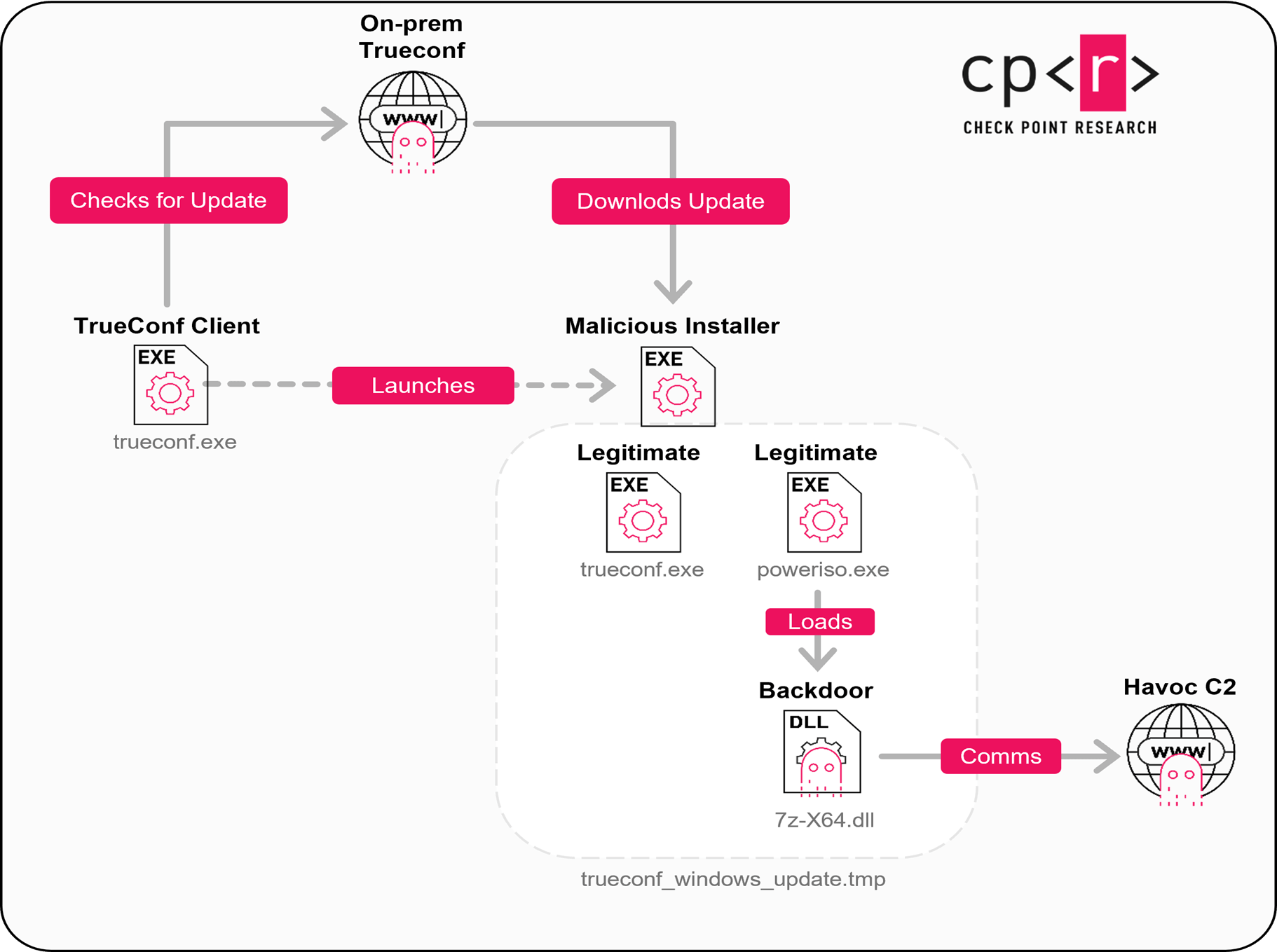
Malicious Client Update Attack Chain

At the heart of Operation TrueChaos is a flaw in how the TrueConf Windows client validated software updates delivered from an on premises server. In secure enterprise and government environments, update mechanisms are often implicitly trusted, particularly when they operate entirely within a private network. That trust became the attacker’s entry point. 

When a TrueConf client starts, it automatically checks its connected on premises server for newer versions. If the server advertises a newer client build, the user is prompted to download and install the update directly from the internal server. Critically, researchers found that the client did not sufficiently verify the integrity or authenticity of the update package before execution. 

This meant that: 

  • Any executable placed on the TrueConf server could be presented as a “legitimate update” 
  • The client would download and execute it without robust cryptographic validation 
  • The update inherited the full trust of an enterprise application 

As the attack chain leveraged a legitimate application, trusted internal update workflow and User approved installation prompts, the initial infection blended seamlessly into normal enterprise activity. Most notably, the attacker did not need to compromise each endpoint individually. Every device connected to the compromised server, and trusting it for updates, became a potential infection point. What is usually considered a strength of centralized management became a force multiplier for the attacker. 

The malicious update was carefully constructed: 

  • It performed a valid client upgrade to avoid suspicion 
  • It dropped additional files that abused DLL sideloading to execute attacker controlled code 
  • This code enabled reconnaissance, privilege escalation, persistence, and communication with attacker command and control infrastructure 

This vulnerability has since been fixed, with TrueConf introducing improved validation controls in updated client versions. However, the incident underscores a broader challenge: software update mechanisms themselves have become high value targets for advanced attackers. 

The Role of Zero Day Vulnerabilities in Modern Espionage 

Zero day vulnerabilities, flaws unknown to vendors and defenders, remain one of the most powerful tools in advanced cyber operations. What makes CVE20263502 particularly significant is where it sits in the attack chain. 

Rather than exploiting browsers or operating systems, this flaw targeted a trusted internal software update process – a mechanism most organizations implicitly rely on and rarely monitor. 

This marks a broader industry issue: as organizations harden their perimeters, attackers increasingly target software supply chains, management tools, and internal trust relationships – especially in environments assumed to be “secure by design.” 

Why This Campaign Looks Like Cyber Nation State-Backed Espionage 

Several indicators suggest Operation TrueChaos was motivated by intelligence collection rather than financial gain: 

  • Target selection focused on government and government affiliated entities 
  • Use of Havoc, an advanced post exploitation framework which is also associated with state aligned operations 
  • Command and control infrastructure hosted in environments previously linked to Chinese-nexus threat activity 
  • Overlap in targeting with other Chinese-linked malware frameworks, including ShadowPad 
Industry Impact: What Operation TrueChaos Signals 

Operation TrueChaos exposes a blind spot across many organizations, not just those using TrueConf. 

What this means for the industry in summary is:  

  • “Trusted” internal tools can be abused at scale 
  • On premises are not inherently immune to advanced threats 
  • Software update mechanisms are now high value attack targets 
  • Zero days increasingly enable supply chain style attacks without third party compromise  
How to Stay Safe: Reducing Zero Day and Supply Chain Risk 

While zero day vulnerabilities cannot always be prevented, their impact can be significantly reduced. Organizations – especially governments and critical infrastructure operators – should take the following steps immediately: 

  1. Patch and Update
  • Ensure TrueConf Windows clients are updated to version 8.5.3 or later, which includes the vendor’s fix for CVE20263502 
  1. Monitor Internal Update Channels
  • Monitor for unexpected executables, unsigned binaries, or anomalous update behavior 
  1. Harden Privileged Infrastructure
  • Restrict administrative access to central servers that distribute software or configuration updates 
  • Apply least privilege controls and multifactor authentication wherever possible 
  1. Detect Lateral Trust Abuse
  • Look for endpoint activity originating from legitimate internal applications behaving abnormally 
  • Hunt for suspicious process chains, DLL sideloading behavior, and unsigned update files 
  1. Assume Breach—Even in Secure Environments
  • Zero trust principles apply inside the network, not just at the perimeter 
  • Validate, verify, and continuously monitor – even systems designed to operate offline 

Operation TrueChaos is more than a single zero day disclosure – it is a warning. As attackers continue to evolve, trust itself has become the attack surface. Collaboration tools, management servers, and update mechanisms now sit squarely in the crosshairs of advanced threat actors. 

For governments and enterprises alike, the lesson is clear: Security isn’t just about blocking access – it’s about continuously validating what you already trust. 

Staying ahead of today’s threats means securing not only endpoints and networks, but also the invisible systems that bind them together. 

Read the full research report here.