


Vishing, or voice phishing, is a type of cyber-attack that utilizes telephone devices to deceive targets. Threat actors typically use social engineering tactics to convince targets that they can be trusted, for example, by masquerading as a family member, their bank, or trusted a government entity. One method frequently used by vishing actors is to intimidate their targets, convincing them that they may face monetary fines or jail time if they do not provide sensitive information.
Vishing attacks utilize social engineering tactics that exploit human psychology and emotion. Threat actors often impersonate trusted entities and can make it appear as though a call is coming from a reputable or known source. These actors often target organizations, specifically their employees, and pressure them to obtain sensitive corporate data, such as privileged credentials, by creating a sense of urgency, intimidation or fear. Corporate credentials can then be used to gain unauthorized access to an organization’s network, often bypassing traditional security measures and human security teams.
On August 12, 2024, Darktrace / NETWORK identified malicious activity on the network of a customer in the hospitality sector. The customer later confirmed that a threat actor had gained unauthorized access through a vishing attack. The attacker successfully spoofed the IT support phone number and called a remote employee, eventually leading to the compromise.

During the call, the remote employee was requested to authenticate via multi-factor authentication (MFA). Believing the caller to be a member of their internal IT support, using the legitimate caller ID, the remote user followed the instructions and confirmed the MFA prompt, providing access to the customer’s network.
This authentication allowed the threat actor to login into the customer’s environment by proxying through their Virtual Private Network (VPN) and gain a foothold in the network. As remote users are assigned the same static IP address when connecting to the corporate environment, the malicious actor appeared on the network using the correct username and IP address. While this stealthy activity might have evaded traditional security tools and human security teams, Darktrace’s anomaly-based threat detection identified an unusual login from a different hostname by analyzing NTLM requests from the static IP address, which it determined to be anomalous.
Darktrace, therefore, recognized that this login was likely made by a malicious actor.
Darktrace subsequently observed the malicious actor performing a series of reconnaissance activities, including LDAP reconnaissance, device hostname reconnaissance, and port scanning:


The threat actor was also seen making numerous failed NTLM authentication requests using a generic default Windows credential, indicating an attempt to brute force and laterally move through the network. During this activity, Darktrace identified that the device was using a different hostname than the one typically used by the remote employee.
In addition to the detection by Darktrace / NETWORK, Darktrace’s Cyber AI Analyst launched an autonomous investigation into the ongoing activity. The investigation was able to correlate the seemingly separate events together into a broader incident, continuously adding new suspicious linked activities as they occurred.

Upon completing the investigation, Cyber AI Analyst provided the customer with a comprehensive summary of the various attack phases detected by Darktrace and the associated incidents. This clear presentation enabled the customer to gain full visibility into the compromise and understand the activities that constituted the attack.

Despite the sophisticated techniques and social engineering tactics used by the attacker to bypass the customer’s human security team and existing security stack, Darktrace’s AI-driven approach prevented the malicious actor from continuing their activities and causing more harm.
Darktrace’s Autonomous Response technology is able to enforce a pattern of life based on what is ‘normal’ and learned for the environment. If activity is detected that represents a deviation from expected activity from, a model alert is triggered. When Darktrace’s Autonomous Response functionality is configured in autonomous response mode, as was the case with the customer, it swiftly applies response actions to devices and users without the need for a system administrator or security analyst to perform any actions.
In this instance, Darktrace applied a number of mitigative actions on the remote user, containing most of the activity as soon as it was detected:

This vishing attack underscores the significant risks remote employees face and the critical need for companies to address vishing threats to prevent network compromises. The remote employee in this instance was deceived by a malicious actor who spoofed the phone number of internal IT Support and convinced the employee to perform approve an MFA request. This sophisticated social engineering tactic allowed the attacker to proxy through the customer’s VPN, making the malicious activity appear legitimate due to the use of static IP addresses.
Despite the stealthy attempts to perform malicious activities on the network, Darktrace’s focus on anomaly detection enabled it to swiftly identify and analyze the suspicious behavior. This led to the prompt determination of the activity as malicious and the subsequent blocking of the malicious actor to prevent further escalation.
While the exact motivation of the threat actor in this case remains unclear, the 2023 cyber-attack on MGM Resorts serves as a stark illustration of the potential consequences of such threats. MGM Resorts experienced significant disruptions and data breaches following a similar vishing attack, resulting in financial and reputational damage [1]. If the attack on the customer had not been detected, they too could have faced sensitive data loss and major business disruptions. This incident underscores the critical importance of robust security measures and vigilant monitoring to protect against sophisticated cyber threats.

Darktrace’s First 6: Half-Year Threat Report 2024 highlights the latest attack trends and key threats observed by the Darktrace Threat Research team in the first six months of 2024.
Credit to Rajendra Rushanth (Cyber Security Analyst) and Ryan Traill (Threat Content Lead)
IoC - Type – Description
/nice ports,/Trinity.txt.bak - URI – Unusual Nmap Usage
Tactic – ID – Technique
INITIAL ACCESS – T1200 – Hardware Additions
DISCOVERY – T1046 – Network Service Scanning
DISCOVERY – T1482 – Domain Trust Discovery
RECONNAISSANCE – T1590 – IP Addresses
T1590.002 – DNS
T1590.005 – IP Addresses
RECONNAISSANCE – T1592 – Client Configurations
T1592.004 – Client Configurations
RECONNAISSANCE – T1595 – Scanning IP Blocks
T1595.001 – Scanning IP Blocks
T1595.002 – Vulnerability Scanning

Thanks for signing up!
Look out for your first newsletter, coming soon.
Oops! Something went wrong while submitting the form.
When you walk into a stadium on game day, you are entering a small smart city. Ticketing, turnstiles, payments, public Wi-Fi for tens of thousands of fans, CCTV, lighting, even the HVAC all run on connected systems. The experience for fans has become unmatched, but that dependency has created a much larger attack surface than people may realize.
Our latest threat research backs that up. In the past year, a survey that Darktrace commissioned found that 84% of respondents from professional sports organizations had at least one cyber incident, and 57% were hit more than once. For a sector that relies on the impact of the live moment, those numbers translate directly into operational risk.
Sport is a highly visible target with fixed timelines, so attackers know exactly when disruption will have the most impact. It also holds valuable data, athlete medical records, contracts, sponsorship deals, which carry financial, reputational, and regulatory risk if exposed. At the same time, delivery depends on a wide set of third parties: ticketing providers, broadcasters, cloud services, stadium technology. Any of those connections can become an entry point. Put visibility, timing, data, and dependency together, and you get an environment where even a small foothold can turn into a visible, time-critical incident.
Email and identity remain the front door. From October 2025 through March 2026, Darktrace / EMAIL™ detected more than 116,000 phishing emails aimed at sports organizations across our customer base, and our sports customers received 19% more phishing emails than organizations in other sectors. The numbers tell the story:
BY THE NUMBERS
A large proportion of these emails passed authentication checks, which means traditional security controls are no longer a reliable barrier. Attackers are not relying on spoofed domains – they're using legitimate infrastructure and trusted platforms. Behavior matters. Once an account is compromised, the behavior shifts quickly. Login patterns change, inbox rules are created to hide responses, and accounts start being used for internal discovery or further phishing. These aren’t high-noise events. They sit in normal workflows, which is why they’re often missed.
Ransomware tells a similar story. In one case inside a sports deployment, attackers had quietly been moving data to an outside server for a full two weeks before they triggered encryption. By the time the ransom note appeared, the outcome was already set. That sequence shows up consistently is access first, movement next, disruption last. If detection starts at encryption, it’s already too late.
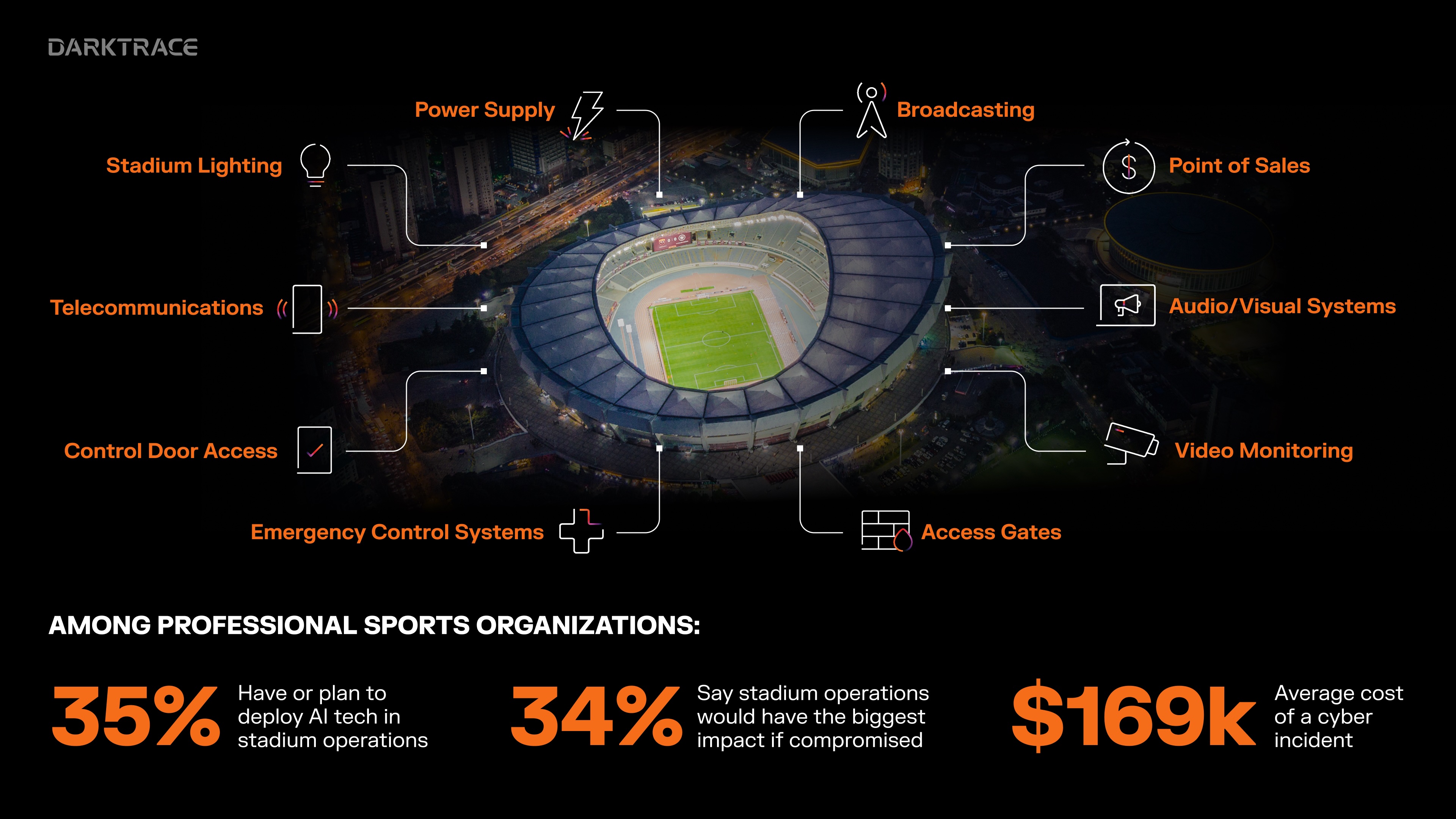
The increasing adoption of AI is expanding the potential attack surface. 72% of the security professionals we surveyed expect AI to increase their cyber risk over the next year, and yet 35% are already using or planning to use it in stadium operations, the most critical functions to protect. In addition to prompt injection and AI build risks, shadow AI is becoming a more immediate issue. Staff are already putting sensitive data—performance metrics, scouting reports, contracts, health data—into tools with little or no governance. The upside is clear, but so is the exposure—and it is happening before most organizations have any visibility or control. At the same time, attackers are using the same technology to scale phishing and social engineering. The net effect is simple: more exposure, at higher speed.
Across high profile events, Darktrace’s experience shows that effective cyber defense includes preparation, real‑time visibility, and the ability to respond dynamically and decisively when timing, complexity, and public exposure converge.
There are a few strategic implications for cybersecurity teams:
With the 2026 World Cup about to stretch across three countries and dozens of host cities, the attack surface is wide and the schedule is unforgiving.
Geopolitical signaling is raising the threat profile further. Previous international sporting events have demonstrated that nation‑state actors use the cyber domain to signal intent, influence narratives, or retaliate symbolically. In the context of the 2026 World Cup, Russia’s continued exclusion from international sport, the ongoing conflict in Ukraine, US defensive support to Ukraine, and Iran’s likely participation in the tournament introduce additional motivations for state‑aligned and non‑traditional affiliated actors to operate below the threshold of armed conflict. This doesn’t require new techniques—just the right timing and visibility.
In practice, this comes down to preparation: knowing what normal looks like across IT and OT, controlling third-party access, and spotting when behavior shifts.
In sport, disruption does not build slowly—it happens in real time and in public. By that point, the groundwork has already been set, long before the whistle goes.
Findings are based on Darktrace threat-research telemetry across sports-sector customer deployments (Q4 2025–Q1 2026) and a survey of 875 IT cybersecurity professionals in the US, UK, Australia, and Germany, fielded by Opinion Matters between May 28 and June 3, 2026. Read the full report for complete methodology, incident analysis, and strategic recommendations.
[related-resource]
Continue reading

About the author

Nathaniel Jones
VP, Security & AI Strategy, Field CISO
Stadium and large public venue operators are confronted with a unique set of cyber security challenges. Often described as a ‘honeypot’ for cyber-criminals, the sports and entertainment industry is an attractive target for threat actors for three main reasons:
In a recent Darktrace-commissioned survey, 84% of professional sports organizations reported at least one cyber incident in the past year, and 57% were hit more than once [1]. The potential ramifications of cyber disruption during a large-scale sports event cannot be overstated. A momentary lapse in access to power could bring TV broadcasts to a halt; disruption to access controls could restrict fans from entering the grounds; CCTV outages could increase the risk of criminal behavior and physical injuries. If data is not reliable and stadium machines are outputting the wrong metrics, a venue could become dangerously overcrowded. The barrier between the cyber and physical worlds has long dissolved – cyber-attacks threaten human safety.
In this blog, I explore the key challenges of stadium cyber security and explain the unique capabilities of Self-Learning AI that led me to adopt Darktrace as a head of ICT and cyber security for international venues and events. Over my career I have helped secure football and rugby World Cups, World Athletics Championships and more than 500 events ,and the lessons from each have only sharpened my conviction in this approach.
The biggest challenge lies in the paradox of securing a site where various internal services are provided to a large number of unknown and unmanaged users, suppliers and devices. When it’s game time, or ‘D-Day’, you see a huge influx of thousands of people, each with their own devices, needing to connect to your network and your infrastructure. The floodgates are opened. But certain parts of your digital environment need to remain protected: your sensitive employee and customer data, your critical OT systems. I liken this to opening the door to your home, and letting the entire town come in and wander around. But you still need to secure your master bedroom.
A multitude of different actors must be able to work on-site to provide services or content during the event. Broadcasters, staff and suppliers need to have access to manage the show, and all these people need to access or interact with the IT infrastructure. In many ways, these additional bodies are already inside the perimeter and could host unknown malicious threats.
This year, the paradox is wider than ever. A tournament spread across hundreds of suppliers and vendors means the foothold an attacker needs may already belong to a trusted partner – a single compromised supplier can become the doorway to everything else. And the adversary is no longer working alone: generative AI now lets attackers probe and weaponize vulnerabilities across thousands of software dependencies at a speed no human team could match, turning the access paradox from a manageable risk into a fast-moving target.
Achieving this balance between accessibility and security requires a shift in mindset from perimeter-based security to one that can detect and respond to threats on the inside. The complexities involved requires technology that can identify malicious behavior in real time based on the wider context of an incident. A particular behavior or connection may be benign in one context and yet critically disruptive in another — tools and technology must be able to discern between the two.
This is why I considered Darktrace’s Self-Learning AI a suitable fit: rather than defending at the perimeter, it focuses on detecting and responding to malicious activity already inside. Because it learns the unique ‘patterns of life’ of its surroundings, it can detect subtle deviations that indicate a threat and initiate a targeted response – without relying on pre-programmed rules and playbooks.
The second key challenge is the issue of IT and OT convergence. Typical stadiums and arenas consist of a wide range of Industrial Control Systems (ICS).
This involves a complex and messy array of switches, cables, CCTV cameras, as well as devices and technologies being brought in by the media and the press, and all these IT and OT components are now interconnected, which means these technologies now have Internet Protocol (IP)-based threats to manage. The same challenges that the corporate infrastructure for stadium management faces in cyber security are therefore also now an issue for ICS security.
This challenge cannot be addressed by viewing IT and OT security in isolation — these two environments are linked because of the analogue migration to IP. A unified approach is required to detect and respond to threats that start in IT before moving to industrial systems.
The stakes are physical. CCTV, Access Control, Public Annoucement system, lighting and the giant screens are all now running over IP, and a disruption to any of them can force a venue to halt play on safety grounds. Scale compounds the problem. At the Qatar 2022 World Cup, eight stadiums were purpose-built to a single technical standard, which made the digital environment relatively uniform to defend. The 2026 tournament is the opposite: dozens of host venues across three countries, each with its own operator, its own contractors and its own legacy systems.This creates a far more fragmented and unpredictable estate to secure.
In addition, cyber security technology must be able to deal with complexity. Darktrace’s AI thrives in the most complex environments, with more data points adding more context to inform the AI’s decision making. It covers OT and IT with a single, unified AI engine, that can also detect and respond across cloud infrastructure, SaaS applications, email systems and endpoints. It is ready to adapt to the messy, interconnected systems that make up large stadiums’ digital infrastructure.
Finally, the nature of stadium events means that timing is critical and puts enormous pressure on the organizers and operators. ‘D-Day’ cannot be replayed or postponed, and so if cyber disruption occurs during the event, every minute is crucial. You cannot reschedule a World Cup final or move an opening ceremony; the date is fixed, the world is watching, and there is no second take.
There is consequently a strong emphasis on two key metrics
It is perhaps more imperative in stadium event management than anywhere else that these two metrics be minimized.
This leads to the third criteria in assessing cyber security technology: does it help with response? And critically, can that response be nuanced and targeted, able to contain that threat without causing further disruption?
To this end, Darktrace’s Autonomous Response takes machine-speed action to contain cyber-attacks, when humans are too slow to react or aren’t around at all. It’s powered by Darktrace’s AI, so it has a nuanced and continuously updating understanding of what’s ‘normal’ across IT and OT systems. This means its response actions are targeted: designed to eliminate the threat, but not at the cost of disruption. Crucially, this enables responses that are surgical rather than blunt. For example, taking an entire server offline to stop a ransomware attack can cause more disruption than the attack itself, so the real value lies in neutralizing the malicious activity precisely — containing the threat without taking down the systems the event and business depends on.
Depending on the nature and severity of the threat, the technology can block specific malicious connections by enforcing the normal ‘pattern of life’ of a device or account. When every second counts, this is the speed and granularity that you need in a cybersecurity technology.
Darktrace can be deployed across every area of the digital enterprise, including network, email, cloud and SaaS environments with the same self-learning approach, stopping anomalous behaviors that point to account takeover and other cloud-based threats. Earlier this year, we announced that Darktrace is also extending its behavioral approach to help businesses deploy and scale AI securely by understanding how these AI systems and agents behave, interact with other systems and humans, and evolve over time. This is critical because 72% of cybersecurity professionals at sports organizations believe AI will increase their cyber risk over the next 12 months [2].
Wherever it is deployed, Darktrace allows the stadium operator to focus on the vital part of the game and offers real-time protection without any modification in the network topology or infrastructure.
Cyber-criminals are constantly developing their approach in an attempt to evade security tools trained to look for specific hallmarks of an attack. As they get creative and continuously experiment with new tactics and techniques, the human operators using these tools are forced into a constant state of catch up.
An AI-based approach that learns an organization and its normal behavior patterns from the ground up puts an end to this game of ‘cat and mouse’, shifting the balance in favor of the defenders and allowing them to stay ahead of the threat. This matters more than ever, because adversaries are now using AI to scale their attacks. If you do not have AI working to protect you against malicious AI, you are already at a disadvantage.
With a nuanced understanding of what’s ‘normal’ for the business, unified IT/OT coverage, and an Autonomous Response solution that takes immediate, surgical action, the playing field is leveled, and large stadium and events operators can focus on delivering the best possible experience for attendees, digital viewers, partners and performers.
[related-resource]
References:
[1] [2] Darktrace: Cybersecurity in Global Sport, June 2026. Findings based on survey of 875 IT cybersecurity professionals based in the US, UK, Australia and Germany, working in professional sports organizations (including clubs, societies & sporting bodies) employing 10+ people. The survey was fielded between May 28, 2026 and June 3, 2026 by independent market research agency, Opinion Matters.
Continue reading
About the author

Karim Benslimane
VP, Field CISO
此内容由惯性聚合(RSS阅读器)自动聚合整理,仅供阅读参考。 原文来自 — 版权归原作者所有。