
惯性聚合 高效追踪和阅读你感兴趣的博客、新闻、科技资讯
阅读原文 在惯性聚合中打开

推荐订阅源

GbyAI
GbyAI
奇客Solidot–传递最新科技情报
奇客Solidot–传递最新科技情报
Blog — PlanetScale
Blog — PlanetScale
PCI Perspectives
PCI Perspectives
K
Kaspersky official blog
T
Tenable Blog
Help Net Security
Help Net Security
Vercel News
Vercel News
Threat Intelligence Blog | Flashpoint
F
Fortinet All Blogs
罗磊的独立博客
P
Palo Alto Networks Blog
爱范儿
爱范儿
Google DeepMind News
T
Threat Research - Cisco Blogs
Security Archives - TechRepublic
Cyber Security Advisories - MS-ISAC
人人都是产品经理
人人都是产品经理
L
LangChain Blog
Recent Announcements
有赞技术团队
有赞技术团队
博客园_首页
D
Darknet – Hacking Tools, Hacker News & Cyber Security
H
Help Net Security
S
Secure Thoughts
freeCodeCamp Programming Tutorials: Python, JavaScript, Git & More
Project Zero
Project Zero
Exploit-DB.com RSS Feed
V
V2EX
Last Week in AI
Last Week in AI
H
Heimdal Security Blog
U
Unit 42
Y
Y Combinator Blog
The GitHub Blog
The GitHub Blog
SecWiki News
SecWiki News
量子位
博客园 - 【当耐特】
Martin Fowler
Martin Fowler
NISL@THU
NISL@THU
S
Securelist
P
Proofpoint News Feed
宝玉的分享
宝玉的分享
T
Tailwind CSS Blog
云风的 BLOG
云风的 BLOG
I
Intezer
CTFtime.org: upcoming CTF events
博客园 - Franky
Cisco Talos Blog
Cisco Talos Blog
小众软件
小众软件
C
CXSECURITY Database RSS Feed - CXSecurity.com

Unit 42

Three Steps to the Terminal: A Siemens ROX II Zero-Day Trilogy AI, Automation and Attacks: Unpacking the Unit 42 2026 Global Incident Response Report AI, Automation and Attacks: Unpacking the Unit 42 2026 Global Incident Response Report TuxBot v3: Inside an IoT Botnet Framework With LLM-Assisted Development No Manners Here: The Ruthless Rise of The Gentlemen Ransomware Vidar Stealer Unmasked: Code Signing Abuse, Go Loaders and File Inflation How We Added WebAuthn to a Browser-Based RDP Client Phantom Squatting: AI-Hallucinated Domains as a Software Supply Chain Vector CL-STA-1062 Targets Southeast Asian Governments and Critical Infrastructure OpenClaw’s Skill Marketplace and the Emerging AI Supply Chain Threat The Global Namespace Risk: Universal Bucket Hijacking Technique for Cloud Data Exfiltration Threat Brief: Mitigating Large-Scale Credential Attacks Pickle in the Middle – Hijacking Vertex AI Model Uploads for Cross-Tenant RCE Inside the Modern SOC: The 72-Minute Race Tracing Digital Intent: New MacOS Tahoe 26 Artifact Discovered Trust No Skill: Integrity Verification for AI Agent Supply Chains Blinding the Watchmen: Abusing Cloud Logging Services for Defense Evasion and Visibility When “Hi, This Is IT” Comes Through Microsoft Teams Threat Brief: Active Exploitation of PAN-OS CVE-2026-0257 The npm Threat Landscape: Attack Surface and Mitigations (Updated June 2) Operation FlutterBridge: macOS Malvertising Campaign Spreads New FlutterShell Backdoor 2026 World Cup: Discussing The World’s Biggest Game’s Attack Surface Out of the Crypt: The Evolving Cyber Extortion Economy Tracking Iranian APT Screening Serpens’ 2026 Espionage Campaigns Paved With Intent: ROADtools and Nation-State Tactics in the Cloud Tracking TamperedChef Clusters via Certificate and Code Reuse Gremlin Stealer's Evolved Tactics: Hiding in Plain Sight With Resource Files Inside AD CS Escalation: Unpacking Advanced Misuse Techniques and Tools Threat Brief: Exploitation of PAN-OS Captive Portal Zero-Day for Unauthenticated Remote Code Execution Copy Fail: What You Need to Know About the Most Severe Linux Threat in Years Essential Data Sources for Detection Beyond the Endpoint That AI Extension Helping You Write Emails? It’s Reading Them First TGR-STA-1030: New Activity in Central and South America Frontier AI and the Future of Defense: Your Top Questions Answered Can AI Attack the Cloud? Lessons From Building an Autonomous Cloud Offensive Multi-Agent System
Russian Global Webmail Espionage
Unit 42 · 2026-07-23 · via Unit 42

Executive Summary

Unit 42 has observed a persistent cyberespionage campaign we track as CL-STA-1114. This activity cluster overlaps with activity from a Russian threat actor tracked by other vendors as Void Blizzard and LAUNDRY BEAR.

The attackers behind this campaign targeted Zimbra webmail in organizations in the following sectors:

  • Governments
  • Defense
  • Transportation
  • Financial organizations across the following regions:
    • NATO member states
    • Ukraine
    • Commonwealth of Independent States (CIS) countries
    • Africa

Unique to this campaign, the group leveraged zero-click phishing emails that exploit a vulnerability in the Zimbra Collaboration Suite (ZCS) webmail platform (CVE-2025-66376). The exploit automatically injects a malicious JavaScript payload without requiring recipient interaction. Once executed, the payload exfiltrates sensitive user data, including login credentials, email archives, and search histories. Threat actors continue to actively target unpatched ZCS instances using CVE-2025-66376.

Palo Alto Networks customers are better protected from the threats discussed above through the following products:

If you think you might have been compromised or have an urgent matter, contact the Unit 42 Incident Response team.

Technical Analysis

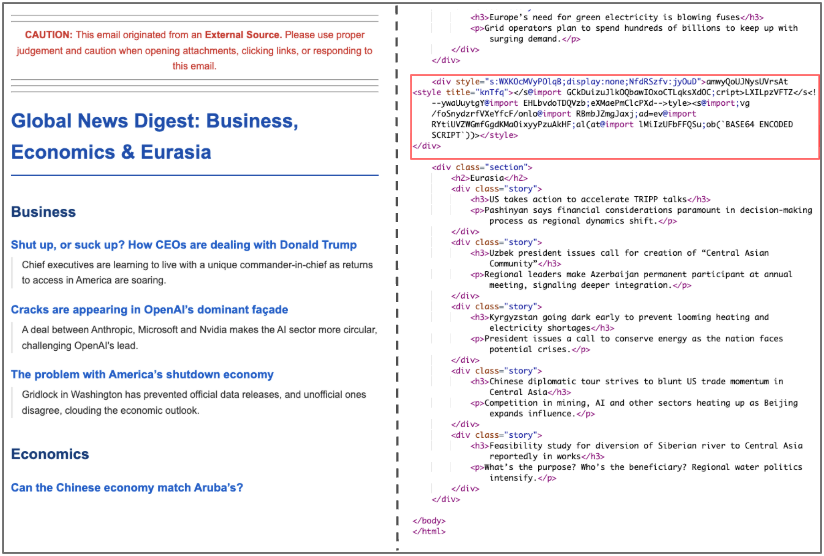
The attackers behind CL-STA-1114 have been active since at least 2024, and this campaign targeting Zimbra servers started in July 2025. Initial access starts with a phishing email that contains either an HTML attachment or embedded HTML in the message text. This lure is designed to catch recipients' attention with news headlines.

Figure 1 shows an example of the lure used and a snippet of the underlying HTML code.
A screenshot of a split screen image displaying a webpage layout. On the left, content under 'Global News Digest: Business, Economics & Eurasia' with articles discussing CEOs, OpenAI, and the impact of American technology firms. On the right, rows of HTML code and text highlighting technical aspects of webpage formatting. The content covers topics such as business strategies, economic developments, and technological advancements
Figure 1. Example lure and a snippet of its underlying HTML content.

The HTML text contains an obfuscated division with a Base64-encoded script (highlighted in red in Figure 1). The obfuscated section creates an invisible Scalable Vector Graphics (SVG) element that, upon loading, decodes the Base64-encoded script into a JavaScript payload that it injects into the victim’s browser.

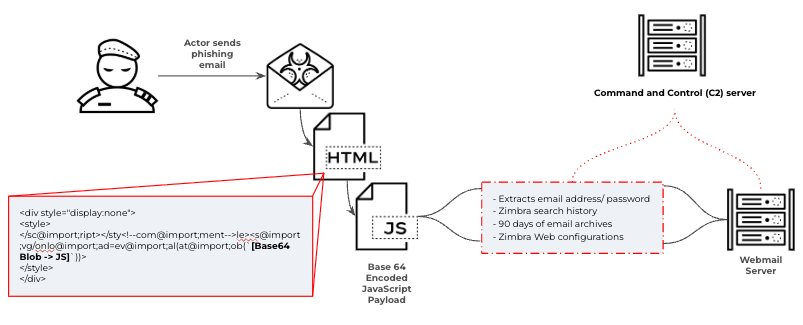
When executed, this JavaScript exfiltrates the victim’s Zimbra webmail data to a hard-coded command and control (C2) server. Exfiltrated data includes:

  • CSRF tokens
  • Email address and password
  • Two-factor authentication (2FA) scratch codes
  • System and environment details
  • The victim’s last 90 days of email and search history

Over the course of this campaign, we observed minimal changes to the JavaScript payload.

Figure 2 illustrates the attack chain.
A flowchart illustrating a cybersecurity attack chain. On the left, a person sends a phishing email leading to downloads of HTML and JavaScript files. The files are depicted with labels "Base 64 Encoded JavaScript Payload." The process connects to a "Command and Control (C2) server" and a "Webmail Server," showing the extraction of emails, passwords, search history, email archives, and Zimbra Web configurations.
Figure 2. The attack chain.

Since we began tracking this campaign, there have been at least nine IP addresses and nine domains for the C2 servers. These servers were active for an average of 35.4 days. See the Indicators of Compromise (IoC) section for a list of the IP addresses and domains used in CL-STA-1114 activity.

Conclusion

This campaign activity in CL-STA-1114 illustrates the persistent and evolving threat of state-sponsored cyberespionage. The attacker behind this activity targets widely used mail platforms like Zimbra, posing a risk to critical industries globally.

This research highlights the need for vigilance, proactive patching and advanced threat detection to protect organizations. Network administrators, defenders and security researchers should patch vulnerable systems and use the IoCs below to investigate and strengthen defenses against CL-STA-1114 and similar activity.

Palo Alto Networks customers are better protected from the threats discussed above through the following products:

If you think you may have been compromised or have an urgent matter, get in touch with the Unit 42 Incident Response team or call:

  • North America: Toll Free: +1 (866) 486-4842 (866.4.UNIT42)
  • UK: +44.20.3743.3660
  • Europe and Middle East: +31.20.299.3130
  • Asia: +65.6983.8730
  • Japan: +81.50.1790.0200
  • Australia: +61.2.4062.7950
  • India: 000 800 050 45107
  • South Korea: +82.080.467.8774

Palo Alto Networks has shared these findings with our fellow Cyber Threat Alliance (CTA) members. CTA members use this intelligence to rapidly deploy protections to their customers and to systematically disrupt malicious cyber actors. Learn more about the Cyber Threat Alliance.

Indicators of Compromise

IP addresses

  • 37.120.247[.]228
  • 64.226.124[.]190
  • 104.248.134[.]194
  • 185.86.79[.]95
  • 193.238.152[.]66
  • 194.156.103[.]193
  • 216.252.238[.]18
  • 216.252.238[.]64
  • 216.252.238[.]104

Domains

  • analyticemailmeter[.]com
  • emailanalytics[.]com[.]ua
  • istc-cloud[.]com
  • mailnalysis[.]com
  • synacorzimbra[.]nl
  • zimbra-metadata[.]com
  • zimbrastat[.]com
  • zimbrasoft[.]com[.]ua
  • zmailanalytics[.]com

Additional Resources