
惯性聚合 高效追踪和阅读你感兴趣的博客、新闻、科技资讯
阅读原文 在惯性聚合中打开

推荐订阅源

酷 壳 – CoolShell
酷 壳 – CoolShell
G
Google Developers Blog
V
V2EX
美团技术团队
H
Help Net Security
月光博客
月光博客
爱范儿
爱范儿
Engineering at Meta
Engineering at Meta
The Cloudflare Blog
U
Unit 42
大猫的无限游戏
大猫的无限游戏
Recent Announcements
A
About on SuperTechFans
博客园 - Franky
The GitHub Blog
The GitHub Blog
N
Netflix TechBlog - Medium
人人都是产品经理
人人都是产品经理
博客园 - 司徒正美
MyScale Blog
MyScale Blog
B
Blog
雷峰网
雷峰网
Y
Y Combinator Blog
云风的 BLOG
云风的 BLOG
T
The Blog of Author Tim Ferriss

Help Net Security

ChatGPT advanced account security adds passkeys and hardware keys Week in review: High-severity LPE vulnerability in the Linux kernel, cPanel 0-day exploited for months Automating Pentest Delivery: A Step-by-Step Guide - PlexTrac Open-source privacy proxy masks PII before prompts reach external AI services Shadow AI risks deepen as 31% of users get no employer training Identity is the control plane for distributed infrastructure AI traffic is getting bigger, louder, and less predictable New infosec products of the month: April 2026 cPanel zero-day exploited for months before patch release (CVE-2026-41940) Cisco releases open-source toolkit for verifying AI model lineage Met Police face criticism for using AI to spy on their own officers Nine-year-old Linux kernel flaw enables reliable local privilege escalation (CVE-2026-31431) Hacker with a special interest in breaching sports institutions ends behind bars - Help Net Security IP Fabric MCP server adds governance and control to enterprise AIOps workflows - Help Net Security Aqua Compass MCP server enables real-time investigation and containment of runtime threats - Help Net Security Google brings instant email verification to Android, no OTP needed - Help Net Security If cyber espionage via HDMI worries you, NCSC built a device to stop it - Help Net Security Apple fixes iPhone bug that let FBI retrieve deleted Signal messages(CVE-2026-28950) - Help Net Security GopherWhisper APT group hides command and control traffic in Slack and Discord - Help Net Security OpenAI tackles a bad habit people have when interacting with AI - Help Net Security A year in, Zoom's CISO reflects on balancing security and business - Help Net Security Scenario: Open-source framework for automated AI app red-teaming - Help Net Security GDPR works, but only where someone enforces it - Help Net Security Ransomware, fraud, and lawsuits drive cyber insurance claims to new peaks - Help Net Security Google’s Workspace Intelligence promises privacy while running on your data - Help Net Security Cyberattack on French government agency triggers phishing alert - Help Net Security Claude Mythos finds 271 Firefox flaws, Mozilla believes zero-days are numbered - Help Net Security Prove Identity Platform connects verification, authentication, and fraud prevention - Help Net Security New Mirai variants target routers and DVRs in parallel campaigns - Help Net Security Acronis GenAI Protection gives MSPs control over AI usage and data risks - Help Net Security
Legit Security brings agentic AI to AppSec remediation an...
Industry News · 2026-06-17 · via Help Net Security

Legit Security has launched new remediation agents that independently prioritize issues, generate fixes, open pull requests, and confirm results using context learned from each organization’s distinct codebase.
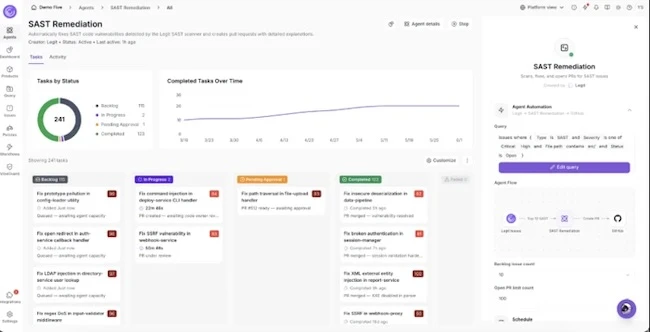
Legit Security remediation agents

As AI allows attackers to exploit vulnerabilities faster than ever, rapid remediation becomes critical. As part of Legit’s agentic AppSec platform, these agents offer parallel remediation across code bases, critical when a common authentication bypass vulnerability is introduced through reused code and propagated across multiple services, along with using business context to prioritize the real threats, and create the right fix, regardless of which AppSec testing tools are deployed.

AI-first development has fundamentally changed the math on application security, necessitating an entirely new approach to AppSec. Consider:

  • AI coding agents account for most of the committed code
  • AI generated code contains 2.74 times more vulnerabilities than human-written code
  • The median time to remediate a vulnerability is 252 days, nearly six times longer than attackers need to move from disclosure to exploitation
  • Attackers equipped with new frontier models exploit new vulnerabilities within minutes of deployments

The bottom line: the faster teams ship with AI, the faster risk compounds – and the faster attackers execute exploitation campaigns. These trends collide to create enormous risk that must be solved with automated, intelligent, agentic tools

“Security teams aren’t losing the war because they lack talent. They’re losing because the model has changed completely, but AppSec testing tools have stayed the same,” said Roni Fuchs, CEO at Legit. “Legit’s new remediation agents were built for this reality by offering AI-speed remediation centered on the context of your business and codebase, so you can trust them.”

Key features: Legit Remediation agents

Unlike general-use AI coding tools like Cursor, Claude Code and GitHub Copilot, Legit’s agents have the security knowledge and business context to generate production fixes, rather than patches. In addition, Legit’s remediation agents:

  • Unified risk posture: Legit’s stores the full risk posture of your codebases and apps, created from continuous scanning across the SDLC and the ingestion of risk signal from 3rd party tools. LLMs and coding agents do not have native access to this data.
  • Know what really matters: Legacy AppSec tools find volumes of issues without clear prioritization. Legit’s agents are informed by each customer’s distinct environment so only issues that really matter, prioritized by factors such as reachability, exploitability and production status, reach the remediation queue.
  • Close complete attack surface gaps: Vulnerabilities rarely live in a single repo; a critical CVE can exist across dozens of services simultaneously. Legit’s agents open pull requests across every affected repo in parallel, to close every gap in the attack surface.
  • Validate before opening a PR: Legit’s agents run tests, confirm the remediation held, and then create the PR with a plain-language explanation of what was fixed and why.
  • Create auditable records of agent activity: Legit records every action its remediation agents take – from the original finding to the PR, the validated fix, and what engineering did with it, providing a complete, auditable record of activity.

“Security teams tell us they’ve tried pointing AI coding tools at their vulnerability backlogs, but the results are thousands of patches that lack context and aren’t validated, some even try to fix false positives, which wastes a lot of time,” said Yoav Stahl, vice president of product at Legit. “Legit’s agents know your codebase, your risk profile, and your organizational policies, so when we deliver a fix, we know it works for you.”