


Sign up to see the future, today
Can’t-miss innovations from the bleeding edge of science and tech
The future of food is looking a little grim.
In the event we turn all arable land on this planet into a barren heath incapable of growing food, humankind may have to resort to reaping what we sowed by eating our own plastic pollution.
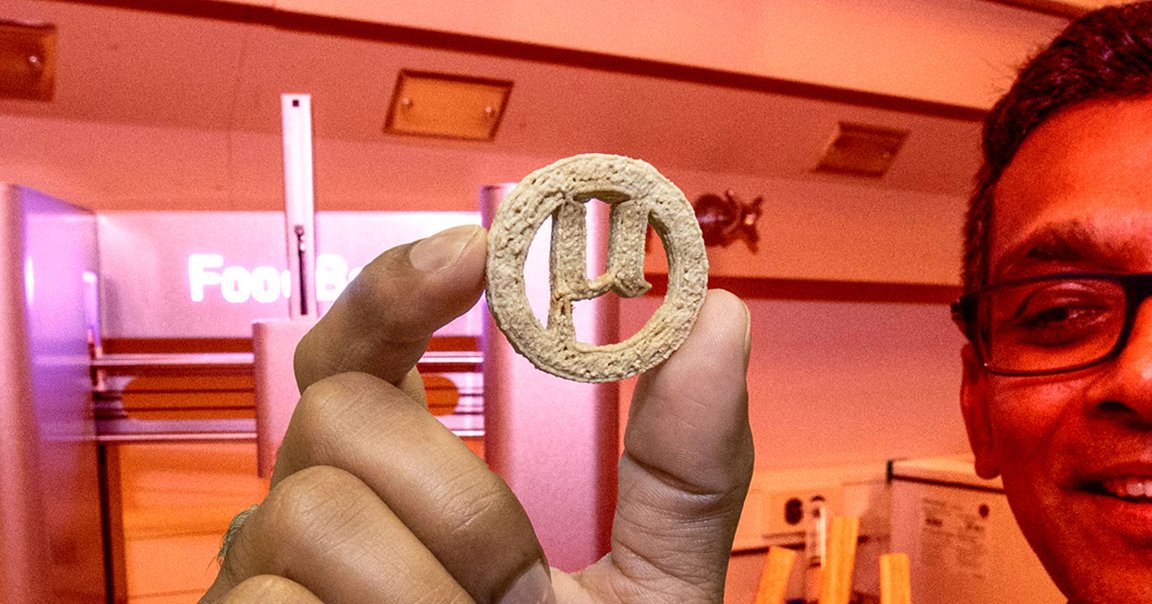
A team of researchers at Southern Illinois University Carbondale just demonstrated that this was possible by using specially engineered yeast to create tasty — and yes, edible — cookies which they 3D printed out of plastic waste.
The yeast breaks down the components of plastic compounds and agricultural byproducts like discarded plant stalks into proteins, fats, acids, and flavorings that we can eat. When these are combined together, the mixture is fed into a 3D printer that spits out cookies of any desired shape.
The researchers chose to print their cookies as the Greek letter µ, creating what they call “µBites” — or micro bites. They haven’t actually eaten one of their µBites yet, as they wait for university approval, but they’re not hedging their bets: the cookies will be safe and tasty. The David Cronenberg film “Crimes of the Future” may prove to be a prophecy after all.
“I think it has a pleasant, appealing aroma,” Lahiru Jayakody, a microbiologist at SIU who led the research, told NewScientist. “And it will taste good, too. We’ve not tasted it, but it smells good — that’s for sure — like a real cookie.”
In their work, which is being presented at the meeting of the American Chemical Society in Chicago on Monday, the researchers used CRISPR gene-editing technology to reprogram yeast strains to eat polyethylene terephthalate (PET), a widely used form of plastic commonly found in disposable water bottles, food packaging, and clothes, which is rich with carbon.
Before the yeast can start feasting, the PET plastics are subjected to a process called oxidative hydrothermal dissolution to break them down into smaller bits that the microbes can digest. The purported advantage of this approach is that it’s environmentally friendly, using only heat, water, and oxygen. The yeast feasts on these stripped-down plastic bits, turning them into a slurry of proteins, fats, and acids that’re combined with fiber, starch, and sweetener to make them more palatable. One of the yeast strains in particular was able to turn plant biomass into tasty vanilla flavorings.
Ideally, this technique could kill two birds with one stone: addressing food insecurity across the globe, and whittling away at the mountains of plastic waste that we’ve littered the Earth with. But right now, it’s an expensive process, costing around $60 to produce a kilogram of cookies, The Guardian reported. And some experts say it’s wishful thinking to believe we can 3D-print, and then eat, ourselves out of these global problems with 3D-printed, delectable treats.
“We produce 400 million tons a year of plastic waste. You’re not going to turn it all into cookies,” Jason Hallett at Imperial College London told New Scientist. “So it’s not a solution to the plastic-waste crisis. There’s no way you could do this commercially. We’re not gonna be eating plastic cookies.”
Perhaps the cookies could find a more niche use. The researchers say that their work, which was funded as part of NASA’s Deep Space Food Challenge, could also be used to feed astronauts on lengthy missions to distant worlds like Mars. More food for thought, indeed.
More on food: Scientists Genetically Engineer High-Protein Lettuce