

惯性聚合 高效追踪和阅读你感兴趣的博客、新闻、科技资讯
阅读原文 在惯性聚合中打开

推荐订阅源

雷峰网
雷峰网
爱范儿
爱范儿
宝玉的分享
宝玉的分享
Apple Machine Learning Research
博客园 - Franky
freeCodeCamp Programming Tutorials: Python, JavaScript, Git & More
OSCHINA 社区最新新闻
OSCHINA 社区最新新闻
博客园 - 三生石上(FineUI控件)
人人都是产品经理
人人都是产品经理
阮一峰的网络日志
阮一峰的网络日志
钛媒体:引领未来商业与生活新知
钛媒体:引领未来商业与生活新知
Last Week in AI
Last Week in AI
博客园 - 聂微东
大猫的无限游戏
大猫的无限游戏
让小产品的独立变现更简单 - ezindie.com
罗磊的独立博客
博客园 - 叶小钗
WordPress大学
WordPress大学
奇客Solidot–传递最新科技情报
奇客Solidot–传递最新科技情报
酷 壳 – CoolShell
酷 壳 – CoolShell
小众软件
小众软件
博客园 - 司徒正美
博客园 - 【当耐特】
IT之家
IT之家

Business of Apps

Agentic AI is coming for the app growth playbook [online event] As app discovery expands to ChatGPT, AppTweak launches AI Visibility for Apps Apps in Motion is bringing the best app operators to NASDAQ on April 8 Up your AI game at Business of Apps London 2026 The Business of Apps newsletter is evolving Early bird ticket sale for Business of Apps London ends this week Smadex unveils unique CTV Pause Ads via OpenGlass partnership Build your network at Business of Apps London 2026 Why smaller apps should rethink TV and connected TV for UA Influencer marketing gains traction among AI apps AI agents are becoming the new junior marketers Inside the key themes driving app growth at Business of Apps London 2026 Where is App Store Optimization heading in 2026? [webinar series] From social-first brand to subscription-led app, inside Mob’s rise to the UK’s leading recipe app Apps capture larger share of health and fitness market revenue in 2025 Upcoming RealityMine webinar to highlight blind spots in first-party app data From ad network to scalable performance ecosystem, EVADAV announces a newly enhanced corporate structure The biggest apps and brands are in for Business of Apps London 2026 Diversification takes centre stage in app user acquisition Super early bird ticket sale for Business of Apps London ends this week App-to-web monetisation moves into the mainstream Latest speakers confirmed for Business of Apps London 2026 Agentic coding drives number of iOS apps to highest level ever Smadex and Anzu bring performance and clickability to intrinsic in-game advertising Consumer spending on apps surpassed games for the first time in 2025 The Business of Apps London agenda is now live with more than 70 speakers Opening keynote announced for Business of Apps London ChatGPT was the most downloaded app in 2025, supplanting TikTok Want to speak at Business of Apps London? Branch’s “How I Grew This” episodes land on the Business of Apps podcast
Over half (57%) of monitored apps are susceptible to cybe...
Nayden Tafradzhiyski · 2023-09-21 · via Business of Apps

In a study that pulls back the curtain on the escalating cybersecurity challenges of our digital age, a staggering 57% of monitored apps were found to be at risk of cyber threats. This recent data comes from a comprehensive survey carried out by Digital.ai, who gleaned insights from their global application security clientele.

App popularity does not equal higher risk of attacks

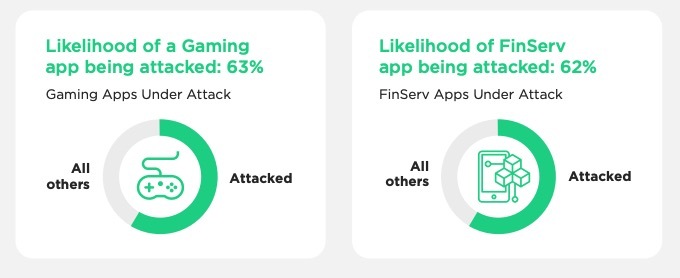
Gaming apps, which constitute a significant portion of the digital landscape, seem particularly exposed, with 63% reporting attacks. Financial Services apps, intricately tied to the world’s financial arteries, are not far behind at 62%. These numbers underscore the mounting pressures these sectors face in ensuring user trust and data integrity.

Interestingly, an app’s standing in popularity charts doesn’t necessarily equate to its vulnerability. The survey revealed a disconnect: there’s no consistent correlation between an app’s popularity and its likelihood of facing an attack.

- Advertisement -

Is your privacy opt-in rate costing you $525,000 a year?

The gap between a 65% and 90%+ privacy opt-in rate can mean $525,000 in lost revenue annually for a 100K DAU app — and most teams have no idea where they stand.

This guide breaks down the true cost of consent debt, why the average app sits at just 80% opt-in, and the exact tactics top performers use to consistently hit 90%+: prompt timing, banner design, vendor list optimization, and more.

Download the Guide.

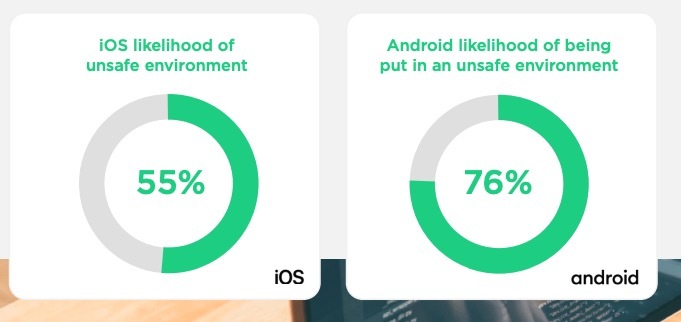
However, the operating system appears to play a significant role in an app’s security paradigm. Android apps, for instance, find themselves more frequently housed in riskier environments, with 76% at potential risk compared to iOS apps, which stand at 55%. This trend is consistent with the observation that Android apps have a 28% likelihood of operating with altered code, a stark contrast to the 6% probability for their iOS counterparts.

Android apps more likely to see attacks
Source: Digital.ai

The statistics presented are based on point-in-time data, curated between February 1 and February 28, 2023. As the digital realm continues to expand and mutate, these insights offer a telling snapshot of the challenges — and imperatives — facing developers and businesses today.

Multiple factors raise risk of cyper attacks

A combination of factors is increasing the likelihood of cyber attacks in 2023.

  • Tools in the Wrong Hands: Hacking tools are getting better and more accessible. Tools like Ghidra and Frida are becoming more sophisticated, making it easier for cybercriminals to carry out attacks.
  • Cryptocurrencies and Easy Cashouts: Cybercriminals find it simpler to cash out from their schemes, especially when using ransomware, thanks to cryptocurrencies and P2P payment apps.
  • Nationalisation of Attacks: Cyberattacks are not just isolated efforts anymore. Some may have backing from governments, giving hackers more resources and power.

Gaming apps and fintech apps more likely to be attacked
Source: Digital.ai

This growing threat highlights the need for strong cybersecurity measures.

“Application owners know all too well the pressures of creating more apps, faster, especially with the addition of AI-code assist tools,” said Derek Holt, CEO, Digital.ai. “This leads to security getting short-changed; it is often not included the DevOps process or it is seen as an impediment without an obvious starting point. Digital.ai’s platform enables teams to inject security capabilities and procedures early into the development cycle, without blocking innovation or slowing down the development and delivery process. This means security teams can monitor applications in production for better visibility into when apps are at risk.”

Key takeaways

  • A staggering 57% of monitored apps are at risk of cyber threats
  • Android apps face a higher risk (76%) compared to iOS apps (55%)
  • Gaming apps (63%) and Financial Services apps (62%) are particularly exposed to attacks