


惯性聚合 高效追踪和阅读你感兴趣的博客、新闻、科技资讯
阅读原文 在惯性聚合中打开

推荐订阅源

C
CXSECURITY Database RSS Feed - CXSecurity.com
K
Kaspersky official blog
A
Arctic Wolf
Attack and Defense Labs
L
LINUX DO - 热门话题
N
News | PayPal Newsroom
cs.CV updates on arXiv.org
L
Lohrmann on Cybersecurity
PCI Perspectives
PCI Perspectives
cs.AI updates on arXiv.org
The Last Watchdog
The Last Watchdog
B
Blog RSS Feed
让小产品的独立变现更简单 - ezindie.com
W
WeLiveSecurity
Know Your Adversary
Know Your Adversary
博客园 - Franky
T
Tenable Blog
T
Tailwind CSS Blog
钛媒体:引领未来商业与生活新知
钛媒体:引领未来商业与生活新知
Help Net Security
Help Net Security
WordPress大学
WordPress大学
T
The Exploit Database - CXSecurity.com
www.infosecurity-magazine.com
博客园 - 司徒正美
阮一峰的网络日志
阮一峰的网络日志
D
Darknet – Hacking Tools, Hacker News & Cyber Security
H
Heimdal Security Blog
TaoSecurity Blog
TaoSecurity Blog
S
Security Affairs
J
Java Code Geeks
小众软件
小众软件
freeCodeCamp Programming Tutorials: Python, JavaScript, Git & More
Apple Machine Learning Research
NISL@THU
NISL@THU
O
OpenAI News
The Cloudflare Blog
月光博客
月光博客
Google Online Security Blog
V
V2EX
罗磊的独立博客
美团技术团队
博客园 - 三生石上(FineUI控件)
Security Latest
Security Latest
奇客Solidot–传递最新科技情报
奇客Solidot–传递最新科技情报
C
Cyber Attacks, Cyber Crime and Cyber Security
cs.CL updates on arXiv.org
Cyberwarzone
Cyberwarzone
L
LINUX DO - 最新话题
Hacker News - Newest:
Hacker News - Newest: "LLM"
大猫的无限游戏
大猫的无限游戏

Google DeepMind News

Strengthening Singapore’s AI Future: A New National Partnership Simulate real-world places with Project Genie and Street View Introducing Gemini Omni Gemini for Science: AI experiments and tools for a new era of discovery Making it easier to understand how content was created and edited Gemini 3.5: frontier intelligence with action Co-Scientist: A multi-agent AI partner to accelerate research How WeatherNext helped the National Hurricane Center better predict Hurricane Melissa’s historic landfall in Jamaica Fast-tracking genetic leads to reverse cellular aging Finding the molecular switches behind new infectious diseases Opening new paths in aging research Accelerating discovery of liver disease mechanisms Uniting biological toolkits for a new approach to ALS Uncovering repurposed medicines to fight liver fibrosis Google Antigravity We’re launching the Google DeepMind Accelerator program in Asia Pacific to tackle environmental risks. AlphaEvolve: How our Gemini-powered coding agent is scaling impact across fields Enabling a new model for healthcare with AI co-clinician Announcing our partnership with the Republic of Korea Decoupled DiLoCo: A new frontier for resilient, distributed AI training Partnering with industry leaders to accelerate AI transformation Gemini 3.1 Flash TTS: the next generation of expressive AI speech Gemini Robotics-ER 1.6: Powering real-world robotics tasks through enhanced embodied reasoning Protecting people from harmful manipulation From games to biology and beyond: 10 years of AlphaGo’s impact A new way to express yourself: Gemini can now create music Accelerating discovery in India through AI-powered science and education Accelerating Mathematical and Scientific Discovery with Gemini Deep Think D4RT: Teaching AI to see the world in four dimensions Veo 3.1 Ingredients to Video: More consistency, creativity and control Gemma Scope 2: helping the AI safety community deepen understanding of complex language model behavior Google DeepMind supports U.S. Department of Energy on Genesis: a national mission to accelerate innovation and scientific discovery Gemini 3 Flash: frontier intelligence built for speed Improved Gemini audio models for powerful voice interactions Deepening our partnership with the UK AI Security Institute Strengthening our partnership with the UK government to support prosperity and security in the AI era FACTS Benchmark Suite: Systematically evaluating the factuality of large language models Engineering more resilient crops for a warming climate AlphaFold: Five years of impact Revealing a key protein behind heart disease How we’re bringing AI image verification to the Gemini app Build with Nano Banana Pro, our Gemini 3 Pro Image model Introducing Nano Banana Pro We’re expanding our presence in Singapore to advance AI in the Asia-Pacific region Start building with Gemini 3 A new era of intelligence with Gemini 3 Google Antigravity WeatherNext 2: Our most advanced weather forecasting model SIMA 2: An Agent that Plays, Reasons, and Learns With You in Virtual 3D Worlds Teaching AI to see the world more like we do How AI is giving Northern Ireland teachers time back Mapping, modeling, and understanding nature with AI Accelerating discovery with the AI for Math Initiative MedGemma: Our most capable open models for health AI development VaultGemma: The world's most capable differentially private LLM Bringing AI to the next generation of fusion energy Introducing Veo 3.1 and advanced capabilities in Flow Introducing the Gemini 2.5 Computer Use model Introducing CodeMender: an AI agent for code security Gemini Robotics 1.5 brings AI agents into the physical world Strengthening our Frontier Safety Framework Discovering new solutions to century-old problems in fluid dynamics Gemini achieves gold-medal level at the International Collegiate Programming Contest World Finals Using AI to perceive the universe in greater depth Image editing in Gemini just got a major upgrade Introducing Gemma 3 270M: The compact model for hyper-efficient AI How AI is helping advance the science of bioacoustics to save endangered species Genie 3: A new frontier for world models Rethinking how we measure AI intelligence Try Deep Think in the Gemini app AlphaEarth Foundations helps map our planet in unprecedented detail Aeneas transforms how historians connect the past Gemini 2.5 Flash-Lite is now stable and generally available Exploring the context of online images with Backstory Advanced version of Gemini with Deep Think officially achieves gold-medal standard at the International Mathematical Olympiad T5Gemma: A new collection of encoder-decoder Gemma models AlphaGenome: AI for better understanding the genome Gemini Robotics On-Device brings AI to local robotic devices We’re expanding our Gemini 2.5 family of models Gemini 2.5: Updates to our family of thinking models Behind “ANCESTRA”: combining Veo with live-action filmmaking How we're supporting better tropical cyclone prediction with AI Advanced audio dialog and generation with Gemini 2.5 Gemini 2.5: Our most intelligent models are getting even better SynthID Detector — a new portal to help identify AI-generated content Our vision for building a universal AI assistant Fuel your creativity with new generative media models and tools Announcing Gemma 3n preview: powerful, efficient, mobile-first AI Gemini 2.5 Pro Preview: even better coding performance Build rich, interactive web apps with an updated Gemini 2.5 Pro Start building with Gemini 2.5 Flash Generate videos in Gemini and Whisk with Veo 2 DolphinGemma: How Google AI is helping decode dolphin communication Gemini 2.5: Our most intelligent AI model Experiment with Gemini 2.0 Flash native image generation Introducing Gemma 3: The most capable model you can run on a single GPU or TPU Start building with Gemini 2.0 Flash and Flash-Lite Gemini 2.0 is now available to everyone State-of-the-art video and image generation with Veo 2 and Imagen 3 Introducing Gemini 2.0: our new AI model for the agentic era
Introducing Gemma 3n: The developer guide
Omar Sanseviero, Ian Ballantyne · 2025-06-26 · via Google DeepMind News

The first Gemma model launched early last year and has since grown into a thriving Gemmaverse of over 160 million collective downloads. This ecosystem includes our family of over a dozen specialized models for everything from safeguarding to medical applications and, most inspiringly, the countless innovations from the community. From innovators like Roboflow building enterprise computer vision to the Institute of Science Tokyo creating highly-capable Japanese Gemma variants, your work has shown us the path forward.

Building on this incredible momentum, we're excited to announce the full release of Gemma 3n. While last month's preview offered a glimpse, today unlocks the full power of this mobile-first architecture. Gemma 3n is designed for the developer community that helped shape Gemma. It’s supported by your favorite tools including Hugging Face Transformers, llama.cpp, Google AI Edge, Ollama, MLX, and many others, enabling you to fine-tune and deploy for your specific on-device applications with ease. This post is the developer deep dive: we'll explore some of the innovations behind Gemma 3n, share new benchmark results, and show you how to start building today.


What’s new in Gemma 3n?

Gemma 3n represents a major advancement for on-device AI, bringing powerful multimodal capabilities to edge devices with performance previously only seen in last year's cloud-based frontier models.
  • Multimodal by design: Gemma 3n natively supports image, audio, video, and text inputs and text outputs.
  • Optimized for on-device: Engineered with a focus on efficiency, Gemma 3n models are available in two sizes based on effective parameters: E2B and E4B. While their raw parameter count is 5B and 8B respectively, architectural innovations allow them to run with a memory footprint comparable to traditional 2B and 4B models, operating with as little as 2GB (E2B) and 3GB (E4B) of memory.
  • Groundbreaking architecture: At its core, Gemma 3n features novel components like the MatFormer architecture for compute flexibility, Per Layer Embeddings (PLE) for memory efficiency, LAuReL and AltUp for architectural efficiency, and new audio and MobileNet-v5 based vision encoders optimized for on-device use cases.
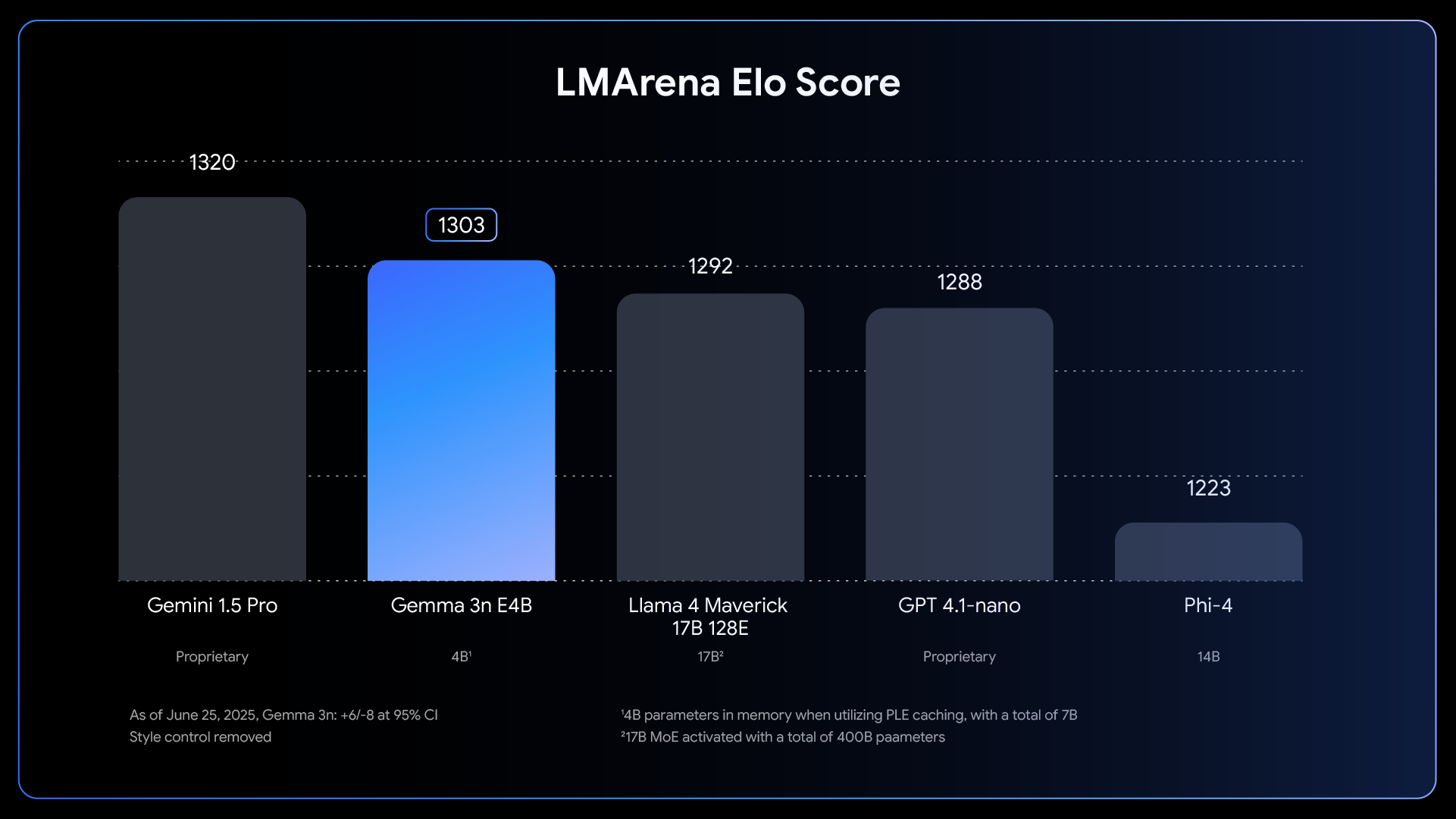
  • Enhanced quality: Gemma 3n delivers quality improvements across multilinguality (supporting 140 languages for text and multimodal understanding of 35 languages), math, coding, and reasoning. The E4B version achieves an LMArena score over 1300, making it the first model under 10 billion parameters to reach this benchmark.

LMArena Text Arena Elo Score rankings for Gemini 1.5 Pro, Gemma 3n E4B llama 4 Maverick 17B 128E GPT 4.1-nano and Phi-4

Achieving this leap in on-device performance required rethinking the model from the ground up. The foundation is Gemma 3n’s unique mobile-first architecture, and it all starts with MatFormer.


MatFormer: One model, many sizes

At the core of Gemma 3n is the MatFormer (🪆Matryoshka Transformer) architecture, a novel nested transformer built for elastic inference. Think of it like Matryoshka dolls: a larger model contains smaller, fully functional versions of itself. This approach extends the concept of Matryoshka Representation Learning from just embeddings to all transformer components.
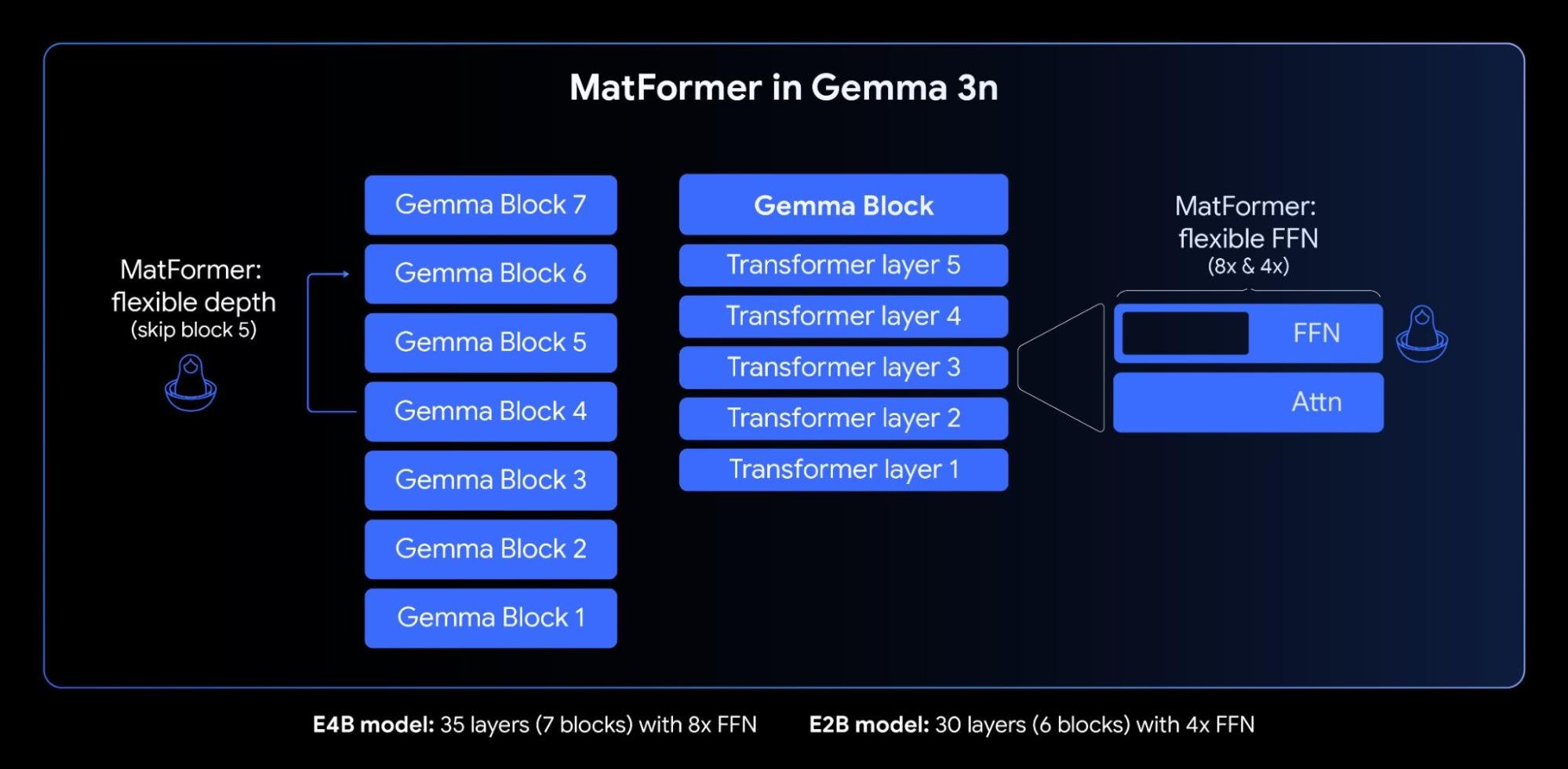
MatFormer in Nano V3

During the MatFormer training of the 4B effective parameter (E4B) model, a 2B effective parameter (E2B) sub-model is simultaneously optimized within it, as shown in the figure above. This provides developers two powerful capabilities and use cases today:

1: Pre-extracted models: You can directly download and use either the main E4B model for the highest capabilities, or the standalone E2B sub-model which we have already extracted for you, offering up to 2x faster inference.

2: Custom sizes with Mix-n-Match: For more granular control tailored to specific hardware constraints, you can create a spectrum of custom-sized models between E2B and E4B using a method we call Mix-n-Match. This technique allows you to precisely slice the E4B model's parameters, primarily by adjusting the feed forward network hidden dimension per layer (from 8192 to 16384) and selectively skipping some layers. We are releasing the MatFormer Lab, a tool that shows how to retrieve these optimal models, which were identified by evaluating various settings on benchmarks like MMLU.
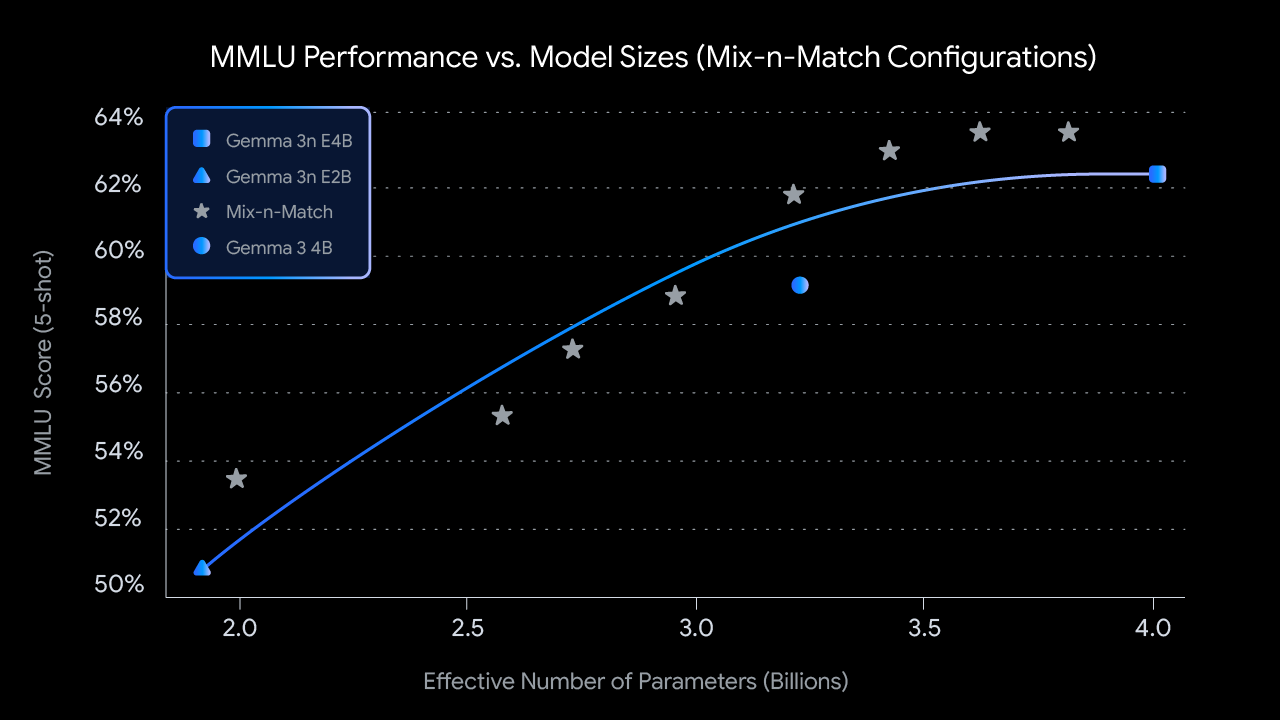
Custom Sizes with Mix-n-Match

MMLU scores for the pre-trained Gemma 3n checkpoints at different model sizes (using Mix-n-Match)

Looking ahead, the MatFormer architecture also paves the way for elastic execution. While not part of today’s launched implementations, this capability allows a single deployed E4B model to dynamically switch between E4B and E2B inference paths on the fly, enabling real-time optimization of performance and memory usage based on the current task and device load.


Per-Layer Embeddings (PLE): Unlocking more memory efficiency

Gemma 3n models incorporate Per-Layer Embeddings (PLE). This innovation is tailored for on-device deployment as it dramatically improves model quality without increasing the high-speed memory footprint required on your device's accelerator (GPU/TPU).

While the Gemma 3n E2B and E4B models have a total parameter count of 5B and 8B respectively, PLE allows a significant portion of these parameters (the embeddings associated with each layer) to be loaded and computed efficiently on the CPU. This means only the core transformer weights (approximately 2B for E2B and 4B for E4B) need to sit in the typically more constrained accelerator memory (VRAM).
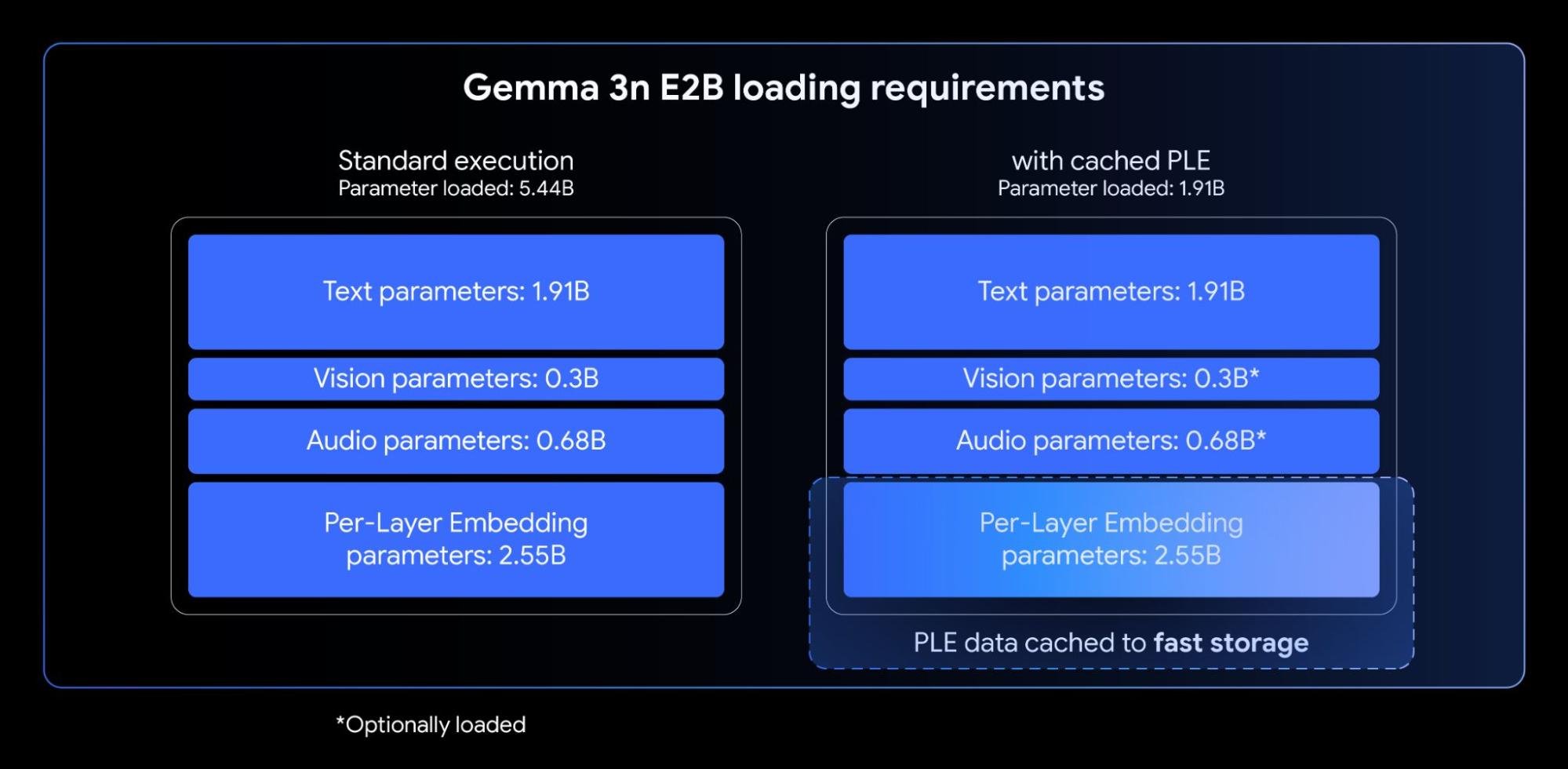
Per-Layer Embeddings

With Per-Layer Embeddings, you can use Gemma 3n E2B while only having ~2B parameters loaded in your accelerator.

KV Cache sharing: Faster long-context processing

Processing long inputs, such as the sequences derived from audio and video streams, is essential for many advanced on-device multimodal applications. Gemma 3n introduces KV Cache Sharing, a feature designed to significantly accelerate time-to-first-token for streaming response applications.

KV Cache Sharing optimizes how the model handles the initial input processing stage (often called the "prefill" phase). The keys and values of the middle layer from local and global attention are directly shared with all the top layers, delivering a notable 2x improvement on prefill performance compared to Gemma 3 4B. This means the model can ingest and understand lengthy prompt sequences much faster than before.


Audio understanding: Introducing speech to text and translation

Gemma 3n uses an advanced audio encoder based on the Universal Speech Model (USM). The encoder generates a token for every 160ms of audio (about 6 tokens per second), which are then integrated as input to the language model, providing a granular representation of the sound context.

This integrated audio capability unlocks key features for on-device development, including:

  • Automatic Speech Recognition (ASR): Enable high-quality speech-to-text transcription directly on the device.
  • Automatic Speech Translation (AST): Translate spoken language into text in another language.

We've observed particularly strong AST results for translation between English and Spanish, French, Italian, and Portuguese, offering great potential for developers targeting applications in these languages. For tasks like speech translation, leveraging Chain-of-Thought prompting can significantly enhance results. Here’s an example:

<bos><start_of_turn>user
Transcribe the following speech segment in Spanish, then translate it into English: 
<start_of_audio><end_of_turn>
<start_of_turn>model

Plain text

Copied

At launch time, the Gemma 3n encoder is implemented to process audio clips up to 30 seconds. However, this is not a fundamental limitation. The underlying audio encoder is a streaming encoder, capable of processing arbitrarily long audios with additional long form audio training. Follow-up implementations will unlock low-latency, long streaming applications.


MobileNet-V5: New state-of-the-art vision encoder

Alongside its integrated audio capabilities, Gemma 3n features a new, highly efficient vision encoder, MobileNet-V5-300M, delivering state-of-the-art performance for multimodal tasks on edge devices.

Designed for flexibility and power on constrained hardware, MobileNet-V5 gives developers:

  • Multiple input resolutions: Natively supports resolutions of 256x256, 512x512, and 768x768 pixels, allowing you to balance performance and detail for your specific applications.
  • Broad visual understanding: Co-trained on extensive multimodal datasets, it excels at a wide range of image and video comprehension tasks.
  • High throughput: Processes up to 60 frames per second on a Google Pixel, enabling real-time, on-device video analysis and interactive experiences.

This level of performance is achieved with multiple architectural innovations, including:

  • An advanced foundation of MobileNet-V4 blocks (including Universal Inverted Bottlenecks and Mobile MQA).
  • A significantly scaled up architecture, featuring a hybrid, deep pyramid model that is 10x larger than the biggest MobileNet-V4 variant.
  • A novel Multi-Scale Fusion VLM adapter that enhances the quality of tokens for better accuracy and efficiency.


Benefiting from novel architectural designs and advanced distillation techniques, MobileNet-V5-300M substantially outperforms the baseline SoViT in Gemma 3 (trained with SigLip, no distillation). On a Google Pixel Edge TPU, it delivers a 13x speedup with quantization (6.5x without), requires 46% fewer parameters, and has a 4x smaller memory footprint, all while providing significantly higher accuracy on vision-language tasks

We’re excited to share more about the work behind this model. Look out for our upcoming MobileNet-V5 technical report, which will deep dive into the model architecture, data scaling strategies, and advanced distillation techniques.

Making Gemma 3n accessible from day one has been a priority. We're proud to partner with many incredible open source developers to ensure broad support across popular tools and platforms, including contributions from teams behind AMD, Axolotl, Docker, Hugging Face, llama.cpp, LMStudio, MLX, NVIDIA, Ollama, RedHat, SGLang, Unsloth, and vLLM.

But this ecosystem is just the beginning. The true power of this technology is in what you will build with it. That’s why we’re launching the Gemma 3n Impact Challenge. Your mission: use Gemma 3n's unique on-device, offline, and multimodal capabilities to build a product for a better world. With $150,000 in prizes, we're looking for a compelling video story and a "wow" factor demo that shows real-world impact. Join the challenge and help build a better future.


Get started with Gemma 3n today

Ready to explore the potential of Gemma 3n today? Here's how:

  • Experiment directly: Use Google AI Studio to try Gemma 3n in just a couple of clicks. Gemma models can also be deployed directly to Cloud Run from AI Studio.
  • Learn & integrate: Dive into our comprehensive documentation to quickly integrate Gemma into your projects or start with our inference and fine-tuning guides.