
惯性聚合 高效追踪和阅读你感兴趣的博客、新闻、科技资讯
阅读原文 在惯性聚合中打开

推荐订阅源

Vercel News
Vercel News
The GitHub Blog
The GitHub Blog
博客园 - 【当耐特】
Cyber Security Advisories - MS-ISAC
Recent Announcements
D
Docker
GbyAI
GbyAI
酷 壳 – CoolShell
酷 壳 – CoolShell
WordPress大学
WordPress大学
The Cloudflare Blog
雷峰网
雷峰网
A
About on SuperTechFans
小众软件
小众软件
博客园 - Franky
博客园 - 聂微东
F
Full Disclosure
大猫的无限游戏
大猫的无限游戏
C
Check Point Blog
MongoDB | Blog
MongoDB | Blog
G
Google Developers Blog
Microsoft Azure Blog
U
Unit 42
freeCodeCamp Programming Tutorials: Python, JavaScript, Git & More
V
V2EX
Engineering at Meta
Engineering at Meta
宝玉的分享
宝玉的分享
aimingoo的专栏
aimingoo的专栏
量子位
P
Proofpoint News Feed
Hugging Face - Blog
Hugging Face - Blog
博客园_首页
罗磊的独立博客
Martin Fowler
Martin Fowler
D
DataBreaches.Net
cs.CL updates on arXiv.org
S
Secure Thoughts
Project Zero
Project Zero
L
LangChain Blog
阮一峰的网络日志
阮一峰的网络日志
C
Cybersecurity and Infrastructure Security Agency CISA
T
Tailwind CSS Blog
S
Schneier on Security
Blog — PlanetScale
Blog — PlanetScale
The Hacker News
The Hacker News
Spread Privacy
Spread Privacy
Security Latest
Security Latest
NISL@THU
NISL@THU
奇客Solidot–传递最新科技情报
奇客Solidot–传递最新科技情报
C
CXSECURITY Database RSS Feed - CXSecurity.com
J
Java Code Geeks

Google DeepMind News

Strengthening Singapore’s AI Future: A New National Partnership Simulate real-world places with Project Genie and Street View Introducing Gemini Omni Gemini for Science: AI experiments and tools for a new era of discovery Making it easier to understand how content was created and edited Gemini 3.5: frontier intelligence with action Co-Scientist: A multi-agent AI partner to accelerate research How WeatherNext helped the National Hurricane Center better predict Hurricane Melissa’s historic landfall in Jamaica Fast-tracking genetic leads to reverse cellular aging Finding the molecular switches behind new infectious diseases Opening new paths in aging research Accelerating discovery of liver disease mechanisms Uniting biological toolkits for a new approach to ALS Uncovering repurposed medicines to fight liver fibrosis Google Antigravity We’re launching the Google DeepMind Accelerator program in Asia Pacific to tackle environmental risks. AlphaEvolve: How our Gemini-powered coding agent is scaling impact across fields Enabling a new model for healthcare with AI co-clinician Announcing our partnership with the Republic of Korea Decoupled DiLoCo: A new frontier for resilient, distributed AI training Partnering with industry leaders to accelerate AI transformation Gemini 3.1 Flash TTS: the next generation of expressive AI speech Gemini Robotics-ER 1.6: Powering real-world robotics tasks through enhanced embodied reasoning Protecting people from harmful manipulation From games to biology and beyond: 10 years of AlphaGo’s impact A new way to express yourself: Gemini can now create music Accelerating discovery in India through AI-powered science and education Accelerating Mathematical and Scientific Discovery with Gemini Deep Think D4RT: Teaching AI to see the world in four dimensions Veo 3.1 Ingredients to Video: More consistency, creativity and control Gemma Scope 2: helping the AI safety community deepen understanding of complex language model behavior Google DeepMind supports U.S. Department of Energy on Genesis: a national mission to accelerate innovation and scientific discovery Gemini 3 Flash: frontier intelligence built for speed Improved Gemini audio models for powerful voice interactions Deepening our partnership with the UK AI Security Institute Strengthening our partnership with the UK government to support prosperity and security in the AI era FACTS Benchmark Suite: Systematically evaluating the factuality of large language models Engineering more resilient crops for a warming climate AlphaFold: Five years of impact Revealing a key protein behind heart disease How we’re bringing AI image verification to the Gemini app Build with Nano Banana Pro, our Gemini 3 Pro Image model Introducing Nano Banana Pro We’re expanding our presence in Singapore to advance AI in the Asia-Pacific region Start building with Gemini 3 A new era of intelligence with Gemini 3 Google Antigravity WeatherNext 2: Our most advanced weather forecasting model SIMA 2: An Agent that Plays, Reasons, and Learns With You in Virtual 3D Worlds Teaching AI to see the world more like we do How AI is giving Northern Ireland teachers time back Mapping, modeling, and understanding nature with AI Accelerating discovery with the AI for Math Initiative MedGemma: Our most capable open models for health AI development VaultGemma: The world's most capable differentially private LLM Bringing AI to the next generation of fusion energy Introducing Veo 3.1 and advanced capabilities in Flow Introducing the Gemini 2.5 Computer Use model Introducing CodeMender: an AI agent for code security Gemini Robotics 1.5 brings AI agents into the physical world Strengthening our Frontier Safety Framework Discovering new solutions to century-old problems in fluid dynamics Gemini achieves gold-medal level at the International Collegiate Programming Contest World Finals Using AI to perceive the universe in greater depth Image editing in Gemini just got a major upgrade Introducing Gemma 3 270M: The compact model for hyper-efficient AI How AI is helping advance the science of bioacoustics to save endangered species Genie 3: A new frontier for world models Rethinking how we measure AI intelligence Try Deep Think in the Gemini app AlphaEarth Foundations helps map our planet in unprecedented detail Aeneas transforms how historians connect the past Gemini 2.5 Flash-Lite is now stable and generally available Exploring the context of online images with Backstory Advanced version of Gemini with Deep Think officially achieves gold-medal standard at the International Mathematical Olympiad Introducing Gemma 3n: The developer guide AlphaGenome: AI for better understanding the genome Gemini Robotics On-Device brings AI to local robotic devices We’re expanding our Gemini 2.5 family of models Gemini 2.5: Updates to our family of thinking models Behind “ANCESTRA”: combining Veo with live-action filmmaking How we're supporting better tropical cyclone prediction with AI Advanced audio dialog and generation with Gemini 2.5 Gemini 2.5: Our most intelligent models are getting even better SynthID Detector — a new portal to help identify AI-generated content Our vision for building a universal AI assistant Fuel your creativity with new generative media models and tools Announcing Gemma 3n preview: powerful, efficient, mobile-first AI Gemini 2.5 Pro Preview: even better coding performance Build rich, interactive web apps with an updated Gemini 2.5 Pro Start building with Gemini 2.5 Flash Generate videos in Gemini and Whisk with Veo 2 DolphinGemma: How Google AI is helping decode dolphin communication Gemini 2.5: Our most intelligent AI model Experiment with Gemini 2.0 Flash native image generation Introducing Gemma 3: The most capable model you can run on a single GPU or TPU Start building with Gemini 2.0 Flash and Flash-Lite Gemini 2.0 is now available to everyone State-of-the-art video and image generation with Veo 2 and Imagen 3 Introducing Gemini 2.0: our new AI model for the agentic era
T5Gemma: A new collection of encoder-decoder Gemma models
Biao Zhang, Paul Suganthan, Ben Hora · 2025-07-09 · via Google DeepMind News

In the rapidly evolving landscape of large language models (LLMs), the spotlight has largely focused on the decoder-only architecture. While these models have shown impressive capabilities across a wide range of generation tasks, the classic encoder-decoder architecture, such as T5 (The Text-to-Text Transfer Transformer), remains a popular choice for many real-world applications. Encoder-decoder models often excel at summarization, translation, QA, and more due to their high inference efficiency, design flexibility, and richer encoder representation for understanding input. Nevertheless, the powerful encoder-decoder architecture has received little relative attention.

Today, we revisit this architecture and introduce T5Gemma, a new collection of encoder-decoder LLMs developed by converting pretrained decoder-only models into the encoder-decoder architecture through a technique called adaptation. T5Gemma is based on the Gemma 2 framework, including adapted Gemma 2 2B and 9B models as well as a set of newly trained T5-sized models (Small, Base, Large and XL). We are excited to release pretrained and instruction-tuned T5Gemma models to the community to unlock new opportunities for research and development.


From decoder-only to encoder-decoder

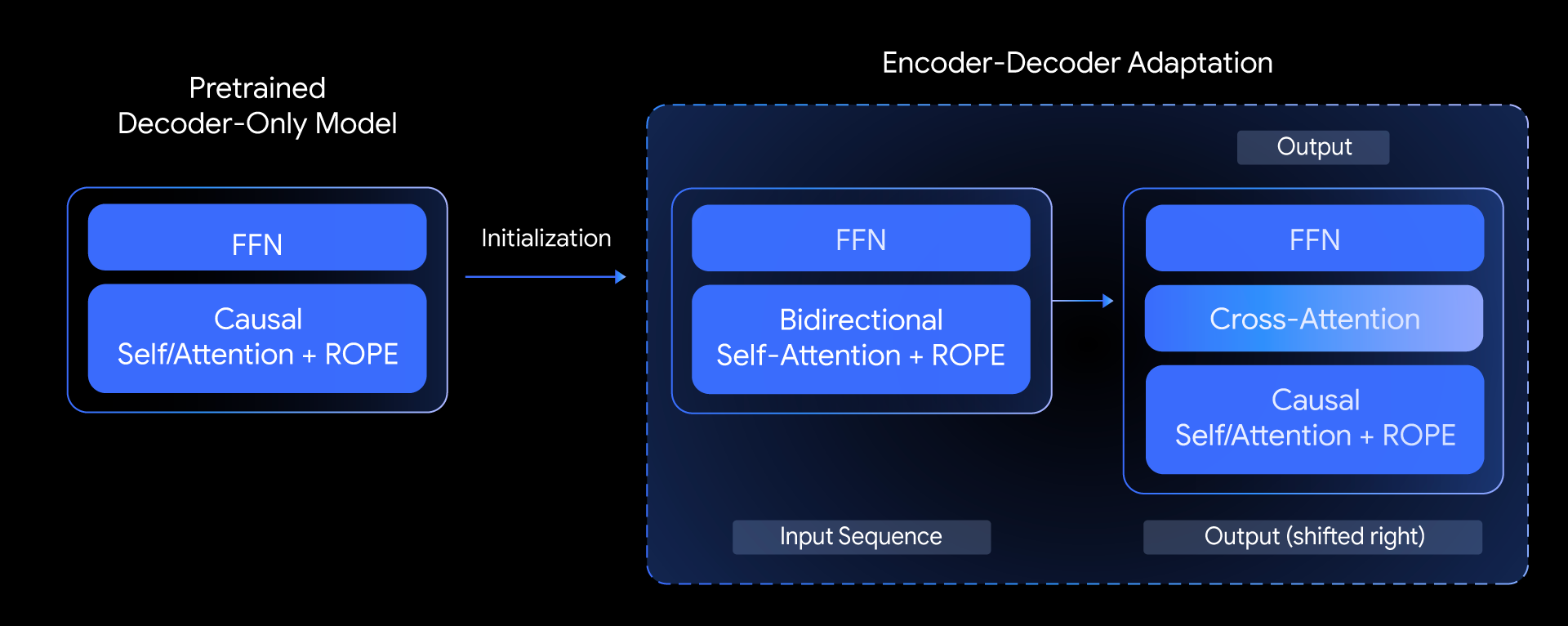
In T5Gemma, we ask the following question: can we build top-tier encoder-decoder models based on pretrained decoder-only models? We answer this question by exploring a technique called model adaptation. The core idea is to initialize the parameters of an encoder-decoder model using the weights of an already pretrained decoder-only model, and then further adapt them via UL2 or PrefixLM-based pre-training.
decoder-only model

An overview of our approach, showing how we initialize a new encoder-decoder model using the parameters from a pretrained, decoder-only model.

This adaptation method is highly flexible, allowing for creative combinations of model sizes. For instance, we can pair a large encoder with a small decoder (e.g., a 9B encoder with a 2B decoder) to create an "unbalanced" model. This allows us to fine-tune the quality-efficiency trade-off for specific tasks, such as summarization, where a deep understanding of the input is more critical than the complexity of the generated output.


Towards better quality-efficiency trade-off

How does T5Gemma perform?

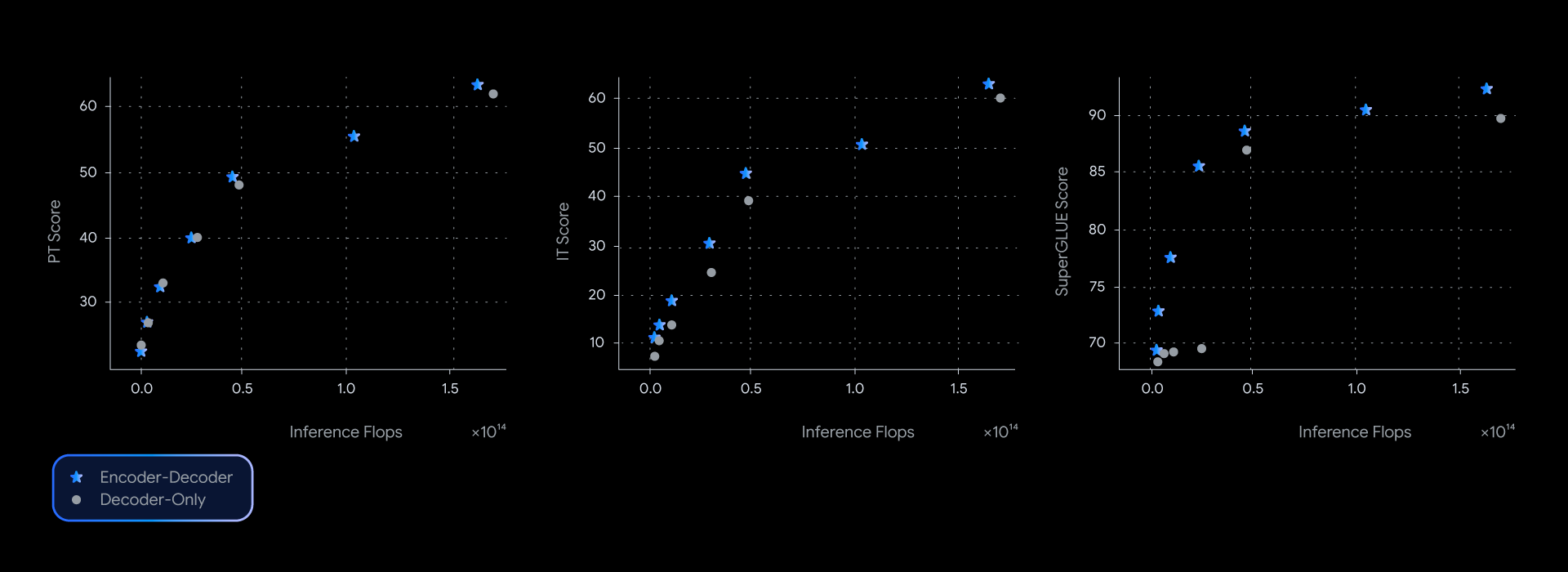
In our experiments, T5Gemma models achieve comparable or better performance than their decoder-only Gemma counterparts, nearly dominating the quality-inference efficiency pareto frontier across several benchmarks, such as SuperGLUE which measures the quality of the learned representation.
Encoder-decoder models benchmarks

Encoder-decoder models consistently offer better performance for a given level of inference compute, leading the quality-efficiency frontier across a range of benchmarks.

This performance advantage isn't just theoretical; it translates to real-world quality and speed too. When measuring the actual latency for GSM8K (math reasoning), T5Gemma provided a clear win. For example, T5Gemma 9B-9B achieves higher accuracy than Gemma 2 9B but with a similar latency. Even more impressively, T5Gemma 9B-2B delivers a significant accuracy boost over the 2B-2B model, yet its latency is nearly identical to the much smaller Gemma 2 2B model. Ultimately, these experiments showcase that encoder-decoder adaptation offers a flexible, powerful way to balance across quality and inference speed.


Unlocking foundational and fine-tuned capabilities

Could encoder-decoder LLMs have similar capabilities to decoder-only models?

Yes, T5Gemma shows promising capabilities both before and after instruction tuning.

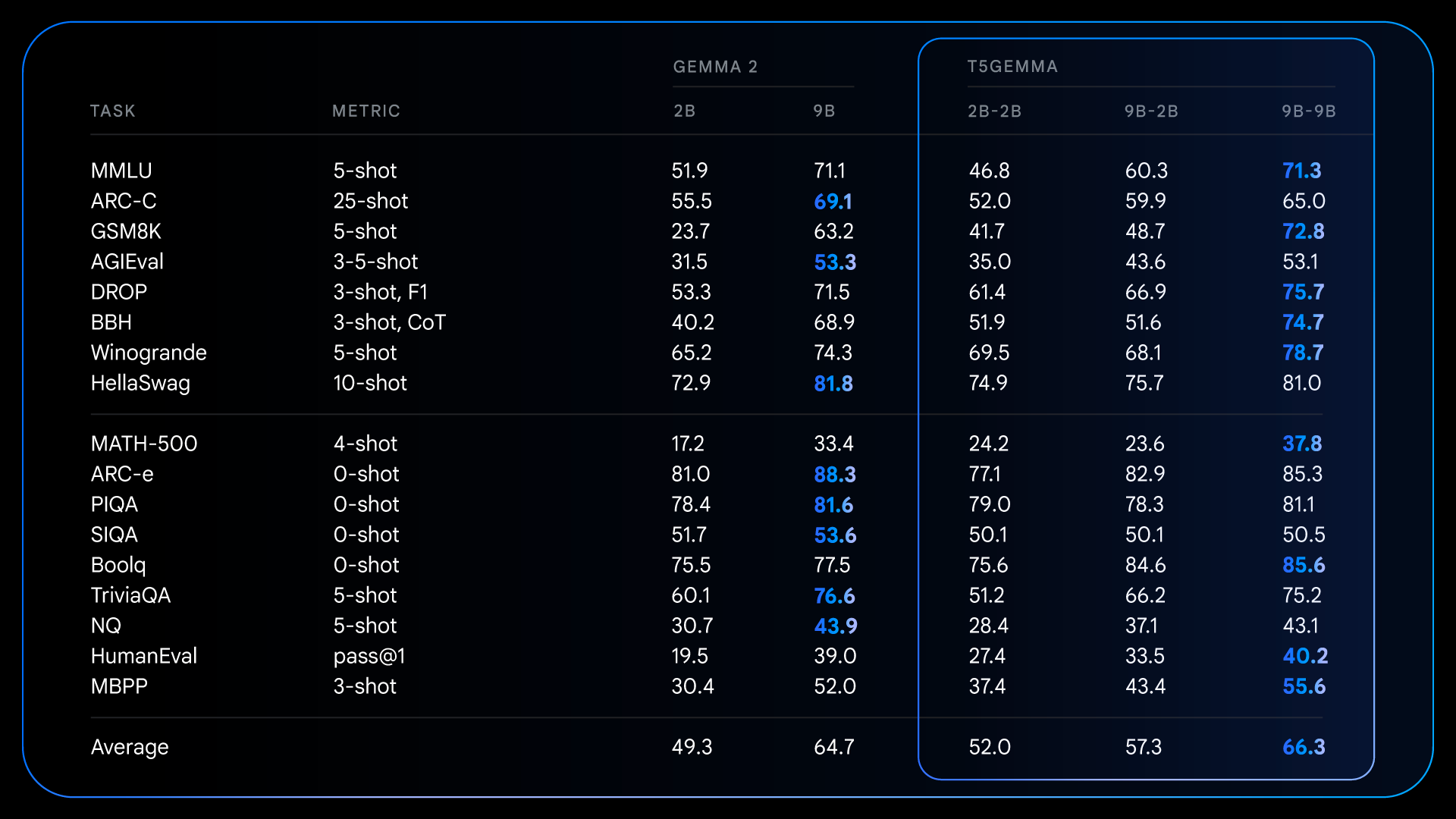
After pre-training, T5Gemma achieves impressive gains on complex tasks that require reasoning. For instance, T5Gemma 9B-9B scores over 9 points higher on GSM8K (math reasoning) and 4 points higher on DROP (reading comprehension) than the original Gemma 2 9B model. This pattern demonstrates that the encoder-decoder architecture, when initialized via adaptation, has the potential to create a more capable, performant foundational model.
Detailed results for pretrained models

Detailed results for pretrained models, illustrating how adapted models have significant gains on several reasoning-intensive benchmarks compared to decoder-only Gemma 2.

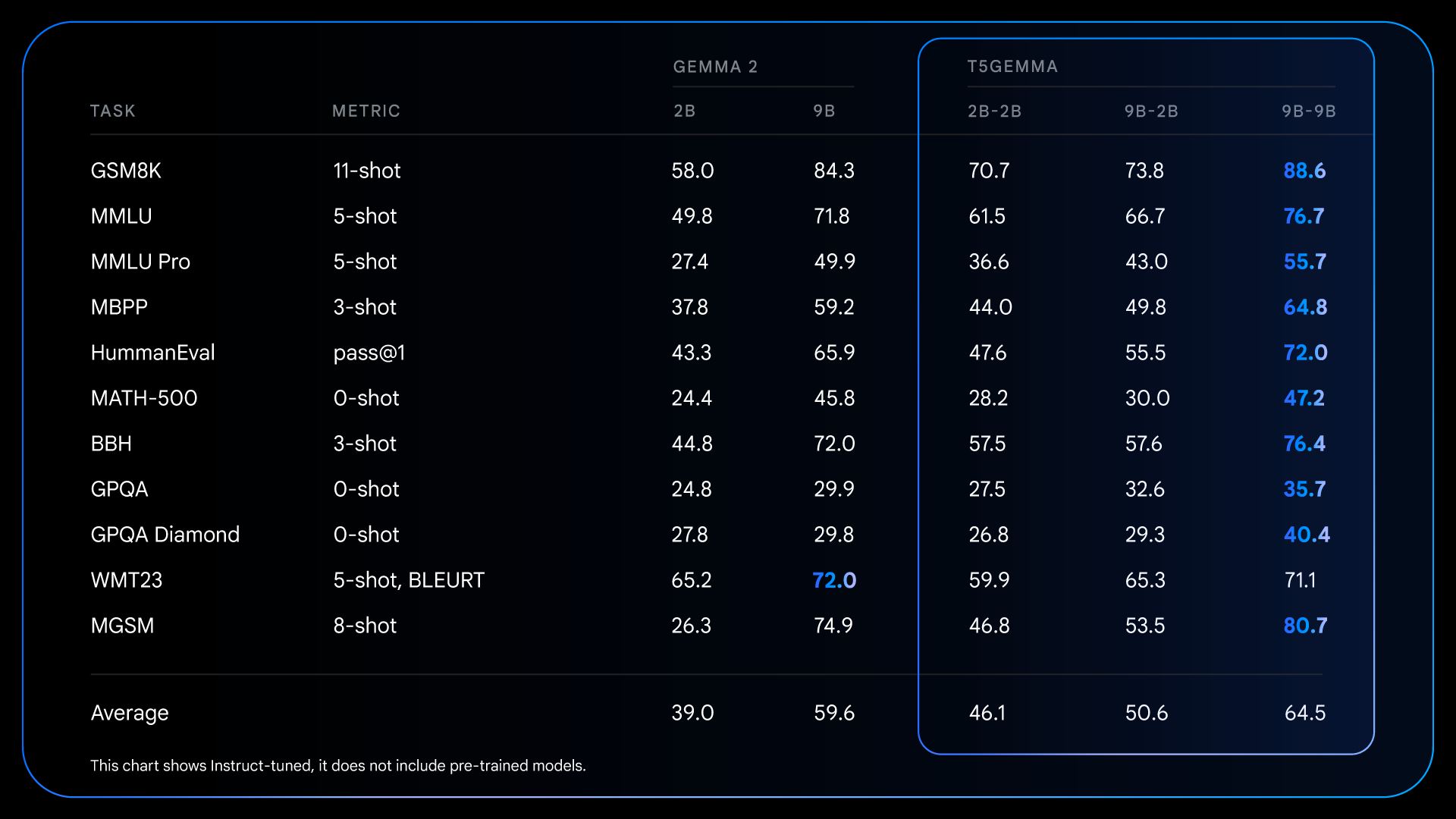
These foundational improvements from pre-training set the stage for even more dramatic gains after instruction tuning. For example, comparing Gemma 2 IT to T5Gemma IT, the performance gap widens significantly across the board. T5Gemma 2B-2B IT sees its MMLU score jump by nearly 12 points over the Gemma 2 2B, and its GSM8K score increases from 58.0% to 70.7%. The adapted architecture not only potentially provides a better starting point but also responds more effectively to instruction-tuning, ultimately leading to a substantially more capable and helpful final model.
Results for fine-tuned + RLHFed models

Detailed results for fine-tuned + RLHFed models, illustrating the capabilities of post-training to significantly amplify the performance advantages of the encoder-decoder architecture.

Explore our models: Releasing T5Gemma checkpoints

We’re very excited to present this new method of building powerful, general purpose encoder-decoder models by adapting from pretrained decoder-only LLMs like Gemma 2. To help accelerate further research and allow the community to build on this work, we are excited to release a suite of our T5Gemma checkpoints.

The release includes:

  • Multiple Sizes: Checkpoints for T5-sized models (Small, Base, Large, and XL), the Gemma 2-based models (2B and 9B), as well as an additional model in between T5 Large and T5 XL.
  • Multiple Variants: Pretrained and instruction-tuned models.
  • Flexible Configurations: A powerful and efficient unbalanced 9B-2B checkpoint to explore the trade-offs between encoder and decoder size.
  • Different Training Objectives: Models trained with either PrefixLM or UL2 objectives to provide either state-of-the-art generative performance or representation quality.


We hope these checkpoints will provide a valuable resource for investigating model architecture, efficiency, and performance.


Getting started with T5Gemma

We can't wait to see what you build with T5Gemma. Please see the following links for more information:

  • Learn about the research behind this project by reading the paper.
  • Explore the models capabilities or fine-tune them for your own use cases with the Colab notebook.