
惯性聚合 高效追踪和阅读你感兴趣的博客、新闻、科技资讯
阅读原文 在惯性聚合中打开

推荐订阅源

B
Blog
Microsoft Security Blog
Jina AI
Jina AI
博客园 - 叶小钗
J
Java Code Geeks
博客园 - 聂微东
博客园 - 司徒正美
大猫的无限游戏
大猫的无限游戏
阮一峰的网络日志
阮一峰的网络日志
V
V2EX
美团技术团队
WordPress大学
WordPress大学
M
MIT News - Artificial intelligence
雷峰网
雷峰网
酷 壳 – CoolShell
酷 壳 – CoolShell
GbyAI
GbyAI
罗磊的独立博客
T
The Blog of Author Tim Ferriss
aimingoo的专栏
aimingoo的专栏
T
Tailwind CSS Blog
The Cloudflare Blog
Stack Overflow Blog
Stack Overflow Blog
N
Netflix TechBlog - Medium
小众软件
小众软件

Robotics - South China Morning Post

New Chinese police tech uses AI to scan suspects’ health and mental states From dance to factory floor: China moves to fast track humanoids into industry China’s EV giants challenge Tesla in race to commercialise humanoid robots Indonesian police in the market for hi-tech Chinese equipment Chinese researchers tackle AI training bottleneck for household robots US public cheers dancing Unitree robots while Congress looks to ban them China just beat Nvidia on a global robotics ranking. Is a new tech war brewing? Opinion | How foreign investors should view China’s ‘little giants’ scheme Unitree clears Shanghai IPO hurdle as China’s humanoid robot wave gathers pace World of humanoid robots set for new blueprint as Nvidia teams with Asian firms ‘Arms race’: why investors can’t let go of robotic hand developers in China Alibaba, Tencent lead pivot from chatbots to embodied AI for robotics Unitree’s IPO progress spurs stock buying of firms with exposure to robot maker As China’s humanoid-robot hype cools, Unitree sees profit plunge ‘Sharif speed’ meets Qwen AI: how Alibaba sealed a sweeping deal with Pakistan Every humanoid robot in China set to receive personal identification number Ancient Chinese texts show ‘immortal mirror’ linking to early notion of robots Inside the Chinese auto-glass maker whose chairman sat beside Elon Musk Why Singapore wants to become the world’s ‘living lab’ for physical AI China unveils first humanoid robot for household chores, ready as early as 2027 Chinese firm Xpeng builds driverless cabs, challenging Tesla’s FSD software Editorial | China’s AI-enabled robots set to transform global playing field Unitree debuts US$574,000 ‘mecha’ robot that ‘transforms’ from 2 legs to 4 Robots to the rescue? South Korea looks for solutions to falling army numbers China robotics to drive next chapter of manufacturing dominance: Morgan Stanley Baggage bots: Chinese humanoids clock on at Japanese airports amid labour crunch Hype or real: China’s robot boom faces reality check as commercialisation lags China’s robots step into real-world roles, from cleaning to directing traffic Exiting China market a ‘self-inflicted wound’ for US tech, think tank warns Quirky China: robot ‘dies’ for pesticide warnings; bot hugs girl, in-car toilet approved
China’s robot rush: Morgan Stanley raises 2026 forecast t...
Richard Chen · 2026-06-24 · via Robotics - South China Morning Post

Morgan Stanley has again raised its forecast for China’s humanoid robot shipments this year, lifting its estimate to 50,000 units from 28,000 as commercial validation, policy support and supply-chain momentum accelerate adoption.

The investment bank had already doubled its projection to 28,000 units in January. In a report published on Tuesday, it said the latest upgrade reflected a growing number of Chinese companies, including electric-vehicle maker Xpeng, announcing plans for mass production by the end of the year.

The bank raised its forecast for annual humanoid robot shipments in China in 2030 to 446,000 units from 262,000 previously.

Full-sized humanoids were expected to become the dominant segment of the market, with their share rising from 30 per cent this year to 50 per cent in 2027, and 70 per cent in 2028, according to the report.
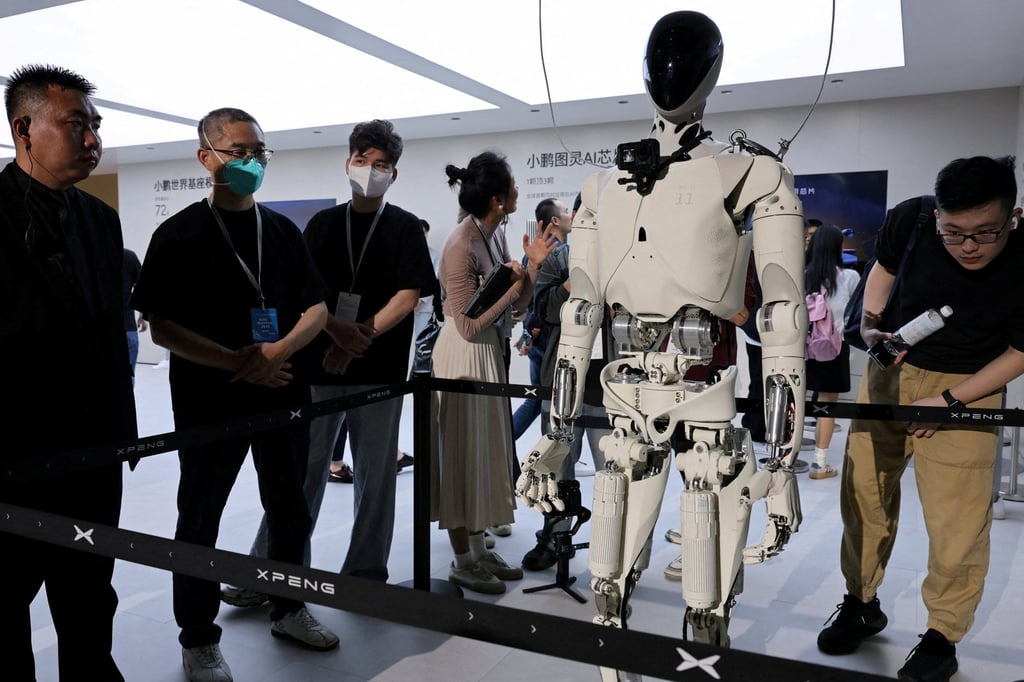
Xpeng’s humanoid robot Iron is displayed during the Auto Shanghai show in Shanghai. The company plans to begin mass production of the model by the end of 2026. Photo: Reuters

Xpeng’s humanoid robot Iron is displayed during the Auto Shanghai show in Shanghai. The company plans to begin mass production of the model by the end of 2026. Photo: Reuters

The bank attributed China’s progress to intensifying competition among domestic humanoid robot developers and strong national policy support. Chinese companies, it said, were leveraging large-scale deployments to generate the data needed to improve robot performance and accelerate commercialisation.

Beijing recently launched a nationwide training programme aimed at expanding robots’ ability to handle real-world tasks, shifting the focus from staged demonstrations to practical deployment in factories, warehouses and hospitals.