
惯性聚合 高效追踪和阅读你感兴趣的博客、新闻、科技资讯
阅读原文 在惯性聚合中打开

推荐订阅源

D
Docker
I
InfoQ
L
LangChain Blog
阮一峰的网络日志
阮一峰的网络日志
Y
Y Combinator Blog
博客园_首页
Martin Fowler
Martin Fowler
宝玉的分享
宝玉的分享
A
About on SuperTechFans
Apple Machine Learning Research
Vercel News
Vercel News
T
The Blog of Author Tim Ferriss
C
Check Point Blog
B
Blog RSS Feed
Cyber Security Advisories - MS-ISAC
Engineering at Meta
Engineering at Meta
B
Blog
爱范儿
爱范儿
Stack Overflow Blog
Stack Overflow Blog
aimingoo的专栏
aimingoo的专栏
WordPress大学
WordPress大学
F
Fortinet All Blogs
月光博客
月光博客
GbyAI
GbyAI

Coco Feng - South China Morning Post

Shein clears Hong Kong IPO hurdle as valuation halves to below US$50b: sources Chinese state-owned firms set up chip funds for long-term innovation Breaking | Shein receives approval for Hong Kong IPO from Chinese regulators Game-changer? Why China is finally letting its AI firms buy the Nvidia H200 Why Alibaba shares just scored their strongest gains in Hong Kong this year China records most new unicorn start-ups in 5 years as AI and robotics boom Final insurance frontier: Hong Kong sees opening in mainland China’s space boom How a Chinese physical AI start-up’s new paradigm bypasses US road maps Dishing the dirt: official media alleges smear tactics in delivery battle Zhipu AI market cap tops HK$1 trillion after GLM-5.2 release Chinese AI improves forecasts as Hong Kong braces for super typhoons Alibaba and JD.com targeted in smear campaign ahead of shopping festival Who pays when rockets explode? China rushes to insure SpaceX’s rivals Microsoft cuts hundreds of mainland cloud jobs, as China, US tighten data laws Huawei chips refine DeepSeek model in leap for China’s AI self-reliance Part boat, part plane, part sci-fi: China debuts consumer watercraft China just beat Nvidia on a global robotics ranking. Is a new tech war brewing? Want to save the planet? Stop being so polite to AI chatbots Alibaba elevates tech chief Wu Zeming to elite committee amid AI push Mainland Chinese locked out of Computex Taipei amid cross-strait tensions ‘Arms race’: why investors can’t let go of robotic hand developers in China Kuaishou beats estimates as Kling AI video tool’s revenue jumps 300% Huawei’s workaround for US chip curbs faces hurdles on road to self-reliance China told the solar industry to cut capacity. Firms built new factories anyway China unveils first humanoid robot for household chores, ready as early as 2027 China’s Moonshot AI moves to unwind offshore structure in IPO pursuit: sources Trump, Xi weigh AI ‘guard rails’ as Nvidia chip exports hang in the balance Alibaba shares surge 7% in Hong Kong as firm accelerates pivot to AI Why are Chinese stock markets hitting record highs ahead of Trump’s visit? Nvidia’s Jensen Huang joins Trump’s trip to China at last minute
Taiwan pushes back on Washington’s aggressive chip reloca...
Ann Cao,Coco Feng · 2026-02-10 · via Coco Feng - South China Morning Post

Taiwan’s move to defend its “silicon shield” is the latest sign of the island’s tech dominance being used as a bargaining chip in trade negotiations, as it faces increased geopolitical pressure to shift semiconductor manufacturing capacity overseas, according to analysts.

It would be “impossible” to move 40 per cent of the island’s semiconductor capacity to the US, Taiwan officials have told the US, according to Taiwan vice-premier Cheng Li-chiun in an interview with local broadcaster Chinese Television System, which aired on Sunday.

Cheng’s remarks signalled a willingness to hold onto Taiwan’s most vital economic asset, as the US request could hollow out its prized semiconductor sector, comprising some of the world’s most advanced chipmakers such as Taiwan Semiconductor Manufacturing Co (TSMC), according to analysts.

“Forcing nearly 40 per cent of capacity to the US would trigger a severe risk of ecosystem disruption”, said Arisa Liu, chief director and research fellow at Taiwan Industry Economics Services, a unit of the Taiwan Institute of Economic Research.

It would not only cause production costs to increase exponentially due to the fragmentation of the supply chain, but also lead to low utilisation rates for expensive advanced manufacturing equipment due to the lack of mid- to high-level skilled workers in the US, Liu said.
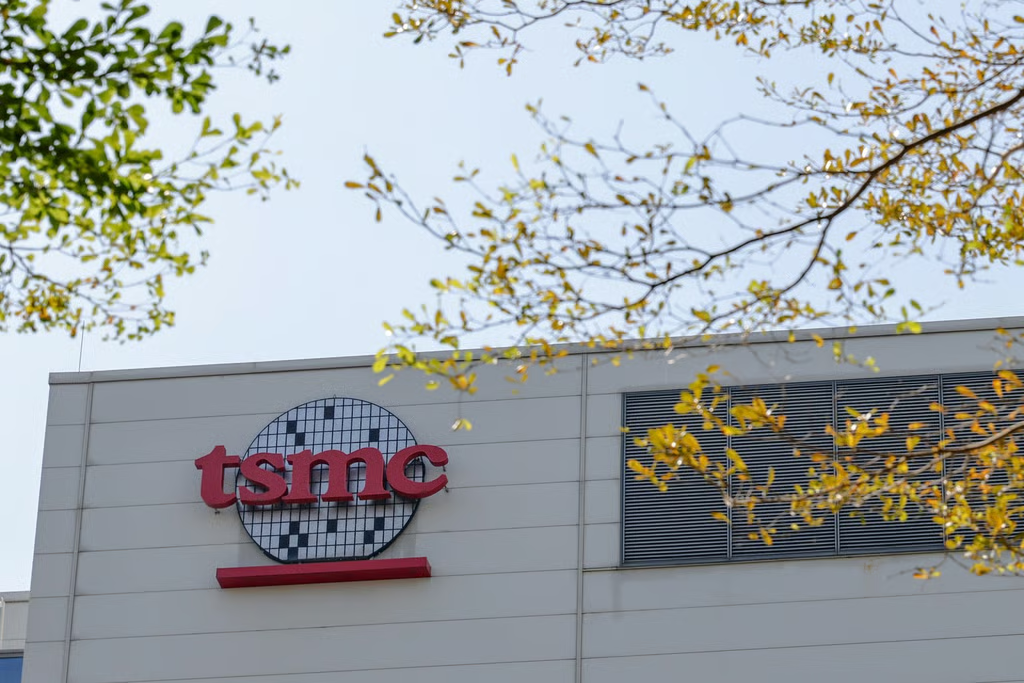
The Taiwanese foundry giant reported a 37 per cent year-on-year revenue surge in January to NT$401.3 billion (US$12.7 billion). Photo: EPA

The Taiwanese foundry giant reported a 37 per cent year-on-year revenue surge in January to NT$401.3 billion (US$12.7 billion). Photo: EPA

Cheng’s comments marked a pushback against recent statements by US Commerce Secretary Howard Lutnick, who called for a major production shift from Taiwan when the two sides reached a trade agreement last month.