


Just before the outbreak of the First World War, one visionary Japanese naval officer proposed plans for what could have been the largest warship ever built. Called the Zipang, this mega ship would have weighed in at an incredible 500,000 tonnes, dwarfing anything afloat then or since.
Since you’ve likely never heard of it, it should come as no surprise that the idea was quickly abandoned. But the concept was both entertaining and fascinating.
Read on to find out more about this mega-battleship that never was.
The brainchild of one Lieutenant Commander Hidetaro Kaneda, the IJN Zipang goes down in history as one of the most ambitious ships ever conceived. Half a million tonnes in displacement, the ship would have had the effective firepower of an entire fleet in one ship.
For reference, at the time, the average battleship weighed between 25,000 and 30,000 tonnes. It also would have dwarfed Japan’s famed super-battleships, the Yamato-class, which weighed in at 72,000 tonnes.
Given that, the Zipang would have been around 7 times larger (in terms of weight) than the Yamato. If ever built, it would also have predated the Yamato by several decades.
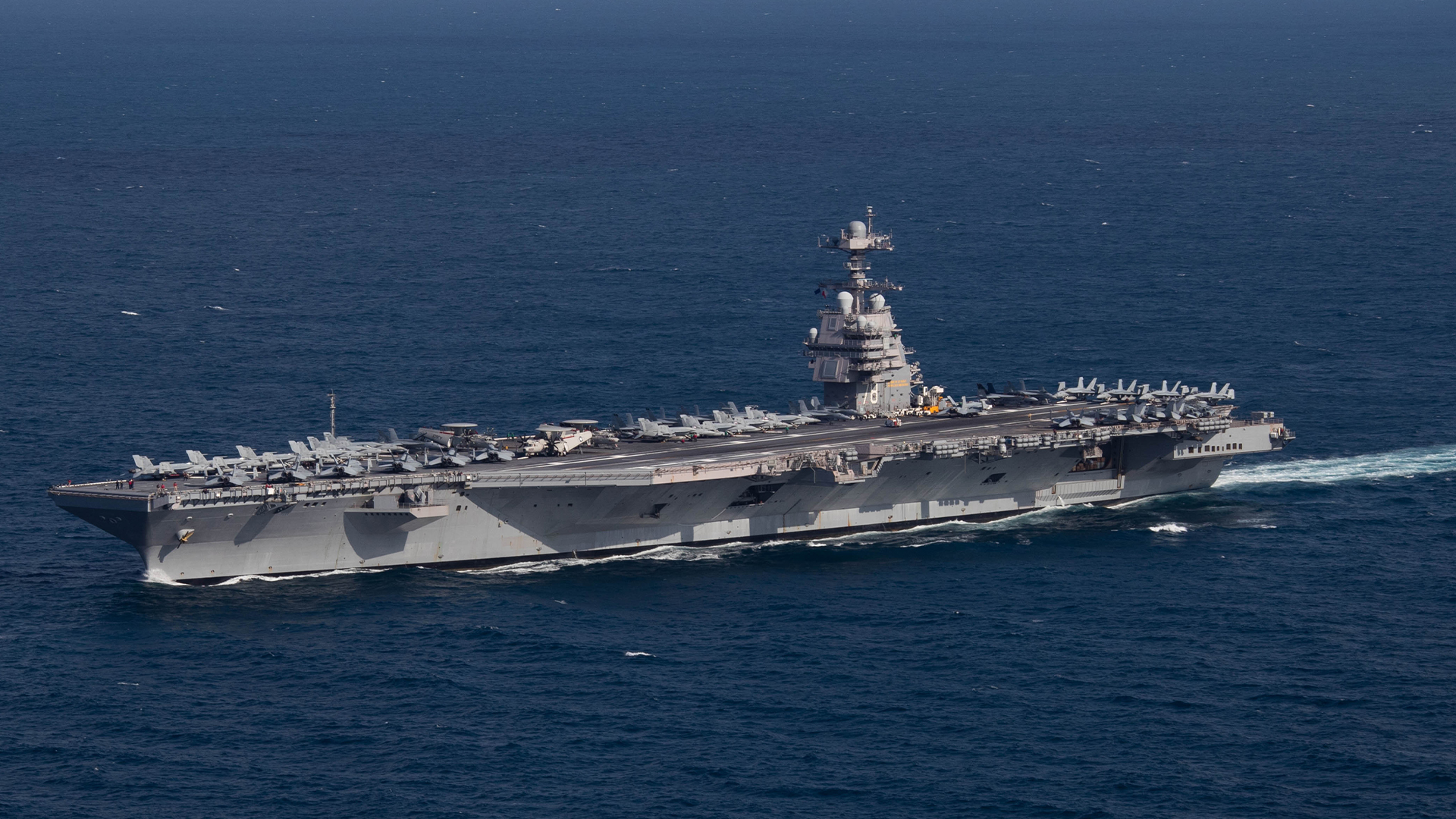
Envisaged with a beam (width) of 295 feet (90 meters), the ship would have been over 2,000 feet (609 meters) long. To put that into perspective, the largest warship ever built, the USS Gerald R. Ford, measures in at a paltry 1,122 feet (342 meters) in length.
These dimensions were not arbitrary; however, Kaneda argued that the beam was necessary to remain stable in the Pacific Ocean.
295 feet just so happens to be the average wavelength of waves in that part of the world. But its size is just the start of the story. A hull of this size would, in theory, enable the Zipang to mount well over 100 heavy guns. Potentially as large a caliber as 20 inches (51 cm).
The ship was also envisaged to be very nimble, with a potential top speed of 42 knots; an ambitious design indeed.
Japan wasn’t the only nation dreaming up goliath-scale warships, either. Famously, the United Kingdom had ambitions for a very large aircraft carrier called HMS Habakkuk.
Planned to be around 1,969 feet (600 meters) long, this ginormous vessel would have been made of a mixture of wood pulp and ice (called pykrete). Ultimately scrapped, the idea was to make it an unsinkable ship to counter German U-boats in the mid-Atlantic theatre.
But why did such a colossal vessel never get past the drawing board?

The first thing to note is that IJN Zipang was never a serious proposal by Kaneda, but rather more of a through experiment. He mused that Japan might want to focus its limited resources on fewer, larger, more powerful ships rather than many smaller, weaker ones.
The IJN Zipang is, in this sense, the ultimate conclusion of this line of thought. While this might sound mad to us today, you need to put yourself into the mindset of naval designers of the time, too.
Before the dominance of aircraft carriers, dreadnoughts (later battleships) were the centerpiece of any serious navy. Sporting massive guns and thick armor, whoever had the biggest had, in theory, the most control of the seas.
Drop in the fact that Japan’s navy had learned some very hard lessons from the Russo-Japanese War on the potency of dreadnoughts, and things start to fall into place (at least conceptually).
Japan has always struggled to source natural resources like steel and oil, and (at the time, at least) was not a major industrial power. And so, Japan could never really match other major powers in terms of numbers.
So, Kaneda believed, it might be best if “we (Japan) can’t outbuild them, outgun them with one monster.” But could Japan have ever made this a reality?
In short, no. At the time, Japan lacked both the resources and the physical ability to handle a project of this scale.
In 1912, the nation had barely enough shipyards to handle the construction of its own dreadnoughts, let alone a behemoth like the Zipang. Its largest warship at the time, the Kongo, had to be outsourced to British shipyards, for example.
A 500,000-ton monster of this kind would require the largest dry docks the world had ever seen at the time. It would have also required equally enormous cranes, steel production capacity, and transport systems to manage.
And that is just to build the hull. For the ship to actually move, it would have needed enormous steam turbines far beyond even the largest built at the time.
Fuel consumption for such a vessel would also likely have bankrupted the Japanese Navy. And even if they could have pulled it off, it is debatable whether such a ship would have been useful in battle anyway.
In combat, it would likely have performed pretty poorly at sea, especially in terms of turning radius. The ship would also be near-impossible to hide, and would have been an ideal target for submarines.
Kaneda’s core concept that Japan should focus more on quality than overwhelming force would inspire the Yamato and Mushashi in the 1930s.
As its more famous descendant, the Yamato, would later find out, it would also have been incredibly vulnerable to aircraft attack. Interestingly, the Yamato’s designer, Yuzuru Hiraga, would later credit Kaneda for his ambitions, explaining he was on the right track, just the scale was a little off.
And that is your lot for today.
While the IJN Zipang would ultimately never be approved, she wasn’t as insane a concept as she might seem at first sight. When put into the perspective of naval strategic thinking of the day, the idea of one-ship-to-rule-them-all suddenly makes sense.
However, as naval history has since shown, investing in a more balanced force rather than betting everything on superweapons has proven to be a better idea.
In terms of size, Kaneda’s dream would later be met, only for commerce, not war. Fittingly built in Japan, the 500,000-ton+ (when fully laden) supertanker Seawise Giant would set sail in 1979.
此内容由惯性聚合(RSS阅读器)自动聚合整理,仅供阅读参考。 原文来自 — 版权归原作者所有。