


The team developed a chemical-hardness strategy to control crystal growth.

Chinese scientists have pushed perovskite tandem solar cells past the critical 30 percent efficiency mark after developing a new way to control how the materials crystallize during manufacturing.
The research team was led by Ge Ziyi, PhD, and Liu Chang, PhD, from the Ningbo Institute of Materials Technology and Engineering (NIMTE), under the Chinese Academy of Sciences (CAS). The team hit a certified power conversion efficiency of 30.3 percent in rigid all-perovskite tandem solar cells, and 28 percent in flexible versions.
They believe that the achievement can speed up the development of lightweight, high-efficiency solar technologies that are far cheaper and easier to manufacture than traditional silicon-based panels.
“The findings provide a pathway to simultaneously improve efficiency and durability in both rigid and flexible devices, thereby advancing the development of lightweight, scalable photovoltaic technologies,” the scientists pointed out.
Better solar cells
All-perovskite tandem solar cells are considered among the most promising PV (photovoltaic) technologies, because they can harvest sunlight more efficiently than conventional single-junction solar cells. They can also be produced using low-temperature solution processing, potentially reducing manufacturing costs.
However, asynchronous crystallization remains one of the biggest challenges in multicomponent perovskite films. During production, different parts of the films often crystallize at different rates, creating structural defects and compositional inconsistencies that reduce efficiency and long-term stability.
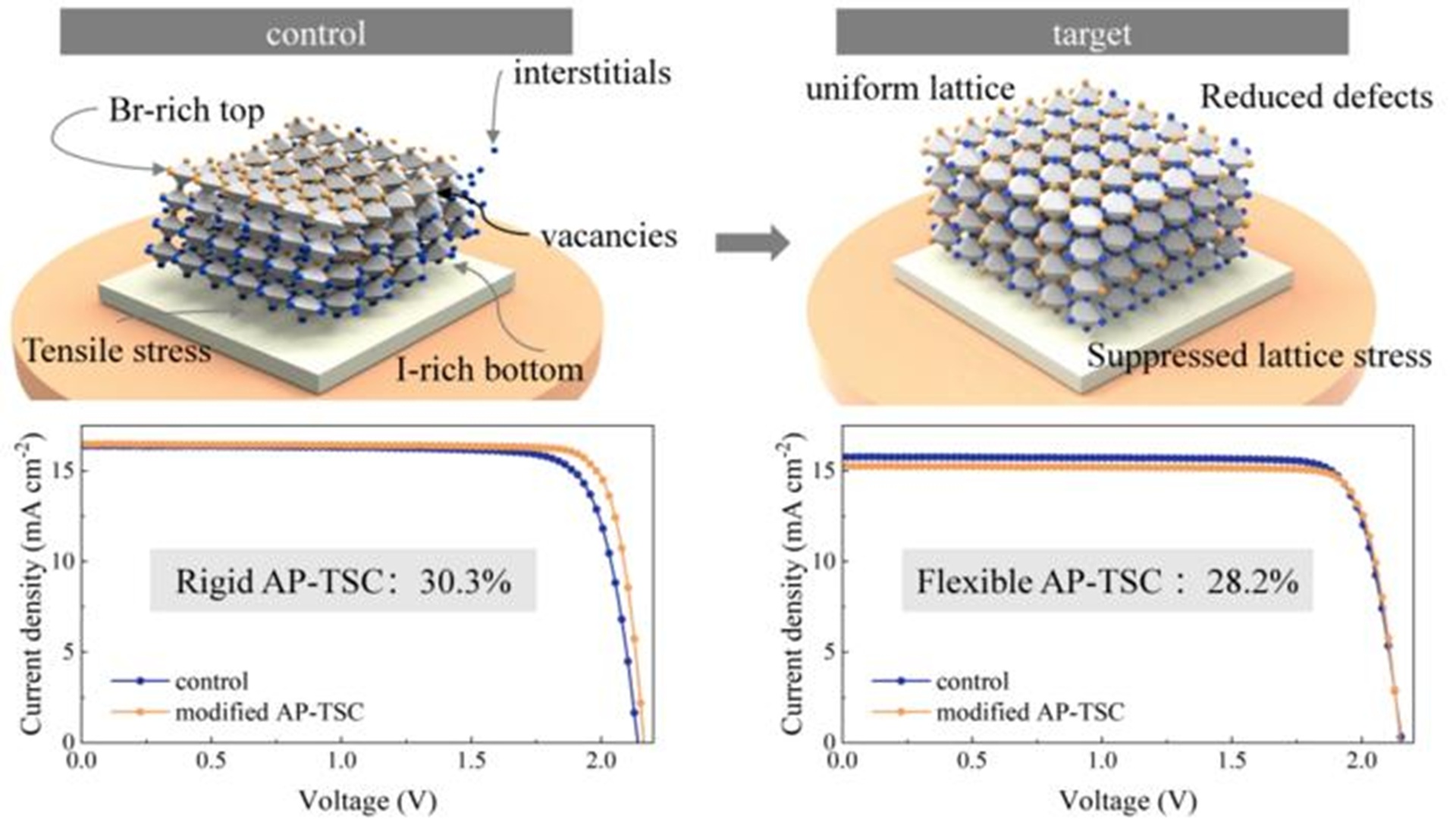
Image credit: NIMTE
To address the issue, the team created an additive design strategy based on hard-soft acid-base (HSAB) theory, which predicts how acids and bases interact. They introduced carefully selected additives into both wide-bandgap and narrow-bandgap perovskite layers to synchronize nucleation and crystal growth.
This not only suppressed uneven vertical phase distribution but also improved film uniformity across the devices. The team used difluoro(oxalato)borate (DFOB⁻) additives for wide-bandgap perovskites and tetrafluoroborate (BF4⁻) for narrow-bandgap layers.
Structural and optical analyses showed that the method promoted homogeneous crystal growth and prevented halide redistribution. This commonly causes defects and stress accumulation inside the solar cells.
A stronger performance
The improvements also boosted the overall performance of the tandem devices. The efficiency of wide-bandgap perovskite solar cells increased from 18.5 to 20.1 percent, while narrow-bandgap devices improved from 21.6 to 23.3 percent.
What’s more, when integrated into monolithic two-terminal tandem architectures, the optimized rigid tandem device reached a peak efficiency of 30.3 percent, with an open-circuit voltage of 2.16 volts (V) and a fill factor of 85.2 percent. Moreover, the flexible tandem cells also delivered strong results. They achieved 28.2 percent efficiency, with a certified value of 28.0 percent.
The devices also featured strong operational stability. This is the most significant and high-stakes bottleneck for the commercial adoption of perovskite solar cells (PSCs).
The optimized rigid device retained 92 percent of its initial efficiency after 1,000 hours of maximum power point tracking. At the same time, the flexible tandems maintained 95.2 percent of their original efficiency after 10,000 bending cycles.
The result highlighted their potential for wearable electronics, lightweight power systems, and flexible solar applications. “This study establishes a general chemical principle for regulating crystallization in compositionally complex perovskite systems,” the researcher concluded in a press release.
The study has been published in the journal Nature Nanotechnology.

Get the latest in engineering, tech, space & science - delivered daily to your inbox.
Based in Skopje, North Macedonia. Her work has appeared in Daily Mail, Mirror, Daily Star, Yahoo, NationalWorld, Newsweek, Press Gazette and others. She covers stories on batteries, wind energy, sustainable shipping and new discoveries. When she's not chasing the next big science story, she's traveling, exploring new cultures, or enjoying good food with even better wine.