








As armies look for ways to keep soldiers under armor while maintaining constant awareness of the battlefield, Teledyne FLIR Defense has introduced a micro-drone system designed to do both.
Unveiled at the Eurosatory defense exhibition in Paris, the Black Recon system enables troops to send out small reconnaissance drones from military vehicles and fixed installations while remaining under protection. The same platform retrieves the aircraft after each mission and prepares them for their next deployment.
The launch reflects a broader shift in military technology. Armed forces increasingly want autonomous systems that can shorten decision cycles, extend reconnaissance beyond line of sight, and continue operating in electronic warfare environments where GPS signals and communications links face disruption.
At the center of Black Recon is a docking station that houses and supports up to three micro-unmanned aircraft. Rather than relying on a single drone and human operators in the field, the system cycles aircraft through missions. One drone can conduct reconnaissance while another recharges, creating what Teledyne describes as near-continuous intelligence, surveillance and reconnaissance coverage.
Each aircraft launches autonomously, carries out reconnaissance and target acquisition tasks, then returns to the vehicle or installation for capture and recharging before the next sortie begins. The approach could prove particularly valuable for mechanized units operating in contested environments where even brief exposure outside a vehicle carries risk.
“Black Recon represents a major step forward in integrated reconnaissance for ground forces,” said Dr. JihFen Lei, president of Teledyne Defense and Aerospace Group and senior vice president of Teledyne Technologies.
Lei said integrating launch, recovery, and recharging capabilities directly into military platforms gives operators persistent situational awareness while speeding access to intelligence and improving force protection during fast-moving operations.
The system was designed specifically for mounted operations instead of being repurposed from equipment meant for troops on foot. Teledyne said each drone weighs less than 450 grams and can stay aloft for about 50 to 60 minutes. The aircraft can also travel at speeds of up to 25 meters per second, extending surveillance beyond traditional engagement ranges.
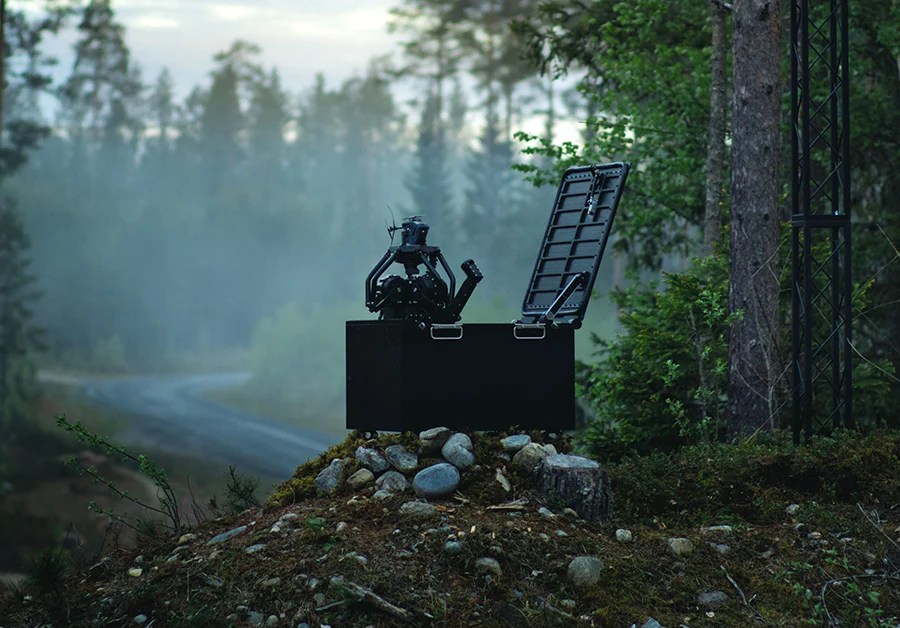
Black Recon also targets one of modern warfare’s growing challenges: operating in electronically contested environments. The company said the drones can continue missions in GPS-denied conditions using advanced sensors and visual navigation systems. Visual inertial navigation also enables radio-silent operations without depending entirely on traditional radio-frequency links.
Additional capabilities include onboard relay functions to extend communications coverage and compatibility with the Black Hornet 4 nano-drone, which is already in service with several military customers.
The company also said the system can support thermal and visible imaging payloads, providing troops with real-time imagery and targeting data during operations.
Although Teledyne developed Black Recon with military users in mind, the company said the technology could eventually support public safety missions, including border security, critical infrastructure monitoring and maritime patrol operations.
The platform’s modular design also leaves room for future payloads. Planned additions include chemical, biological, radiological, and nuclear detection sensors, as well as lethality modules that could expand the system’s role beyond surveillance.
Black Recon is available for order now, with customer deliveries expected to begin in 2027. The launch comes as defense companies race to develop autonomous systems capable of maintaining battlefield awareness while reducing the burden and risk placed on human operators.

Get the latest in engineering, tech, space & science - delivered daily to your inbox.
Aamir is a seasoned tech journalist with experience at Exhibit Magazine, Republic World, and PR Newswire. With a deep love for all things tech and science, he has spent years decoding the latest innovations and exploring how they shape industries, lifestyles, and the future of humanity.
此内容由惯性聚合(RSS阅读器)自动聚合整理,仅供阅读参考。 原文来自 — 版权归原作者所有。