

惯性聚合 高效追踪和阅读你感兴趣的博客、新闻、科技资讯
阅读原文 在惯性聚合中打开

推荐订阅源

MyScale Blog
MyScale Blog
J
Java Code Geeks
Vercel News
Vercel News
A
About on SuperTechFans
G
Google Developers Blog
C
Check Point Blog
腾讯CDC
N
Netflix TechBlog - Medium
博客园 - 司徒正美
S
SegmentFault 最新的问题
D
DataBreaches.Net
博客园_首页
美团技术团队
Stack Overflow Blog
Stack Overflow Blog
博客园 - 聂微东
量子位
雷峰网
雷峰网
IT之家
IT之家
小众软件
小众软件
Blog — PlanetScale
Blog — PlanetScale
博客园 - 三生石上(FineUI控件)
H
Help Net Security
宝玉的分享
宝玉的分享
博客园 - 叶小钗

All Articles on Seeking Alpha

All Eyes On Cencora, A Healthcare Supplier That Could See Lots More Upside Simply Good Foods Doesn't Look Like A Growth Stock Anymore Applied Digital: Post-Earnings Clarity Confirms An Accelerated Path To $1 Billion NOI Target IBIT: Why I Stepped To The Side (Technical Analysis) (Rating Downgrade) XES: Oil Service Stocks Turn Pricey; Why It's Time To Take Profits (Rating Downgrade) The Only Dividend Strategy I'd Trust In A 3.5% Fed Funds World Opera: AI-Driven Advertising Prospects - Upside Potential And Rich Dividend Yields RenaissanceRe: Preferred Stock Hasn't Been This Appealing In Years Q1 Earnings Kick Off With Major Banks' Results: Bank of America, Netflix In Focus Sezzle: Consolidation Completed, Re-Rating Ahead Bitmine Immersion Q2 Preview: Ethereum Thesis Facing Important Report Card I Am Sharing 2 Of My Retirement High-Yield Gems The Software Narrative Is Leaking Badly Again Thanks To Anthropic Mythos The Muni Market Looks Appealing In Q2 AVIV: Should Keep Rising If The Ceasefire Holds Foundayo Explained: Lilly's New Weight Loss Pill And The Amazon Effect Sabesp: A New Privatization As An Opportunity! EchoStar: Potential Bull Trap At Play - Take Gains Off The Table Teladoc Health: Improving Fundamentals Support A Turnaround Story March CPI Inflation: 5 Reasons To Stay Calm Two 12%+ Yielding BDC Bargains (One Is My Top Deep-Value Pick) TechnipFMC: We Prefer Saipem With More Room To Improve Tesla: From Bye-Bye To Buy-Buy (Rating Upgrade) DMB: Vulnerable To High Interest Rates Western Midstream: A 9% Yield That Still Grows In A Downturn IQQQ: Tax-Efficient Income From The Nasdaq But Does Not Protect Against Declines Qualys Share Price Pulled Down By Potential Cybersecurity Disruptor S&P 500: A Dead Money Era May Be Here. How To Thrive In It Vistance Networks Looks Better Than Before With Powerful Earnings Growth Commerce Bancshares: Valuation, Not Quality, Is The Problem
Q&A: What Backwardation In Oil Futures Reveals About Mark...
2026-05-16 · via All Articles on Seeking Alpha
Oil Pumps And Rig At Sunset By The Sea

imaginima/E+ via Getty Images

By OpenMarkets

Oil markets have been in focus since conflict began in the Middle East in late February, with prices at times surging past $100 per barrel. However, this time around, even as the effective closure of the Strait of Hormuz has removed a historically unprecedented share of global supply, prices have risen far less dramatically than past disruptions.

What explains this disconnect? And what does the move into backwardation – where prices for near-term delivery rise above prices for delivery further in the future – signal for investors navigating this volatile environment?

Erik Norland, CME Group's Chief Economist, sat down with OpenMarkets to discuss what 40 years of market data reveals about oil futures dynamics during periods of backwardation. This conversation has been edited for brevity.

Can you explain what the current backwardation in the WTI Crude Oil futures curve tells us about market expectations for supply and demand?

It suggests that investors expect things to return to normal. In the near term, the market is disrupted with reduced supply coming out of the Middle East, pushing near-term prices to around $100 per barrel. However, the market seems to expect prices could return to around $75 by year-end if conditions normalize. Keep in mind, these are just market expectations, and they’re constantly changing.

What historical trends or patterns have you observed in crude oil returns when the market structure is in contango compared to backwardation?

Since around 1985, a consistent pattern has emerged. When holding a long position during periods of contango, crude oil positions often (but not always) lose capital. By contrast, a long position in crude oil during periods of backwardation typically shows positive returns over time – though again, not always. There are always exceptions to every rule.

This pattern suggests that traders have historically underestimated the length of time markets remain oversupplied (in the case of contango) and undersupplied (in the case of backwardation).
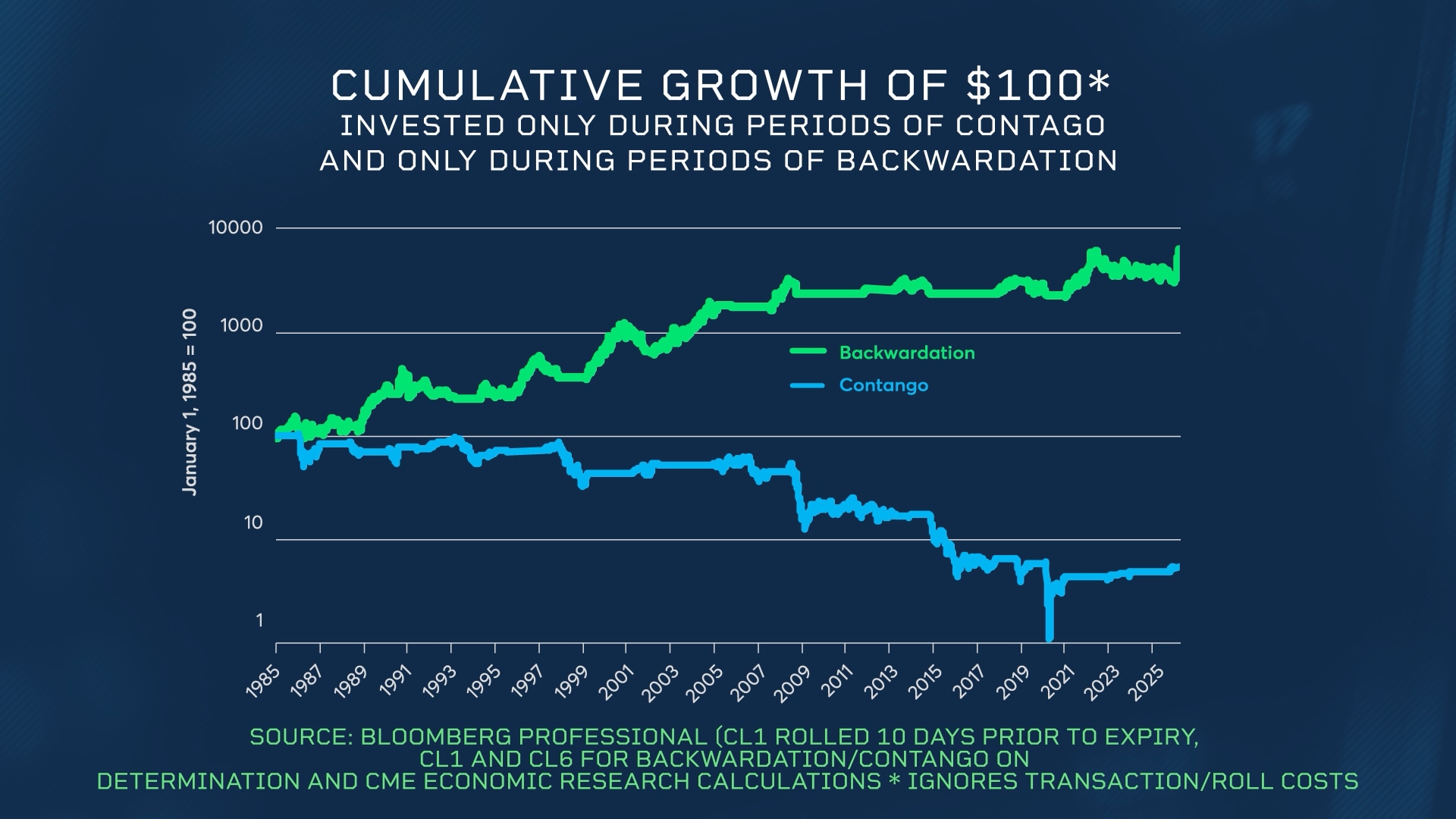
Cumulative growth contango vs backwardation

What role do interest rates play in contango and backwardation, especially in different rate environments?

Interest rates are rarely the main driver of backwardation or contango. The reason for that is that it costs money to store oil. There is also an interest rate cost-of-carry; storing physical oil requires both facility fees and the tying up of capital.

As interest rates rise, the opportunity cost of that capital increases, further incentivizing a contango structure. However, interest rates remain just one of many factors, alongside supply levels and geopolitical risks, which ultimately dictate the curve's shape.

How might the energy transition affect oil’s traditional market dynamics?

Oil producers often worry that higher oil prices could spark a renewed interest in the energy transition. With oil prices rising over the last couple of months, we have seen a renewed tendency on the part of consumers to buy electric vehicles and hybrids.

Original Post

Editor's Note: The summary bullets for this article were chosen by Seeking Alpha editors.