


Saudi billionaire Prince Alwaleed bin Talal has often been described as the “Warren Buffett of the Middle East.” He has picked winners — including Apple, Amazon, Citigroup, and Twitter — that cemented his status as one of the region’s most successful investors, and he’s touting SpaceX as his latest triumph.
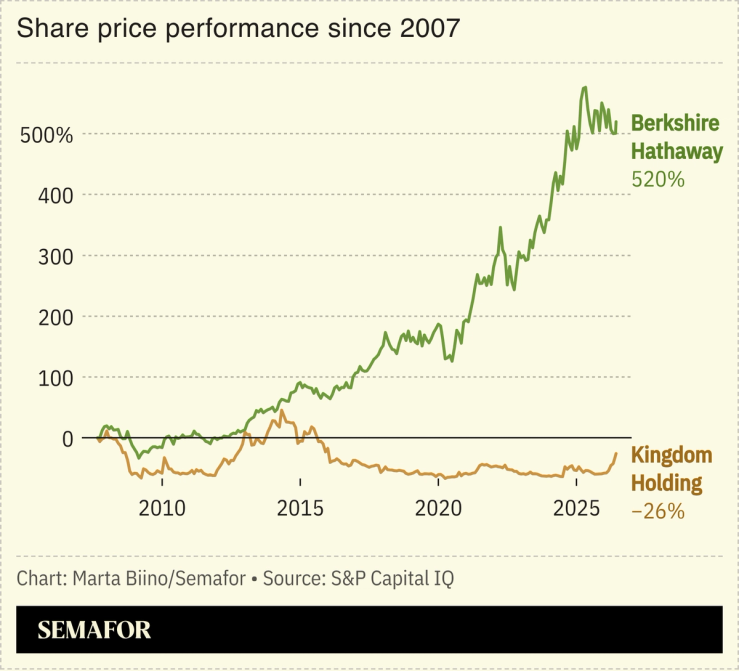
But the investors in his listed conglomerate that houses these stakes haven’t enjoyed Berkshire Hathaway-style returns. Kingdom Holding’s stock has barely moved from its 2007 IPO price, and the SpaceX IPO won’t provide the gains needed to catch up with the “Oracle of Omaha.”
Kingdom Holding has been riding a wave of excitement since late May, when a report from Asharq Business said the company and Alwaleed’s stake could be worth more than $10 billion if SpaceX IPOs at a $1.75 trillion valuation. Investors piled in. The share price hit its highest level in more than a decade. Then came the fine print.
On Thursday, Kingdom Holding clarified that its own stake — separate from its founder’s — would be worth 21.3 billion riyals ($5.67 billion) if SpaceX hit its target IPO value. Investors dumped the shares: The stock tumbled as much as 9% on Thursday, and the decline continued into this week.
Despite owning positions in some of the world’s top companies, Kingdom Holding hasn’t been able to convince investors that those assets can generate sustainable returns. That disconnect stems from an early stumble in the listed entity’s history.
Shortly after going public, the global financial crisis triggered a nearly 31 billion riyal quarterly loss, a blow from which it has never fully recovered. That wound has been kept open not just by bad timing, but by a business model that amplifies volatility without capturing enough of the upside.
Kingdom Holding’s portfolio reads like a prestige menu: Citigroup, Four Seasons, Lyft, media companies, and hospitality assets across four continents. It’s a diversified portfolio, but spreading assets across legacy financial institutions, mature hotel groups, and slow-moving consumer names hasn’t delivered the returns for which Alwaleed is best known.
Alwaleed took to social media to defend his record, framing his position in SpaceX as just the latest example of his ability to identify transformational investments early. He said Kingdom’s shares are currently trading below its net asset value (NAV) and should be more than double the price. But the market has never trusted that the gap can be bridged, and the stock has been languishing below NAV for much of its history.
To close that discount, the company needs more than a favorable IPO. It needs a model that moves capital faster, concentrates more aggressively on high-growth sectors — such as technology, AI infrastructure, clean energy, and Saudi-focused growth plays aligned with Vision 2030 — and is less attached to the kind of blue-chip equity collection that made sense in 1995 but has underperformed over the past decade.
Alwaleed’s defenders will note the wins: early stakes in Apple, Amazon, Twitter, and Lyft before their respective peaks, and now a $4.47 billion SpaceX position. They will argue that a holding company of this scale cannot — and should not — operate like a venture fund. Diversification, they will say, is prudence.
It may be a disciplined approach, but it’s also one that generated long-term returns that lagged a common savings account.
When SpaceX starts trading this week, Alwaleed will have every right to feel vindicated in his bet. But the real test is what Kingdom Holding does with that momentum. If it recycles SpaceX gains into another round of broad-based equity positions in established Western companies, the discount will persist. If it uses the IPO as a pivot to a more growth-oriented strategy that sheds the diversification drag, then the recent pressures on the stock might one day look like the bottom rather than the end of a rally.
Kingdom Holding has always been about Alwaleed’s vision. The question for the next 20 years is whether that vision updates itself.
Wael Mahdi is an independent commentator specializing in OPEC and Saudi Arabia’s economy, and co-author of “OPEC in a Shale Oil World: Where to Next?”
此内容由惯性聚合(RSS阅读器)自动聚合整理,仅供阅读参考。 原文来自 — 版权归原作者所有。