


Even before the bad economic news of the last few days — rising inflation, sour consumer confidence, and the biggest jump in gas prices in decades — Americans were in a bad mood about the economy, and incumbent politicians were trying to figure out how to talk about it.
Semafor is convening America’s largest gathering of CEOs and political leaders this week in Washington for Semafor World Economy to grapple with a central paradox: American politics are polarized and ruinous, and our economy is the envy and powerhouse of the world.
We are living through an inversion of the most basic question in American politics. In 1980, Ronald Reagan defined the basic test of late 20th-century politics. Voters, he said, should choose between candidates based on the question, “Are you better off than you were four years ago?”
Today, the predictive power of that question has flipped. The party you vote for is indicative of how you feel about the economy, rather than vice versa. Polling by Semafor’s partners at Gallup showed Republicans’ confidence in the US economy improving 65 points on a 200-point scale in the week after the 2016 election; Democrats’ outlook rose 81 points after Joe Biden’s inauguration in 2021; and the partisan pattern appeared again after the 2024 election.
Consumer confidence, meanwhile, seems to have lost its connection to underlying economic indicators since the COVID-19 pandemic:
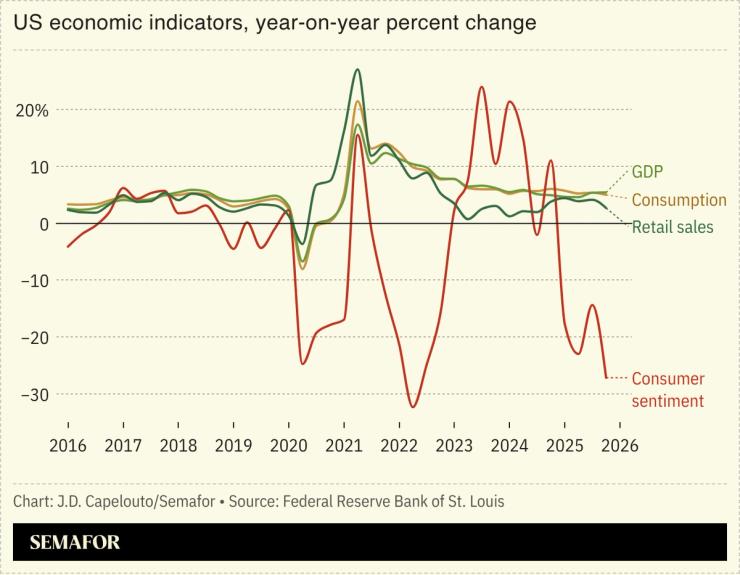
Through a turbulent decade of global politics, traditional, empirical economic measures have broadly failed to predict citizens’ feelings about wages, jobs, and well-being. And this is perhaps the most central fact of American presidential politics: Virtually all of the time, most Americans are mad at you about the economy and there’s little you can do about it. In particular, you are not permitted to confront them with numbers. Real wages are outpacing inflation? Eggs are still more expensive. The US is vastly outpacing China and Europe? Well, we live here. Silicon Valley is driving the global economy? Hate them anyway. And don’t even get started on trying to explain that inflation has actually driven real rents down. (This doesn’t mean you can’t make people madder, as President Donald Trump found when the Iran war drove gas prices up.)
We founded Semafor as a platform for understanding the radical changes in this new world economy, and the unsettled politics that follow it. At the heart of these changes, which policy analyst Gordon LaForge described recently as a “polyamorous” new order, is a power shift away from hobbled governments. In their place are coming private actors — primarily private companies, but also NGOs and other non-state actors — whose “wealth, reach and capabilities often surpass those of nation-states.” This contested intersection of public and private power has transformed Washington from an economic backwater into the center of the global economy, which makes it the right place for Semafor to host America’s biggest economic conversation. More than 500 global CEOs and dozens of top US and global economic officials will join us this week.
The conventions of American journalism don’t serve this shifting, multi-sided reality well. The most important stories sit in the empty space between the political and business sections of the newspaper. There are many more than two sides to them. And the dominant ideological silos that increasingly shape digital media exclude the perspectives of key players whose motives are a core part of any story.
Across Semafor’s digital surfaces — our email briefings, website, and audio and video products — and in our convenings, led by Semafor World Economy, we’re trying to illuminate these new networks and the ideas behind them. It’s why we structure our articles to include alternative points of view. It’s why we ask hard questions on stage and seek out divergent perspectives on the same issues, and why we try to create space on the page and in person for thoughtful disagreement. In this moment of radical, global transition, anyone who seems confident they know exactly what’s going on is selling you something.
此内容由惯性聚合(RSS阅读器)自动聚合整理,仅供阅读参考。 原文来自 — 版权归原作者所有。