


No matter what happens in the Strait of Hormuz, one legacy of the Iran war will have been to lay bare the dire need for energy-importing countries to build new buffers from volatile global markets. No country is better positioned than China to thrive in that environment. As the supplier of more than 70% of the world’s clean energy hardware, the leading “electro-state” will move quickly to capitalize — both financially and geopolitically — on surging interest from countries like Egypt in breaking their long-term dependency on fossil fuel supply lines that can be severed or experience turbocharged pricing with little notice, outside their control.
Dependence on Chinese supply chains comes with its own risks, and “the type of power that a country can exercise through its dominance in the production of renewable energy hardware is really untested,” said Ilaria Mazzocco, deputy director for Chinese business and economics at the Center for Strategic and International Studies in Washington, DC. Still, she said, “this isn’t going to work in the same way as oil and gas. Imagine China blocking solar panel exports — it just won’t have the same shock on energy markets” as closing the Strait of Hormuz.
Partnering with China on renewables can bring lower prices, better customer service, and investments in local factories. Beijing and Cairo are “fully aligned about what’s really needed to upgrade the sector here in Egypt,” said Diaa Elsherbiny, an energy policy official in the Dutch embassy in Cairo with extensive experience in Egypt’s renewables sector. And when it comes to investment incentives, ranging from tax breaks to cheap land, he said, “everything is on the table.”
When Infinity Power began planning its first from-scratch wind farm in Egypt — it acquired an already-built one down the road in 2023 — it looked at bids from a range of European and Chinese suppliers, the company’s co-founder and chairman Mohamed Ismail Mansour said in an interview from his 15th-floor Cairo office with sweeping views of the Nile. While the Europeans’ offers — including Vestas, Siemens, and others — ranged from about $980,000 to $1.2 million per megawatt, the Chinese manufacturer Goldwind was able to offer a similar product for less than $800,000, Mansour said.
“That basically killed any argument,” he said, even though Infinity Power’s backers at the European Bank for Reconstruction and Development had pushed for European suppliers. “The quality is great, the service is good. It’s a no-brainer.”
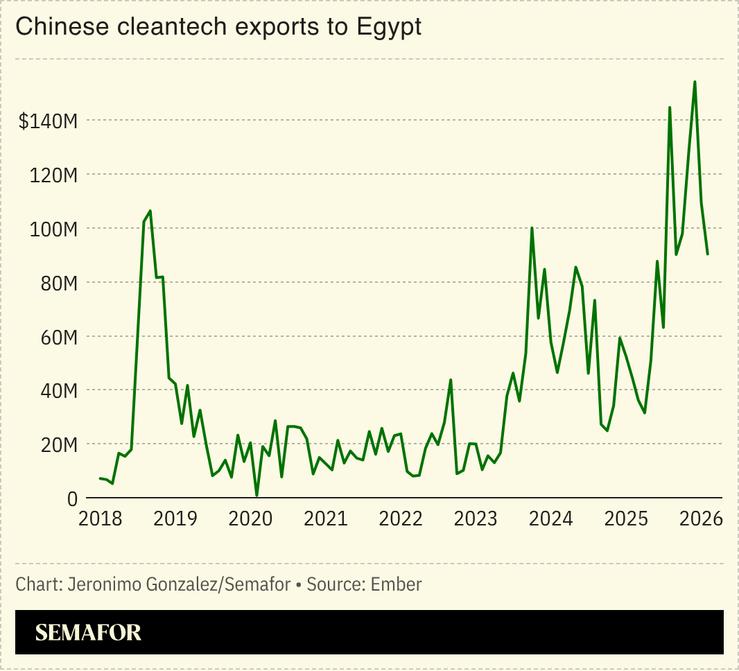
For China, the partnership comes at an opportune moment. Clean energy projects produce roughly one-tenth of China’s GDP. But the domestic renewables market is “getting tougher and tougher” because of cutthroat competition and vanishing government subsidies, said Qu Jinwei, the top executive in Egypt for PowerChina. The Beijing-based engineering, procurement, and construction company with 130,000 employees building renewable and hydro energy projects in more than 100 countries is constructing the Ras Ghareb wind farm on Infinity Power’s behalf. International expansion offers a lower-resistence path to growth for Chinese clean energy companies — and a chance to outcompete the US in the global economy: China now earns more from exporting clean tech than the US earns from selling fossil fuels. Exports to Africa, in particular, are booming.
Egypt’s ability — with Chinese assistance — to reengineer its power sector could provide a template for the dozens of countries across the developing world that have been hit hard by the war in Iran.
“There’s a global interest in making sure countries like Egypt make it,” Rachel Kyte, the UK’s special representative for climate, told me after making her own visit to Egypt this month. “They’re in a difficult neighborhood, but they have the potential to be a green manufacturing base for the world if they get their energy security sorted out.”
此内容由惯性聚合(RSS阅读器)自动聚合整理,仅供阅读参考。 原文来自 — 版权归原作者所有。