


Many avalanche accidents occur just after a storm, when blue-sky conditions return and people head to the backcountry to enjoy fresh powder. These kinds of accidents happen every year, despite warnings to those heading out into the snow. It is easy to dismiss some behaviour as reckless, and sometimes it is – but it is also human behaviour, and it is nothing new.
I have been there too; I have made mistakes and got lucky. When I was about 18, while freeriding with my brother, we suddenly changed direction towards a beautiful and untracked powder field. It felt magical, until we realised we were heading straight for a 100-metre cliff. We turned back just in time, and moments later, a huge avalanche released exactly where we had been, and went over the edge.
This winter in the Alps has been marked by a very high number of deadly avalanche accidents, prompting headlines about “unstoppable walls of snow” and a far-reaching search for answers. At the time of writing, the death toll for the season, counted from 1 October, is 146. This is not without precedent, but it is clearly above average – and more than twice the number recorded in some recent years.
This season has shown that even very experienced people, such as mountain guides, ski patrollers and professional riders, can get caught in perilous situations. So what has gone wrong?
The composition of the snowpack was particularly tricky. The season started early, with snowfall in November. Then came a long period of drought, with very little precipitation, but extremely cold temperatures and many sunny days. This is the perfect recipe for the formation of what we call “persistent weak layers”: the snow crystals transform into large, fragile grains with very poor bonding.
Then, when snowfall finally returned in January, it did so in relatively large amounts. Usually, when there is new, powdery snow, we recommend being patient and waiting a few days before going into backcountry terrain, so the snow has time to bond with the rest of the snowpack and increase stability.
However, this year the situation was more complicated. The new snow became denser and gained cohesion, forming what we call a “snow slab”, which covered the weak layer that had formed earlier in the season. Essentially, the snow slab was resting on a very fragile house of cards, always at risk of collapse.
This season’s avalanche accidents show how difficult such weak layers are to manage and predict: an avalanche can be triggered from a locally thin or weak part of the snowpack, or after a sharp, high-pressure turn or a fall by a skier on top of it. While these unstable conditions are not visible on the surface of the snow, they are usually very well described in the avalanche bulletin, which is published daily. Most of the time, the relevant safety information is out there.
In fact, given how tricky this winter’s snowpack was, the number of fatalities is not notably high everywhere. In Switzerland, we have had 18 fatalities so far, whereas the 20-year mean is about 21 per year. So is it luck? Or have we provided better avalanche bulletins, improved rescue operations and educated more people? Probably a bit of everything.
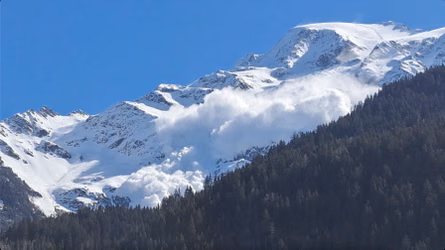
We should not ignore the human dimension to the problem. After long dry periods, frustration can build up. So when the snow finally returns, some skiers want to immediately take advantage, chasing those first tracks or the perfect powder turn to share on social media. We witnessed some striking scenes this year. In Verbier in February, for instance, dozens of people were skiing the same steep slope together, despite clear warnings of high avalanche risk they ultimately triggered an avalanche that buried several people. Fortunately all were successfully rescued.
Again, this behaviour is not entirely new: what may be changing is the scale. There are more people in the mountains, more accessibility, more equipment and more tourism. This increases overall exposure.
And then there is the question of climate. What we observed this season – long, dry, very cold spells followed by intense snowfall – is consistent with what we expect from climate change: more variability, more extremes and longer periods without precipitation, combined with short, intense snow events. We may see more seasons with such persistent weak layers, and therefore more complex and dangerous avalanche situations.
Education remains key to ensuring fewer fatalities in future. There has been a lot of effort in recent years to improve avalanche awareness in Europe, through courses, outreach events, academic teaching and role models promoting conservative decision-making on social media.
But there is still a gap in public understanding. In particular, I believe we need to put more emphasis on consequences: not only on the likelihood of an avalanche being triggered, but on how much snow could be released if it were, how to avoid exposed terrain and how to plan a safe tour. The White Risk app is an excellent example of a tool that provides the kind of detailed information needed.
For those heading out with skis or snowboards, the message is simple: carry avalanche safety gear and practise using it regularly. Terrain choice is always critical, and even more so when a persistent weak layer is present. This means avoiding slopes steeper than about 30 degrees, and avoiding areas where avalanches from above could reach you. It means paying attention to warning signs: recent avalanches, collapsing snowpacks and the classic “whumpf” sound that tells you a weak layer is failing beneath you. If you hear a whumpf when approaching a slope, that is a very clear sign: it’s time to go home.
Effectively managing avalanche risk is not always popular: it means being patient, and sometimes accepting that you should not ski the best lines. In avalanche terrain, the goal is not to win the day. It is to keep playing the game.
-
Johan Gaume is an ex-pro snowboarder and a professor of alpine mass movements at ETH Zürich and SLF Davos